Does DEI Help or Hurt Merit-Based Hiring Outcomes?

Do Diversity, Equity, and Inclusion (DEI) initiatives affect merit-based hiring? In most organizations, DEI is designed to improve how merit is identified by reducing bias in hiring processes and expanding access to qualified candidates.

However, debates continue about whether certain implementations shift attention away from individual qualifications. Understanding how DEI interacts with modern hiring systems is essential as companies move toward skills-based and competency-driven evaluation models.

AI-Powered Recruitment for Faster Hiring

Find qualified candidates faster with intelligent sourcing and automated screening.

Start Hiring Now

Key Summary

  • DEI can support merit-based hiring by reducing bias and widening candidate access.
  • Structured interviews, blind screening, and skills assessments help evaluate real ability.
  • DEI may weaken hiring if representation targets override competency standards.
  • The blog concludes that transparent, skills-based hiring systems help DEI and merit coexist.

What DEI Means in Modern Hiring Systems

In hiring, Diversity, Equity, and Inclusion (DEI) focuses on how organizations design recruitment and evaluation processes to ensure fair access to opportunities. Rather than changing hiring standards, DEI initiatives often aim to reduce bias in sourcing, screening, and interviewing candidates.

Many companies apply practices such as structured interviews, blind resume screening, and broader recruiting channels to ensure that hiring decisions focus on measurable skills, competencies, and job-related performance rather than background signals.

Core Components of DEI

DEI in hiring systems usually focuses on three operational principles:

  • Diversity: Representation of candidates from varied educational, professional, and demographic backgrounds.
  • Equity: Hiring processes designed to ensure candidates are evaluated under comparable conditions.
  • Inclusion: Workplace structures that allow employees to participate in decision-making and team collaboration.

These elements influence recruitment channels, evaluation methods, and how organizations structure candidate assessment.

How the Definition of Merit Is Changing in Hiring

In hiring research, the meaning of merit has gradually shifted from background indicators to measurable capability. By 2026, the concept is often described through two evaluation models.

Traditional Merit (Proxy Model)

This model relies on past signals believed to predict future performance.

Common indicators include:

  • Academic credentials such as degrees from selective universities
  • Employer pedigree, including roles at well-known companies
  • Years of experience within a specific industry
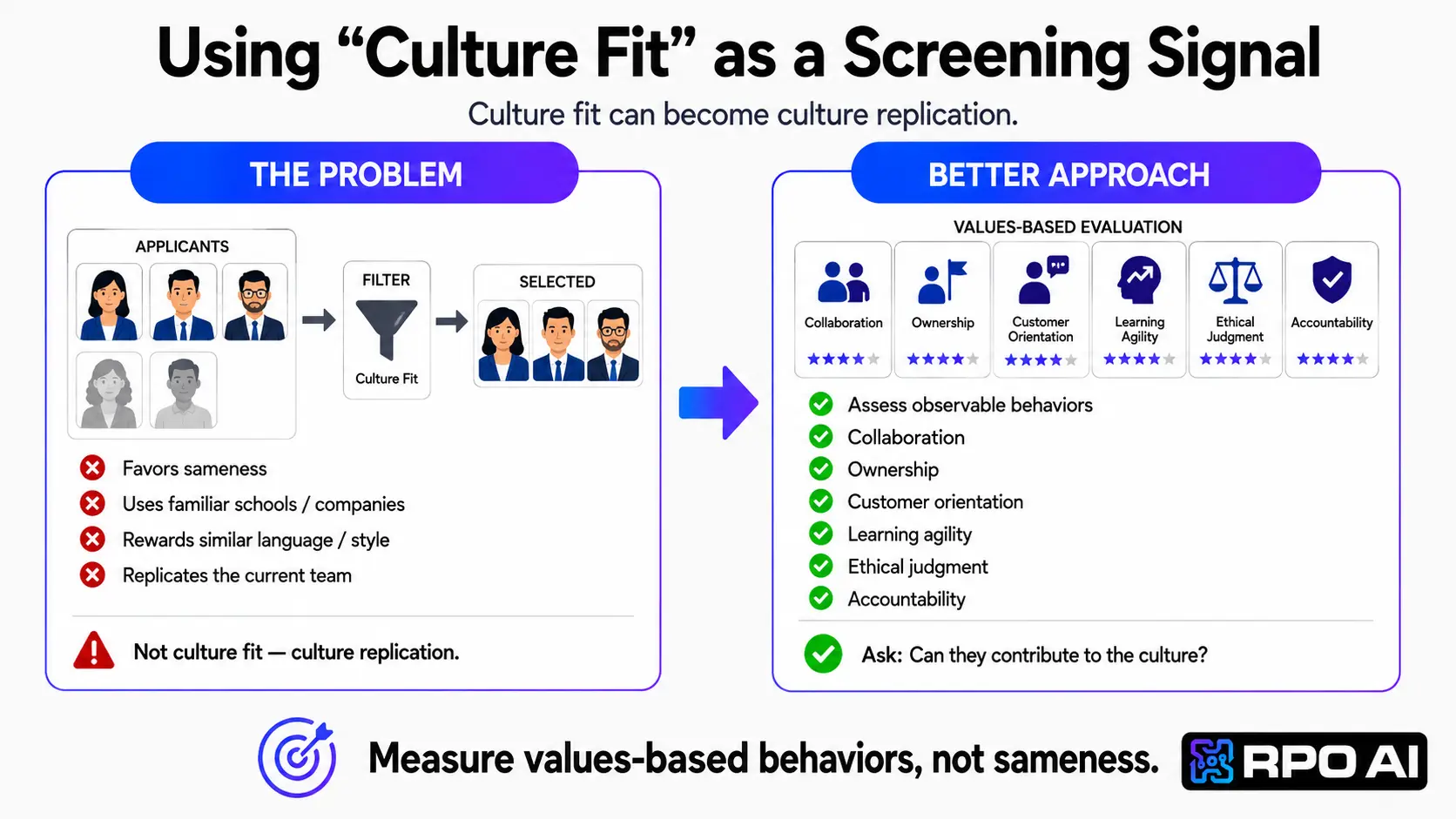
  • Perceived cultural fit, often assessed through interviews

These factors act as proxies rather than direct evidence of job performance.

Modern Merit (Evidence Model)

A newer approach prioritizes measurable ability and outcomes.

Key evaluation factors include:

  • Verified skills and competencies through assessments or simulations
  • Performance outcomes tied to measurable KPIs
  • Problem-solving ability and adaptability
  • Learning trajectory and growth potential

Hiring Infrastructure

Many systems now support merit evaluation through structured processes:

  • Standardized scoring rubrics
  • Blind resume screening
  • Job-related performance assessments

Comparison of Modern Hiring Models

Hiring Model Key Method Companies Using It Strengths Risks
Traditional Merit Credentials, employer pedigree, years of experience Many legacy corporate hiring systems Simple benchmarking across candidates May overlook capable candidates without elite credentials
DEI-Informed Hiring Bias-aware screening, broader sourcing, structured interviews Large enterprises adopting inclusive hiring frameworks Expands candidate pools and reduces evaluation bias Perception concerns whether the hiring criteria are not transparent
Skills-Based Hiring Job simulations, competency tests, portfolio evaluation IBM, Google, and many tech firms Direct measurement of job-relevant ability Requires well-designed and validated assessments

5 Modern Hiring Funnel

How DEI Can Support Merit-Based Hiring Outcomes

Supporters argue that DEI can strengthen merit-based hiring when it improves how candidates are sourced and evaluated. Many organizations use structured hiring methods to reduce bias and focus on measurable ability.

Key ways DEI supports merit-based hiring include:

  • Expanded sourcing pipelines: Companies recruit beyond traditional universities or networks, increasing access to qualified candidates who may otherwise be overlooked.
  • Bias-reduction screening methods: Practices such as blind resume screening remove identifiers like names or demographics so recruiters focus on experience and skills.
  • Structured evaluation metrics: Standardized interview rubrics, work simulations, and skills assessments allow hiring teams to compare candidates using consistent performance criteria.

Research in hiring behavior also shows that structured interviews and standardized scoring systems often produce more reliable hiring decisions than informal interviews.

How DEI May Affect Merit-Based Hiring Outcomes

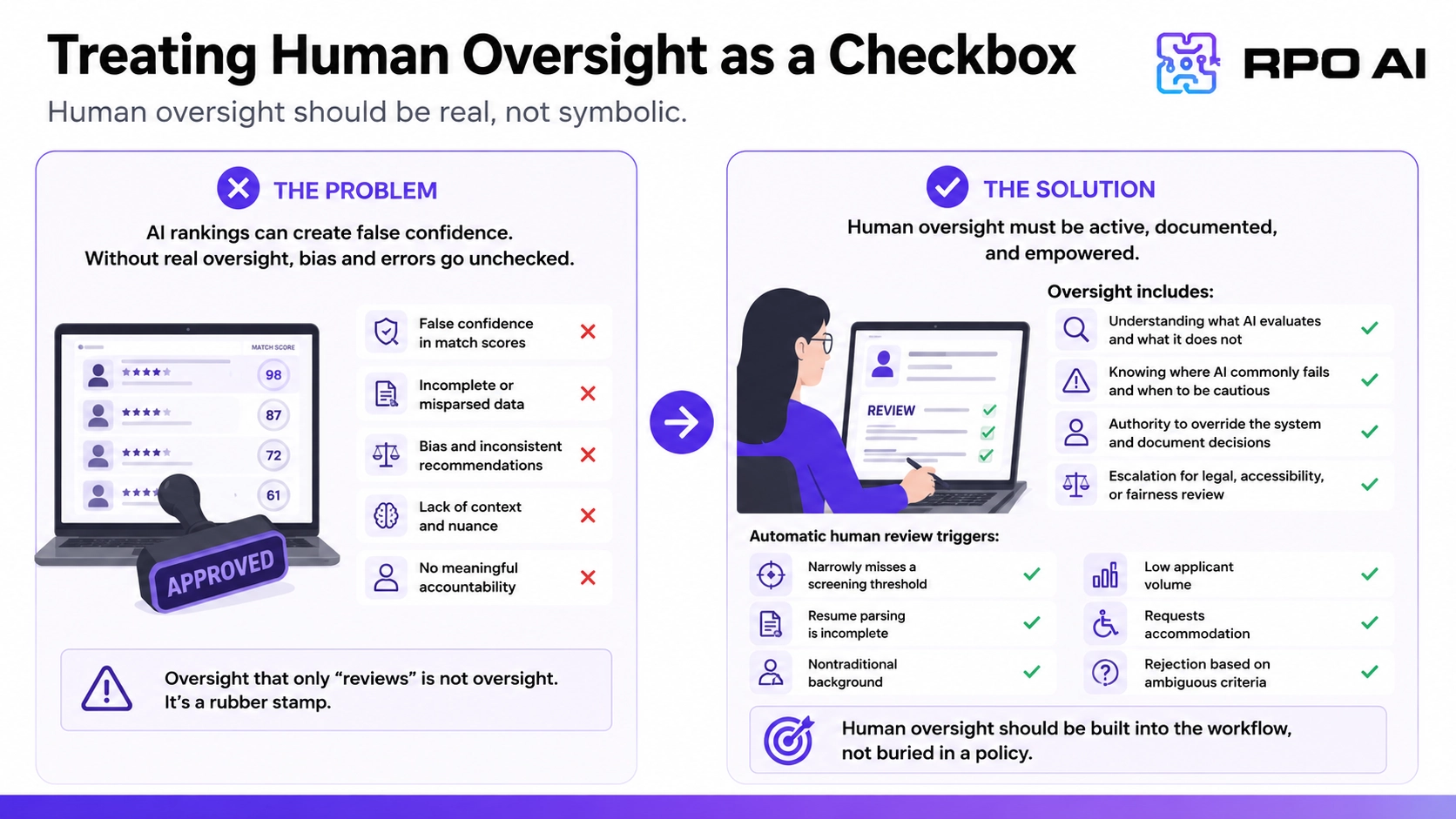
Critics argue that certain DEI implementations can complicate merit-based evaluation when demographic goals begin to influence hiring decisions. The concern is not about diversity itself, but about how hiring frameworks are applied.

Common arguments include:

  • Target-driven hiring pressure: When organizations prioritize diversity metrics, some critics argue that hiring teams may feel pressure to meet representation targets during recruitment.
  • Perception of identity-based decisions: If employees believe hiring decisions are influenced by demographic factors, workplace trust and perceptions of fairness may be affected.
  • Concerns about evaluation standards: Some critics argue that reducing emphasis on traditional credentials or testing could weaken consistent skill assessment.

These critiques often emphasize the importance of maintaining transparent and competency-based hiring processes.

Research Findings on DEI and Hiring Performance

Several research organizations have studied how workforce diversity and inclusive hiring systems influence business outcomes and talent performance.

  • McKinsey & Company – Diversity Wins Report: McKinsey analyzed over 1,000 companies across multiple industries and found that organizations with higher ethnic diversity in leadership teams were 36% more likely to outperform competitors financially. The study linked diversity to broader decision-making perspectives and stronger innovation outcomes.
  • Harvard Business Review research: Studies published in Harvard Business Review show that diverse teams often examine problems from multiple viewpoints, which can improve decision quality in areas such as hiring, product development, and strategy.
  • MIT Sloan School of Management: Research from MIT Sloan indicates that organizations with inclusive workplace cultures tend to report higher employee engagement and retention, which directly affects long-term hiring success and workforce stability.

World Economic Forum workforce studies: Global workforce analyses suggest that companies expanding access to talent pools often increase innovation capacity and productivity by bringing in candidates with varied expertise and experiences.

Common Misconceptions About DEI in Hiring

Public discussions about DEI often include assumptions that do not reflect how most hiring systems actually operate. Clarifying these points helps separate policy debates from hiring mechanics.

  • DEI lowers hiring standards: Most organizations still rely on competency frameworks, skills testing, and structured interviews. DEI initiatives typically expand candidate sourcing rather than change performance criteria.
  • DEI requires hiring quotas: In many companies, DEI programs focus on widening recruiting pipelines and reducing bias in screening processes, not mandating fixed demographic hiring targets.
  • DEI replaces merit-based evaluation: Modern hiring models increasingly use standardized assessments and role-specific scoring systems to evaluate measurable skills.

DEI prioritizes identity over capability: In structured hiring systems, candidate capability, experience, and demonstrated performance remain central to final hiring decisions.

Examples of Merit-Based Hiring Systems Used Today

Many organizations apply structured hiring systems to evaluate candidates using measurable skills and consistent criteria rather than informal judgments.

  • Google structured interviews: Google uses standardized interview rubrics where candidates are evaluated against predefined competencies. Interviewers score responses using consistent criteria to reduce subjective bias.
  • Amazon leadership principle scoring: Amazon evaluates candidates using its leadership principles framework. Interviewers assess responses against behaviors such as ownership, problem-solving, and customer focus.
  • Skills-based hiring models: Many organizations now prioritize job-relevant skills through coding tests, simulations, or work samples instead of relying primarily on degrees or employer pedigree.

Blind resume screening systems: Some hiring platforms remove personal identifiers such as names or demographics during early screening to focus attention on qualifications and experience.

When DEI Strengthens Merit-Based Hiring

In practice, DEI tends to support merit-based hiring when it improves the hiring system rather than replacing it.

Examples include:

  • Structured interviews that score candidates against the same competency rubric
  • Blind resume screening that removes irrelevant identity signals
  • Expanded recruitment pipelines that increase access to qualified candidates

In these cases, DEI operates as a process correction tool, reducing noise in candidate evaluation.

When DEI Weakens Merit-Based Hiring

Hiring outcomes can become distorted when DEI goals shift from process design to representation targets.

Examples include:

  • Hiring quotas that override competency scoring
  • Informal pressure on recruiters to meet demographic metrics
  • Reduced emphasis on validated skill assessments

In these cases, the hiring system may move away from performance-based evaluation.

The Real Determinant: Hiring System Design

The impact of DEI on merit-based hiring depends less on ideology and more on how hiring systems are structured.

Organizations that rely on:

  • standardized assessments,
  • measurable performance indicators, and
  • transparent evaluation criteria.

They are more likely to identify high-performing candidates regardless of the label attached to their hiring philosophy.

The debate, therefore, centers less on whether DEI exists and more on whether hiring systems accurately measure capability.

Wrapping Up

The impact of DEI on merit-based hiring often depends on how structured the hiring process is. Organizations that use standardized interviews, competency frameworks, and skills-based assessments can evaluate candidates more accurately. AI-powered recruitment platforms make this process faster by automating sourcing and screening. 

Solutions like AI-driven hiring systems enable companies to identify qualified candidates efficiently while keeping the focus on measurable skills and real performance.

To explore how we support growing teams

Talk to Us

FAQs on Merit Based Hiring

  1. Does DEI reduce hiring standards?

Most organizations continue to use structured hiring criteria such as competency frameworks, role-specific assessments, and interview scoring systems. DEI initiatives generally focus on widening candidate sourcing and reducing bias in screening rather than changing performance standards.

  1. Can merit-based hiring and DEI coexist?

Yes. Many organizations combine broad talent sourcing with structured evaluation systems. This approach allows companies to expand access to candidates while still selecting hires based on demonstrated skills, experience, and performance indicators.

  1. What is skills-based hiring?

Skills-based hiring evaluates candidates using measurable abilities such as technical tests, work simulations, or portfolio reviews. Instead of relying mainly on academic credentials or employer history, hiring decisions are based on job-relevant competencies.

  1. Why are companies shifting to competency-based hiring?

Organizations increasingly prioritize competency-based hiring because it focuses on verified skills and measurable outcomes. This approach can improve hiring accuracy by aligning candidate capabilities with the actual requirements of a role.

  1. Where to place this section:

Add the FAQ section just before the conclusion of the article. This placement strengthens SEO by capturing People Also Ask queries while maintaining a logical flow from discussion → evidence → hiring systems → final summary.

How Does Recruitment Process Outsourcing Work? A Complete Guide

Looking to optimize your hiring process and make it move faster?

We’ve all been there: The extended hours, the never-ending swamp of LinkedIn DMs, and conducting dozens of interviews only for the perfect candidate to vanish at the last moment.

And the cycle starts: follow-ups, more reschedules, and that quiet little thud feeling when a strong candidate drops out again.

That’s why moving toward a recruitment process outsourcing model isn’t just a “fix”; it’s a strategic pivot. 

To give you a clear view of how recruitment process outsourcing works, let’s break down the mechanics of the recruitment process outsourcing services model.

Before we get into the details, it helps to see the difference at a glance.

A quick glimpse at how recruitment process outsourcing works compared to traditional hiring:

Hiring Aspect Traditional Hiring Recruitment Process Outsourcing (RPO)
Hiring Structure Internal HR teams handle recruiting, often supported by external agencies for urgent roles. A dedicated recruiting team operates as an embedded extension of your company’s hiring function.
Talent Sourcing Approach Mostly reactive: job postings, inbound applications, and agency submissions. Proactive sourcing using talent pipelines, targeted outreach, and continuous candidate discovery.
Process Ownership Hiring responsibility is spread across HR teams, hiring managers, and agencies. A centralized system where the RPO team manages and optimizes the entire recruiting workflow.
Scalability Hiring capacity depends on internal team bandwidth and agency availability. Recruiting capacity can scale up or down based on hiring needs.
Cost Structure Agency placements often involve high one-time fees per hire and unpredictable costs. More predictable hiring investment aligned with recruiting scope and hiring volume.
Candidate Pipeline Often built role-by-role, leading to inconsistent candidate flow. Continuous talent pipelines are built in advance for key roles and skill sets.
Hiring Visibility Limited insight into funnel performance and sourcing effectiveness. Data-driven recruiting with visibility into pipeline health, conversion rates, and hiring metrics.
Employer Brand Experience Candidate communication may vary across recruiters or agencies. Consistent candidate experience aligned with your employer brand.

The Idea Behind the RPO Model

The idea behind the RPO model is simple: turn hiring from a reactive activity into a structured system.

Instead of rebuilding the recruiting process every time a role opens, an RPO setup creates a consistent workflow that keeps talent pipelines moving and hiring decisions faster.

This is why many organizations today consider outsourcing talent acquisition as a scalable hiring strategy.

At its core, the model is designed to solve three common hiring challenges.

The Three Problems RPO Typically Solves

  • Slow Hiring Cycles

When hiring starts from scratch each time, roles take longer to fill. RPO outsourcing focuses on building continuous talent pipelines so hiring moves faster.

  • Unpredictable Recruiting Costs

Agency-based hiring often comes with high placement fees. Recruitment outsourcing solutions shift hiring toward a more structured and predictable cost model.

  • Inconsistent Candidate Quality

When recruiting is fragmented across teams and vendors, candidate quality varies. Outsourced recruitment introduces standardized sourcing, screening, and evaluation processes.

Is your hiring process a bridge or a bottleneck?

If you’re feeling the “Scalability Rollercoaster” right now, let’s talk about building a more stable engine. 

[Get Started with Hiring]

How Recruitment Process Outsourcing Works (Step by Step)

Now let’s get practical.

Once a company works with an RPO partner, the focus shifts from filling roles to building a repeatable hiring process.

While setups vary by company, most RPO engagements follow a similar sequence of steps.

Recruitment Process Outsourcing Works (Step-by-Step)

Step 1: Hiring Process Assessment

The first step is understanding how hiring currently works inside the company.

Reviewing Hiring Goals

The RPO team works with leadership and hiring managers to understand upcoming hiring plans, role priorities, and growth targets.

Auditing the Existing Hiring Process

This includes reviewing job descriptions, sourcing channels, interview stages, and candidate pipelines to identify bottlenecks.

Identifying Hiring Gaps

At this stage, common issues such as slow screening, limited sourcing channels, or unclear interview workflows are mapped out.

The objective here is simple: understand what needs fixing before scaling the hiring process.

Step 2: Integrating the RPO Team With Your Hiring Setup

Once the assessment is complete, the RPO team integrates with the company’s existing hiring environment.

Working Within Your Tools

RPO teams typically plug into the company’s Applicant Tracking System (ATS), communication tools, and hiring workflows.

Aligning With Hiring Managers

Hiring managers and internal HR teams work closely with the RPO team to define role expectations, candidate profiles, and interview criteria.

Operating Under Your Employer Brand

Candidates interact with the RPO team as representatives of your company, ensuring a consistent employer brand experience through professional outsourcing recruitment services.

At this stage, the RPO team becomes an embedded extension of your recruiting function.

Step 3: Building the Talent Sourcing Pipeline

Instead of waiting for applications, the RPO team focuses on building a consistent pipeline of candidates.

Proactive Talent Sourcing

Recruiters actively search for candidates through professional networks, talent databases, and industry communities.

Targeted Outreach

Qualified candidates are approached directly through platforms such as LinkedIn, professional groups, and referrals.

Talent Pool Development

Over time, the RPO team builds a structured talent pool so future roles can be filled faster.

This approach ensures companies always have candidates moving through the pipeline, rather than starting from zero every time.

Step 4: Candidate Screening and Qualification

Once candidates enter the pipeline, the RPO team begins the evaluation process.

Resume and Profile Review

Candidates are screened based on role requirements, skills, and experience.

Initial Recruiter Conversations

Preliminary interviews help assess communication, interest in the role, and overall alignment.

Skills and Cultural Fit Checks

Candidates who move forward are evaluated for technical capabilities and alignment with the company’s work culture.

Only the most relevant candidates are forwarded to hiring managers, saving valuable time during the interview stage.

Step 5: Managing Interviews and Candidate Communication

Recruitment operations involve more than just finding candidates.

Interview Scheduling

The RPO team coordinates interview times between candidates and internal stakeholders.

Communication and Follow-Ups

Candidates receive timely updates, feedback, and next-step information.

Candidate Experience Management

Clear communication and structured interactions help maintain a positive employer brand throughout the hiring journey.

Step 6: Hiring Metrics and Process Optimization

One of the biggest advantages of recruitment process outsourcing is the use of hiring data to improve results.

Tracking Key Hiring Metrics

Important metrics such as time-to-fill, source effectiveness, and candidate conversion rates are monitored.

Identifying Hiring Bottlenecks

If interviews are delayed or candidate drop-offs occur, the RPO team identifies and addresses the problem quickly.

Continuous Process Improvements

Based on these insights, the hiring workflow is refined to make the process faster and more efficient over time.

Business Benefits of Recruitment Process Outsourcing

By this point, you’ve seen how the RPO model works structurally. But many leaders still ask a practical question: what changes for the business once this system is in place?

To answer that question, here are some of the most noticeable benefits of the recruitment process that outsourcing companies experience.

  • Scalability Without the Overhead

Hiring needs fluctuate. This RPO outsourcing allows you to scale your recruiting horsepower up during a growth spurt and dial it back down during a “steady state,” all without hiring or laying off internal HR staff.

  • Reduced Cost-per-Hire

By moving away from high-percentage agency placement fees (often 20-30% of salary) to a structured recruitment process outsourcing solution, companies typically see a significant reduction in total recruiting spend while gaining more predictable monthly costs.

  • Enhanced Candidate Experience (Which Protects Your Brand)

Candidates don’t just evaluate the job; they evaluate the process. Outsourced recruitment services improve communication, scheduling, and follow-through so candidates stay engaged.

  • Data-Driven Hiring

RPO makes hiring easier to measure, providing real-time dashboards on “Time-to-Fill” and “Quality-of-Hire,” turning recruiting from a “gut feeling” into a predictable science.

The RPO.ai Advantage

Since you’re exploring recruitment process outsourcing providers, here’s how RPO.ai is different from a typical RPO provider. Most RPO teams focus mainly on adding recruiters to fill roles. 

We go a step further; we help you build a repeatable hiring system that stays consistent across roles, teams, and hiring waves. 

From day one, we align on your hiring goals and success criteria, then plug into your workflow to run structured sourcing, screening, interview coordination, and feedback loops, so you get control, speed, and consistency (not chaos).

Take a closer look at how our service is set up.

The difference becomes clearer in the results. For example, when Coursera needed to scale hiring across multiple departments and regions, our embedded recruiting team supported sourcing, engagement, and hiring across tech, product, people operations, sales, marketing, and finance roles

Within the first year, we helped fill over 100 roles across North America and India, enabling the company to scale its teams quickly while maintaining hiring quality.

Wrapping Up

By now, you’ve seen how the RPO model works and why many growing companies rely on outsourced recruitment to scale hiring.

If you’re wondering how this approach could fit your hiring goals, a short conversation is the best place to start.

To explore how we support growing teams

Talk to Us

FAQs

1) How is RPO different from in-house recruiting?

RPO uses an external recruiting team embedded into your hiring process to run sourcing, screening, and coordination. In-house recruiting relies on your internal HR/recruiters to manage the full workload.

2) How long does it take to implement an RPO model?

Most RPO setups go live in 2–6 weeks, depending on hiring volume, roles, and tool/ATS integration.

3) Can RPO handle high-volume hiring?

Yes. RPO is built for scale by using continuous talent pipelines, structured screening, and centralized interview coordination.

4) Who should use recruitment process outsourcing?

RPO is best for companies that need repeatable, scalable hiring, fast-growing teams, multi-role hiring, or hiring across multiple locations.

Contingent Staffing – Why It Makes Sense for Growing Companies

Growth rarely follows a straight line. For most companies, it comes in bursts: new clients, sudden project demands, market expansions, or product launches. The challenge isn’t just growth itself; it’s building a workforce that can keep up without creating long-term financial strain. 

That’s where contingent staffing comes in.

Instead of relying solely on traditional hiring, companies are increasingly turning to flexible talent models to stay agile. Whether it’s scaling teams quickly or accessing niche expertise, businesses are rethinking how work gets done and who does it.

But before diving in, it’s important to clearly understand what is contingent workforce and how it fits into a broader hiring strategy.

What Is Contingent Staffing? A Clear, Practical Definition

Contingent staffing means hiring workers on a non-permanent basis to meet specific business needs. In simple terms, it gives companies access to the right skills without long-term employment commitments.

You may also hear this called contingent labor, which refers to temporary, contract, freelance, or project-based workers. Together, these professionals form the contingent workforce, a flexible talent model used by companies to manage workload, fill skill gaps, and scale teams faster.

This is where RPO AI can support businesses by helping them source, screen, and manage contingent talent through a combination of recruitment expertise and AI-powered hiring workflows.

Common Types of Contingent Workers

A contingent worker is anyone who works with a company without being a full-time employee. The right type depends on the project scope, timeline, and expertise needed.

Freelancers/Gig Workers:  Independent professionals hired for short-term, task-based work.
Independent Contractors:  Self-employed specialists engaged for structured projects without full-time commitment.
Temporary Workers:  Workers hired for a fixed period, often through staffing or recruitment partners, to manage seasonal demand or workload spikes.
Consultants:  Experts brought in to solve strategic, technical, or operational business challenges.

For companies that need flexible hiring support, RPO AI helps simplify this process by combining AI-enabled recruiting, staffing support, and talent acquisition expertise to connect businesses with the right contingent workforce faster.

How Contingent Staffing Works in Practice

For growing companies, speed and precision matter. A well-structured approach to contingent workforce staffing typically follows a streamlined process:

Identify the need:  Determine whether the requirement is short-term, project-based, or highly specialized.
Define scope and deliverables:  Outline expectations, timelines, and success metrics clearly.
Source the right talent:  This may involve staffing agencies, freelance platforms, or direct networks.
Onboard quickly:  Minimal onboarding ensures faster time-to-productivity.
Execute and manage output:  Focus on deliverables rather than hours worked.
Evaluate and scale:  Extend contracts, rotate talent, or transition to full-time if needed.

This structured approach is the foundation of effective contingent workforce management, ensuring that flexibility doesn’t come at the cost of control.

Why Growing Companies Are Investing in Contingent Staffing

The shift toward flexible talent isn’t a trend; it’s a strategic response to changing business realities. A well-executed contingent workforce strategy offers measurable advantages across cost, speed, and capability.

1. Workforce Flexibility Without Long-Term Risk
Traditional hiring locks companies into fixed costs. In contrast, contingent staffing allows businesses to:

Scale teams up during peak demand
Reduce workforce size during slow periods
Adapt quickly to market changes

This level of agility is especially valuable for companies navigating uncertain growth trajectories.

2. Cost Efficiency That Aligns with Output
Full-time employees come with salaries, benefits, training costs, and overhead. Contingent workers, on the other hand, are typically engaged for specific deliverables. This means:

Lower fixed costs
Better budget predictability
Higher ROI on talent investments

For companies managing tight margins or fluctuating revenue, this model provides financial control without sacrificing productivity.

3. On-Demand Access to Specialized Skills
Some roles don’t require full-time hires; they require expertise at the right moment. A strong contingent workforce program enables businesses to:

Bring in niche experts for short-term needs
Fill critical skill gaps quickly
Avoid long hiring cycles for specialized roles

This is particularly valuable in industries where technology, compliance, or innovation evolves rapidly.

4. Faster Hiring Cycles and Execution Speed
Time-to-hire is a major bottleneck in traditional recruitment. This significantly reduces this timeline. Instead of months-long hiring processes, companies can:

Identify and onboard talent within days or weeks
Accelerate project timelines
Maintain momentum during critical growth phases

5. Reduced Hiring Risk
Hiring mistakes are costly, not just financially but operationally. It minimizes risk by:

Allowing short-term engagements before long-term commitments
Providing flexibility to pivot if business needs change
Enabling “try-before-you-hire” scenarios

When Contingent Staffing Makes Strategic Sense

Not every situation calls for full-time hiring. In many cases, contingent staffing is the smarter, more efficient choice.

Best Use Cases for Contingent Staffing

Rapid growth phases: When demand outpaces hiring capacity
Project-based work: Product launches, system implementations, or marketing campaigns
Seasonal demand spikes: Retail, logistics, or customer support surges
Testing new roles or markets: Validate ROI before committing to full-time hires
Budget constraints: Maintain productivity without increasing fixed costs

In these scenarios, understanding what is contingent labor becomes essential for making informed workforce decisions.

When Contingent Staffing May Not Be the Right Fit

Despite its advantages, contingent staffing isn’t a one-size-fits-all solution.

It may not be ideal for:

Core business functions requiring long-term ownership
Roles that depend heavily on company culture and collaboration
Positions involving sensitive data or strict compliance requirements

In these cases, full-time employees often provide greater stability and alignment.

Contingent Staffing vs Traditional Hiring

Here’s a clear comparison to help decision-makers evaluate both models:

Factors Contingent Staffing Full-Time Hiring
Flexibility High Low
Cost Structure Variable Fixed
Hiring Speed Fast Slower
Commitment Short-term Long-term
Benefits & Overhead Not included Included

Challenges to Consider Before Scaling a Contingent Workforce

While the benefits are compelling, companies must approach with a structured mindset.

Common Challenges:

Limited control over external workers
Communication gaps across distributed teams
Compliance risks related to worker classification
Knowledge loss when contracts end

Without a clear system in place, these challenges can reduce the effectiveness of your contingent workforce management efforts.

Best Practices for Managing Contingent Workers Effectively

To maximize ROI, companies need more than access to talent; they need a framework.

Define Roles and Deliverables Clearly: Ambiguity leads to misalignment. Set expectations upfront.
Use Standardized Contracts: Ensure legal clarity and protect both parties.
Build a Structured Communication Process: Regular check-ins and clear reporting improve outcomes.
Integrate Without Over-Assimilating: Include contingent workers in workflows, but maintain boundaries.
Track Performance with Data: Measure output, efficiency, and impact using defined KPIs.

For organizations scaling this model, understanding what contingent workforce management is is critical to maintaining consistency and performance across multiple engagements.

The Future of Contingent Staffing: A Blended Workforce Model

The workforce is evolving, and flexibility is becoming a competitive advantage. Key trends shaping the future include:

Increased reliance on global and remote talent pools
Growth of freelance and gig economy platforms
Integration of AI in talent sourcing and matching
Adoption of hybrid workforce models (full-time + contingent)

Forward-thinking companies are no longer asking if they should adopt contingent staffing; they’re refining how to do it better.

Building a Smarter, More Flexible Workforce

Contingent staffing isn’t just a tactical solution; it’s a strategic advantage when used correctly.
For growing companies, it offers:

Flexibility without long-term risk
Access to specialized skills on demand
Faster execution in competitive markets

However, success depends on intentional planning. A well-defined contingent workforce strategy ensures that flexibility translates into measurable business outcomes, not operational complexity.

As workforce models continue to evolve, companies that embrace a balanced approach, blending full-time stability with contingent agility, will be better positioned to scale, adapt, and lead.

FAQ: Contingent Staffing Explained

1. What is contingent workforce in simple terms?

A contingent workforce is a group of non-permanent workers hired for specific tasks or time periods instead of full-time roles.

2. What is contingent workforce management?

It refers to the systems and processes used to source, manage, and optimize non-permanent workers effectively.

3. Is contingent staffing cost-effective for growing companies?

Yes. It reduces fixed costs and allows businesses to pay only for the work they need, improving financial efficiency.

4. What industries benefit most from contingent staffing solutions?

Technology, healthcare, marketing, construction, and consulting industries often rely on contingent staffing solutions to stay agile.

On-Demand Recruiting: How Startups Benefit from Flexible Staffing

Startups grow fast. Hiring needs change quickly. One month, you may need five engineers. The next month, you may pause hiring completely. Traditional recruiting models are not built for this kind of flexibility.

On-demand recruiting gives startups access to professional recruiting support only when they need it. There is no long-term commitment, no full-time recruiter overhead, and no wasted hiring budget. It is a flexible staffing approach designed for companies that need speed, control, and scalability.

This article explains what on-demand recruiting is, how it works, and why startups benefit from flexible staffing.

Benefits of flexible staffing

What Is On-Demand Recruiting?

On-demand recruiting is a flexible hiring model in which companies use recruiting expertise as needed rather than maintaining a full in-house recruiting team.

It allows startups to:

* Quickly scale hiring efforts

* Pause recruiting when demand slows.

* Pay only for the recruiting support they use

* Access experienced recruiters without full-time costs.

This model works especially well for startups that face unpredictable hiring cycles.

How On-Demand Recruiting Works

On-demand recruiting follows a structured but flexible process. It is designed to activate quickly, scale efficiently, and deliver measurable hiring results without long-term contracts.

Here is how it typically works:

1. Define Hiring Requirements

The process starts with a clear understanding of business goals and hiring priorities. This includes the number of roles, required skills, timelines, seniority level, and budget expectations. A detailed intake ensures recruiters align with the startup’s growth stage and urgency.

Clarity at this stage reduces misalignment later and improves candidate quality.

2. Deploy Dedicated Recruiting Support

Based on hiring needs, experienced recruiters are assigned to the project. Support can range from sourcing-only assistance to full-cycle recruitment, including interviews and offer management.

The key difference is flexibility. Startups can increase recruiter capacity during high-growth periods and reduce support when hiring slows.

3. Build and Activate Talent Pipelines

Recruiters begin sourcing candidates using targeted outreach, job boards, professional networks, referrals, and AI-driven tools. Advanced search strategies help identify both active and passive talent.

AI-powered matching tools may assist in ranking candidates based on skills, experience, and role fit. This speeds up the screening process and improves precision.

4. Screen and Shortlist Candidates

Qualified candidates go through structured screening. This may include resume evaluation, skill validation, culture alignment checks, and initial interviews.

Only pre-qualified candidates move forward to hiring managers. This reduces internal review time and improves interview efficiency.

5. Manage Interviews and Offers

The recruiting team coordinates interview scheduling, gathers feedback, and maintains communication with candidates. Offer negotiation and closing support may also be included.

This centralized coordination reduces delays and keeps candidates engaged throughout the process.

6. Track Performance and Optimize

Key hiring metrics such as time-to-fill, candidate quality, cost per hire, and offer acceptance rate are monitored continuously.

Performance data allows startups to adjust hiring strategy quickly and improve future recruiting cycles.

Why Startups Benefit from Flexible Staffing

Startups operate in an environment where priorities shift quickly. Product roadmaps change. Funding timelines move. Market conditions evolve. A rigid hiring structure does not support that level of uncertainty. Flexible staffing allows startups to align recruiting capacity with real business demand.

Here is why that flexibility creates a competitive advantage.

Faster Response to Growth Opportunities

When a startup closes a funding round or launches a new product, hiring demand can increase overnight. Flexible staffing makes it possible to activate recruiting support immediately instead of waiting to hire and onboard internal recruiters.
Speed in hiring directly impacts product delivery, customer acquisition, and revenue growth.

Lower Fixed Costs

Full-time recruiters add salary, benefits, and long-term financial commitment. For early-stage companies, fixed costs reduce runway. Flexible staffing converts those expenses into variable costs.
Startups pay for recruiting support only when hiring is active. When hiring slows, costs decrease accordingly.

Scalable Hiring Without Internal Expansion

Growth is rarely linear. Some months require aggressive hiring, while others require none. Flexible staffing allows startups to scale recruiting resources up or down without restructuring internal teams.

This prevents overstaffing during slow periods and under-resourcing during high-demand phases.

Access to Specialized Expertise

Startups often need niche technical roles, leadership hires, or market-specific talent. Flexible staffing models provide access to experienced recruiters with industry knowledge and established networks.

This improves candidate quality and reduces the risk of poor hiring decisions.

Reduced Operational Burden

Founders and small leadership teams already manage product development, operations, fundraising, and customer growth. Managing recruiting internally adds a significant workload.
Flexible staffing offloads sourcing, screening, scheduling, and candidate communication. Leadership can focus on scaling the business rather than managing hiring logistics.

Improved Hiring Efficiency

Structured recruiting processes, supported by data and modern technology, reduce time-to-fill and improve hiring outcomes. Many flexible staffing providers integrate AI tools that streamline sourcing and candidate matching.

Better efficiency means faster team building and stronger competitive positioning.

When Should Startups Use On-Demand Recruiting?

This model is most effective when:

* Scaling rapidly after investment

* Expanding into new markets

* Hiring for specialized technical roles

* Managing seasonal hiring fluctuations

* Testing new hiring strategies

It provides structured recruiting power without long-term risk.

On-Demand Recruiting vs Traditional Hiring

Traditional vs Ondemand hiring

For startups, flexibility and speed are critical. On-demand recruiting addresses both.

How AI Improves On-Demand Recruiting

AI strengthens on-demand recruiting by increasing speed, accuracy, and scalability. It automates repetitive tasks while giving recruiters better data to make informed decisions.

Here are the key ways AI improves the process:

* Faster Candidate Sourcing- AI scans large databases and professional networks in seconds, identifying relevant candidates based on skills, experience, and role requirements.

* Smarter Candidate Matching- Advanced algorithms analyze more than keywords. They evaluate patterns in career progression and skill alignment to rank candidates by fit probability.

* Automated Resume Screening- AI filters applications quickly, removing unqualified profiles and reducing manual review time for recruiters.

* Data-Driven Shortlisting- Structured scoring systems ensure consistent evaluation criteria, improving screening accuracy and reducing subjectivity.

* Real-Time Hiring Analytics- AI dashboards provide visibility into pipeline health, response rates, and time-to-fill, allowing startups to adjust strategies quickly.

* Improved Candidate Engagement- Automated follow-ups, reminders, and status updates keep candidates informed, improving the overall hiring experience.

* Scalable Recruiting Operations- AI enables recruiting teams to handle larger hiring volumes without increasing headcount, making flexible staffing more efficient.

AI enhances recruiter productivity rather than replacing human judgment. In an on-demand recruiting model, this combination of automation and expertise delivers faster, more predictable hiring outcomes for startups.

Key Metrics to Measure Success

Startups should track:

* Time-to-fill

* Cost per hire

* Offer acceptance rate

* Quality of hire

*Hiring manager satisfaction

These indicators show whether the recruiting model supports growth objectives.

Final Thoughts

Startups need hiring models that match their pace of growth. On-demand recruiting provides that flexibility by allowing companies to scale recruiting efforts up or down based on real demand. It reduces fixed costs, shortens time-to-hire, and delivers access to experienced recruiters without long-term commitments.

When supported by AI-driven sourcing and analytics, the model becomes faster and more precise. Startups gain better visibility into hiring performance while maintaining operational focus.

For growing companies that value speed, efficiency, and control, on-demand recruiting offers a practical and scalable approach to building strong teams.

Frequently Asked Questions

1. What is on-demand recruiting?

On-demand recruiting is a flexible hiring model where startups access recruiting expertise as needed, without hiring full-time recruiters. It allows companies to scale hiring efforts in response to current business demand.

2. How is on-demand recruiting different from traditional RPO?

Traditional RPO often involves long-term contracts and broader outsourcing commitments. On-demand recruiting is more flexible, short-term, and scalable, making it better suited for startups with fluctuating hiring needs.

3. Is on-demand recruiting cost-effective for startups?

Yes. It converts fixed recruiting salaries into variable costs. Startups pay only for the recruiting support they use, helping preserve capital and extend financial runway.

4. How does AI support on-demand recruiting?

AI improves candidate sourcing, resume screening, and talent matching. It accelerates hiring timelines while providing data-driven insights that enhance decision-making and pipeline visibility.

5. When should a startup consider on-demand recruiting?

Startups should consider it during rapid growth, funding rounds, market expansion, or hiring spikes when internal recruiting capacity is limited or inconsistent.

How to Build Remote Tech Teams with International Recruiting Expertise

Hiring challenges are rarely caused by a lack of talent. They are caused by limited access to it. As industries become more specialized and digital work removes geographic barriers, restricting hiring to one country creates artificial scarcity. Organizations compete for the same local candidates, driving up costs while leaving critical roles unfilled.

International recruiting changes that equation, especially when supported by AI sourcing tools that identify and evaluate talent across borders with greater precision. By expanding talent access globally, companies move from reactive hiring to strategic workforce expansion.

Exploring international recruiting is not about adding complexity. It is about widening the lens on where high-quality talent actually exists and using smarter systems to find it.

TL;DR

– Hiring limits are often geographic, not talent-based.
– International recruiting expands access to global skill clusters and reduces reliance on saturated local markets.
– Broader candidate pools increase selectivity, strengthen hiring standards, and improve workforce resilience.
– Global hiring supports cost flexibility, operational coverage, and long-term scalability.
– Organizations that treat international recruiting as a strategic capability build stronger, more adaptable talent systems over time.

Understanding International Recruiting in Modern Workforce Strategy

International recruiting is not simply hiring someone who lives in another country. It is the structured process of identifying, evaluating, and engaging talent across global labor markets in alignment with long-term business goals.

At the top of the funnel, many organizations view global hiring as a response to local shortages. In reality, international recruiting functions as a strategic access model. It allows companies to reach skill clusters that may not exist domestically, diversify workforce capability, and build resilience against regional labor volatility.

To understand its value, it is important to distinguish international recruiting from ad hoc overseas hiring.

What International Recruiting Actually Involves

International recruiting includes:

– Mapping global talent markets based on skill concentration

– Understanding global employment regulations and compliance frameworks

– Designing remote or distributed collaboration models

– Establishing standardized evaluation criteria across geographies

– Managing compensation benchmarking across different economies

This is not a one-time expansion effort. It is a repeatable system for accessing global capability.

When structured properly, international recruiting does not dilute hiring standards. It expands the range of qualified candidates who meet them.

Why Geography Is No Longer a Reliable Talent Filter

Historically, location served as a practical hiring constraint. Proximity enabled collaboration, legal compliance, and payroll simplicity. Today, digital infrastructure, remote-first workflows, and global employment platforms reduce those constraints significantly.

Limiting hiring to a single country often reflects legacy process design rather than operational necessity.

For TOFU-stage organizations exploring international outsourced recruiting, the shift begins with a mindset change. The question is no longer, “Who can we hire locally?” It becomes, “Where does the required expertise exist globally?”

This reframing moves international recruiting from optional expansion to strategic workforce design.

Why Local-Only Hiring Limits Talent Quality

Before evaluating the benefits of international recruiting, it is important to understand the structural limits of geography-bound hiring.

When organizations confine recruitment to a single country or region, they narrow the available talent pool by default. In competitive industries, this creates overlapping demand for the same candidates, which inflates compensation expectations and increases time-to-hire. The issue is not effort. It is a constraint.

Competition Concentrates Around the Same Profiles

In specialized roles such as engineering, data science, cybersecurity, or multilingual customer operations, skill clusters often exist in specific global regions. Restricting hiring to one domestic market forces companies to compete for a limited subset of professionals who meet similar criteria.

This leads to:

– Longer hiring cycles

– Increased reliance on contract or short-term solutions

– Higher turnover due to aggressive poaching

International recruiting distributes that pressure. It allows organizations to source from multiple talent ecosystems rather than one saturated market.

Skill Availability Is Uneven Across Regions

Certain countries invest heavily in specific industries or technical education pipelines. Others develop strong expertise in emerging technologies, finance operations, design, or multilingual support.

Local-only hiring assumes that all skill sets are evenly distributed across borders. In practice, they are not. International recruiting acknowledges this imbalance and enables companies to align hiring strategy with global skill concentration rather than local convenience.

Innovation Benefits From Geographic Diversity

Talent quality is not defined only by technical competence. It is also shaped by perspective. Teams built from a single labor market often share similar educational paths and problem-solving approaches. International recruiting introduces cross-cultural insight, alternative frameworks, and varied market exposure.

For organizations at the awareness stage, this is a key realization. Expanding hiring geography is not just about filling roles. It is about expanding capability, resilience, and innovation capacity across the workforce system.

Key Considerations Before Starting International Recruiting

International recruiting expands access to global talent, but access alone does not guarantee results. Organizations that succeed treat cross-border hiring as a structured capability rather than a reactive solution.

At an early exploration stage, the goal is not to scale globally overnight. It is to understand the foundational elements that make international recruiting effective and sustainable.

1. Compliance and Employment Structures

Each country operates under different labor laws, tax regulations, and employment classifications. Hiring internationally requires clarity around whether talent will be engaged as direct employees, contractors, or through an employer-of-record model.

Understanding these frameworks early prevents operational friction later. International recruiting works best when legal and payroll structures are defined before sourcing begins.

2. Compensation Benchmarking Across Markets

Global salary expectations vary significantly based on region, cost of living, and industry demand. International recruiting requires localized benchmarking rather than direct currency conversion.

Competitive compensation in one country may look different from another, even for the same role. Structured benchmarking ensures fairness while maintaining cost efficiency.

3. Standardized Evaluation Criteria

When hiring across borders, consistency becomes critical. Interview processes, assessment criteria, and performance expectations should remain aligned regardless of geography. Standardization ensures that talent quality is measured against role requirements, not regional familiarity.

4. Communication and Collaboration Infrastructure

Successful international recruiting depends on clear communication systems. Remote collaboration tools, documentation standards, and time zone coordination processes must be in place before teams expand. Global hiring is not just about where talent is located. It is about how teams operate once talent is onboarded.

5. Long-Term Workforce Planning

International recruiting delivers the strongest results when tied to long-term capability planning. Instead of filling one urgent role, organizations identify which functions benefit most from global expansion and design hiring roadmaps accordingly.

When approached methodically, international recruiting becomes a repeatable workforce strategy rather than a one-time hiring experiment.

When International Recruiting Makes Strategic Sense

International recruiting should not begin with expansion. It should begin with a diagnosis. Not every organization needs a global hiring model. The decision should be driven by measurable constraints.

Here are the indicators that global talent access is a strategic move rather than an experiment.

Persistent Skill Shortages

If critical roles remain open despite active sourcing, competitive compensation, and agency support, the issue is likely geographic limitation.

When required skills are scarce in one labor market but abundant in another, restricting hiring domestically creates unnecessary delay. International recruiting becomes a direct solution to capability gaps.

Escalating Talent Costs Without Performance Gain

In saturated markets, compensation increases do not always translate into stronger performance. Companies often pay premiums simply to compete, not to secure better outcomes.

Expanding internationally introduces cost elasticity. Organizations gain access to high-caliber professionals in regions where compensation structures are more aligned with budget models.

Expansion Into Global Markets

Companies serving international customers benefit from teams that understand regional behaviors, regulations, and language nuances. International recruiting supports operational alignment with market expansion. Talent selection becomes tied to business geography, not just headquarters location.

Need for Around-the-Clock Operations

Organizations operating in SaaS, customer support, cybersecurity, or infrastructure management often require extended coverage. Rather than overloading one time zone, international recruiting enables distributed operational continuity without increasing burnout risk.

International recruiting is not a trend-based decision. It is a response to structural business needs. When hiring limitations begin to constrain growth, expanding geographic reach becomes a strategic lever rather than an optional initiative.

The Long-Term Impact of International Recruiting on Workforce Strength

International recruiting influences more than immediate hiring outcomes. Its real impact appears over time through workforce composition, adaptability, and competitive positioning. When organizations consistently access talent across multiple regions, they reduce dependency on a single labor market and stabilize hiring pipelines against regional disruptions.

A globally distributed workforce introduces varied professional backgrounds, regulatory exposure, and market experience into one operating system. This diversity strengthens decision-making quality and reduces institutional blind spots that often develop in geographically concentrated teams.

There is also a structural advantage in workforce flexibility. Economic cycles, talent shortages, and policy changes rarely affect all regions equally. International recruiting allows organizations to shift hiring focus based on availability and strategic demand. This creates continuity when domestic markets tighten.

The long-term effect is not simply access to more candidates. It is the development of a resilient talent architecture. Organizations that integrate international recruiting into their growth strategy position themselves to adapt faster, hire smarter, and maintain operational stability as markets evolve.

Expanding the Talent Horizon Beyond Borders

Hiring limitations are often interpreted as market scarcity when they are actually access constraints. Restricting recruitment to one geography narrows the talent field and increases competitive pressure without improving selection quality.

International recruiting removes that limitation. It aligns hiring strategy with global skill distribution, introduces comparative advantage into candidate evaluation, and strengthens workforce resilience over time. The outcome is not simply a larger pipeline. It is a more balanced, adaptable, and strategically positioned team.

Organizations that widen their talent horizon operate with flexibility. Those who do not remain dependent on the fluctuations of a single labor market. International recruiting transforms hiring from a location-based activity into a capability-driven strategy.

FAQs About International Recruiting

1. What are the three types of recruitment?

The three main types of recruitment are internal recruitment, external recruitment, and international recruitment. Internal focuses on existing employees, external targets candidates outside the company, and international sources talent across global markets.

2. What are the 7 stages of recruitment?

The seven stages of recruitment typically include workforce planning, job analysis, sourcing, screening, interviewing, selection, and onboarding. These stages guide the process from identifying a hiring need to successfully integrating the selected candidate into the organization.

3. What is the 80/20 rule in recruiting?

The 80/20 rule in recruiting suggests that roughly 80 percent of hiring results often come from 20 percent of sourcing efforts or channels. It emphasizes focusing on the highest-performing talent sources rather than spreading effort evenly across all methods.

4. What are the 5 C’s of recruitment?

The 5 C’s of recruitment typically refer to Competence, Commitment, Character, Culture fit, and Compensation alignment. These factors help evaluate whether a candidate has the skills, motivation, values, adaptability, and salary expectations suited to the role.

5. What is the 3-3-3 rule for working?
The 3-3-3 rule suggests focusing on three priority tasks, dedicating three hours of deep work, and completing three smaller maintenance tasks each day. It is designed to improve productivity by balancing high-impact work with routine responsibilities.

How AI Screening Helps Companies Achieve Unbiased Hiring

In today’s competitive talent market, companies face two simultaneous realities: the urgent need to hire top talent quickly and the equally important need to build diverse, inclusive teams. Traditional hiring processes like manual resume reviews, ad-hoc screenings, and subjective judgments often fall short on both fronts. They’re slow, inconsistent, and susceptible to human bias.

That’s why AI-driven screening is rapidly transforming how organizations source, evaluate, and select candidates. Not only does AI slash hiring timelines and costs, but when implemented correctly, it also minimizes bias and delivers fairer, more objective hiring outcomes.

This article explains how AI screening works, why it helps reduce bias, and how companies can deploy it responsibly to make better, faster, and fairer hiring decisions.

Why Unbiased Hiring Matters

Hiring bias can be costly to culture, performance, and the bottom line. When recruiters rely on gut instinct or subjective signals like school names, work gaps, or even candidate names, biases (both conscious and unconscious) can creep into decisions. These biases lead to:

– Underrepresentation of qualified groups
– Higher turnover due to poor culture fit
– Missed talent that doesn’t fit outdated stereotypes
– Negative employer brand perception

It’s clear that removing bias, or at least limiting it, is critical. But ensuring fairness across thousands of applicants using only human effort is nearly impossible. That’s where AI screening enters the picture.

What Is AI Screening in Hiring?

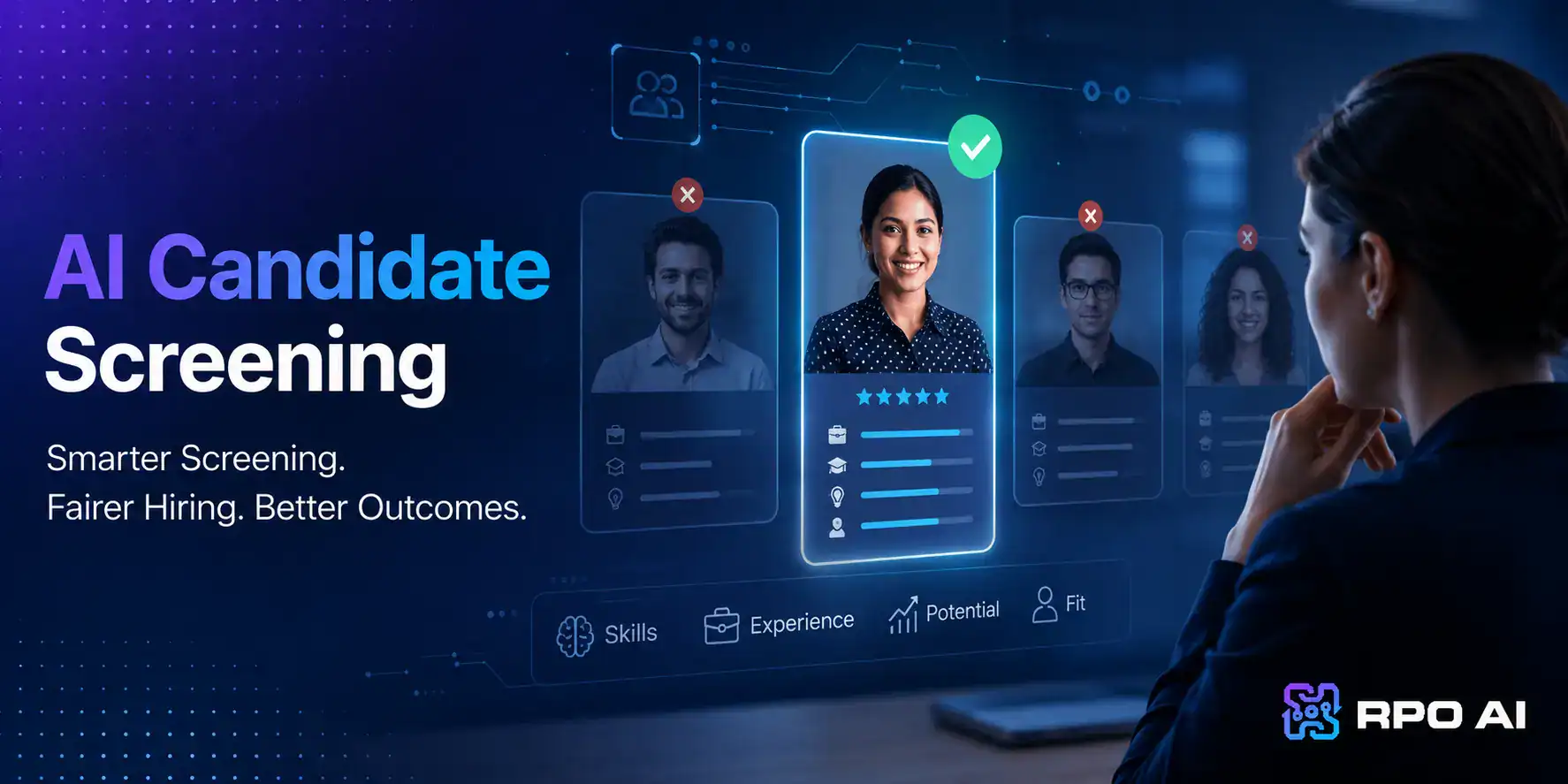
AI screening involves using technology and algorithms to automatically analyze candidate data such as resumes, skills, experience, and assessments, and rank or shortlist applicants based on job-relevant criteria.

Key functions include:

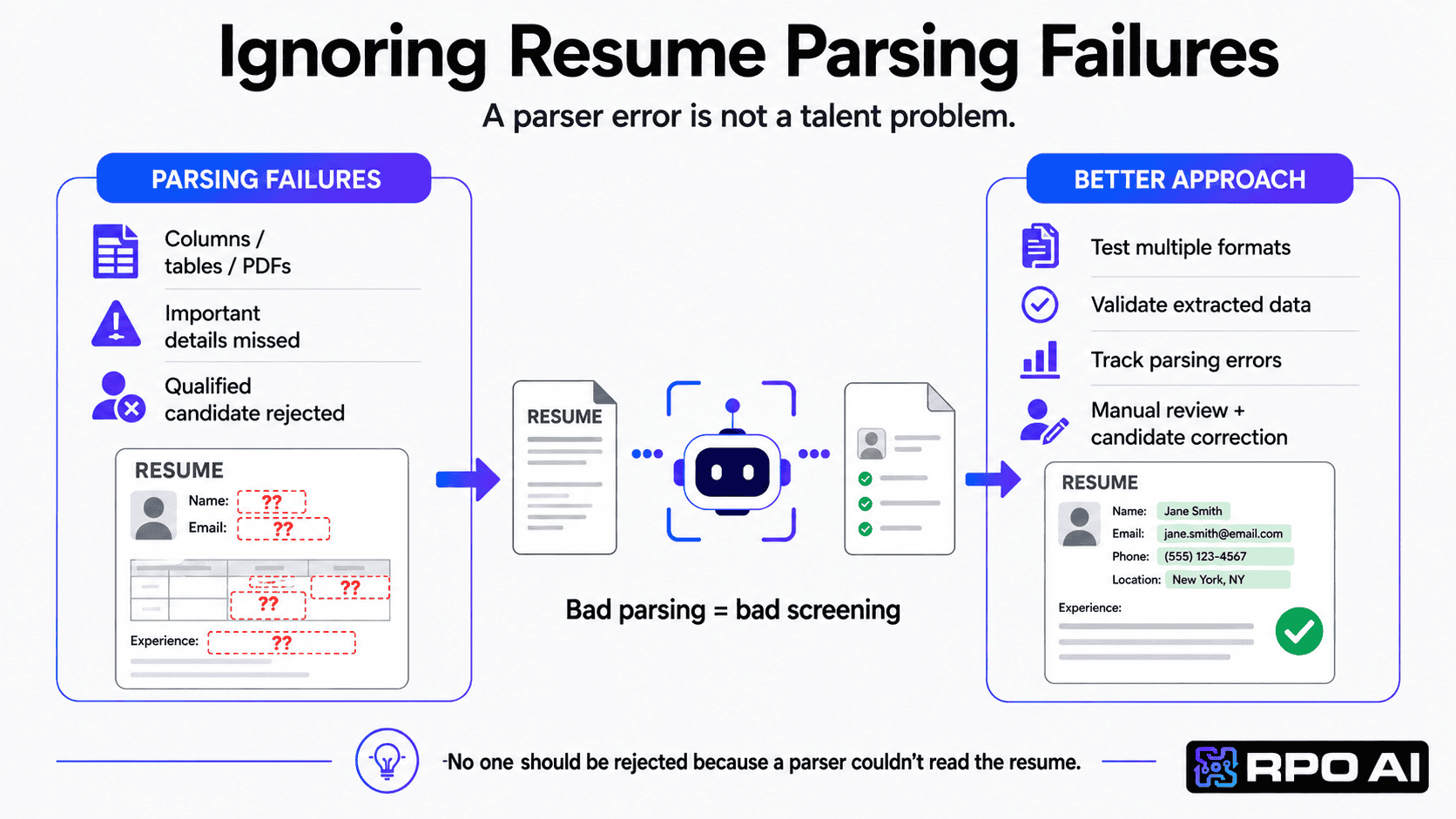
– Resume parsing: fast analysis of skills, experience, and role fit
– Skill matching: comparing candidate profiles to job requirements
– Ranking & shortlisting: prioritizing candidates based on data-driven signals
– Automated communication: engaging applicants at scale

When intelligently designed and governed, AI screening doesn’t replace human judgment; it augments it. Allows recruiters to focus on strategic engagement and relationship-building rather than repetitive manual work.

How AI Screening Reduces Hiring Bias

1. Standardized Evaluation Across the Board

AI screening applies the same criteria to every applicant, every time. Rather than relying on individual recruiters’ impressions or inconsistent judgments, AI evaluates candidates against predefined role-based standards. This consistency reduces variability, a leading source of bias in traditional workflows.

2. Blind Screening Capabilities

Many AI powered tools can mask or ignore demographic information like names, photos, gender indicators, or age, focusing instead on skills, experience, and competency. By filtering out irrelevant human identifiers early in the process, AI minimizes the risk of unconscious preferences shaping evaluations.

3. Focus on Skills

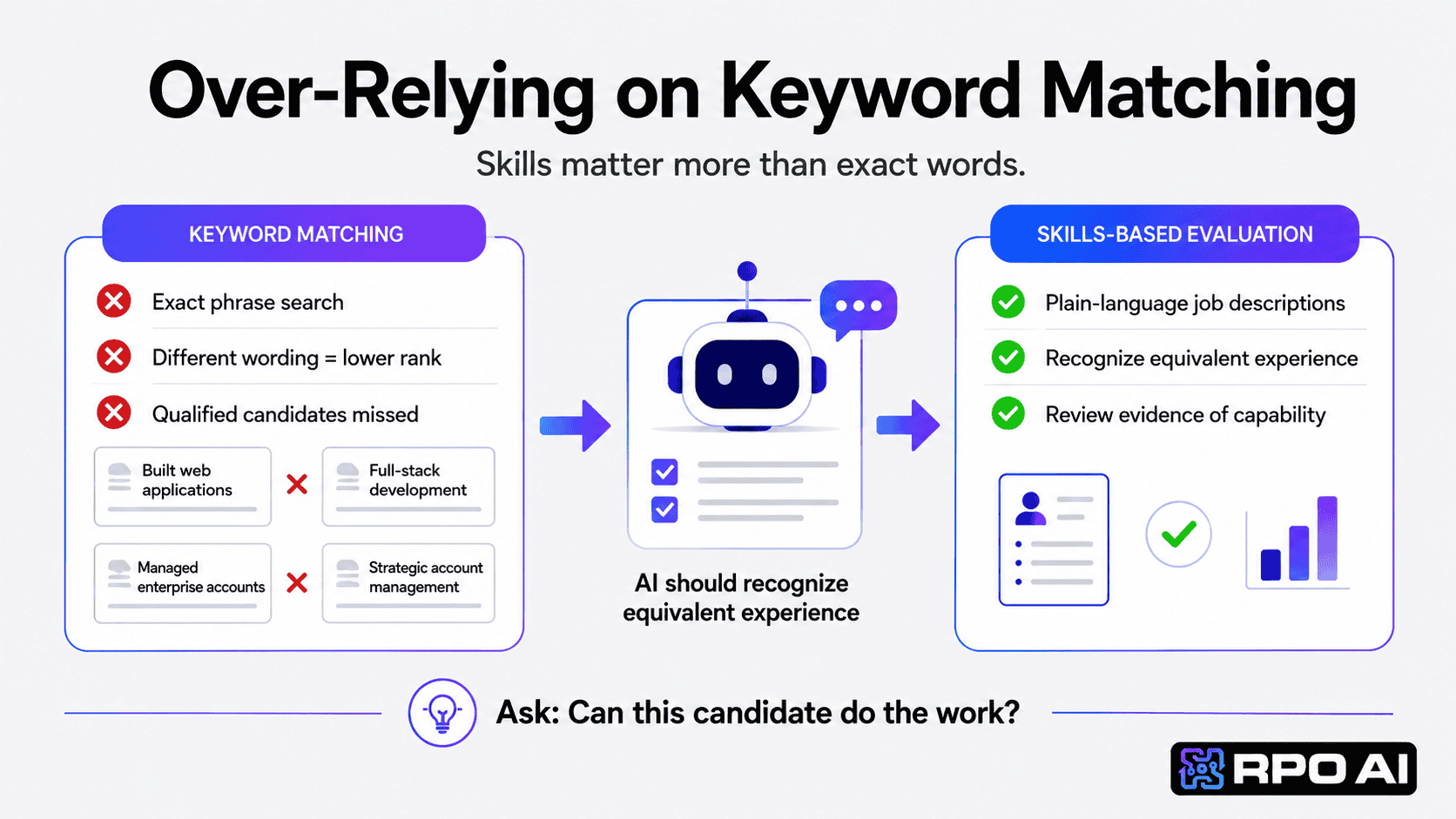
Modern AI systems are no longer just keyword scanners. They analyze contextual skills, project experience, and performance indicators, helping surface qualified candidates that might have been overlooked by humans using traditional screening methods. This emphasis on relevant talents, not superficial traits, leads to fairer, more inclusive shortlists.

4. Data-Driven Decisions That Reveal Patterns

Instead of gut feelings or heuristic assumptions, AI systems generate predictive analytics and scoring models that objectively assess applicant fit. Recruiters can see exactly how candidates compare on job-relevant dimensions, reducing reliance on subjective judgment. The result? A more transparent and defensible hiring process.

Real Benefits: Speed, Quality, and Fairness

AI screening is often discussed in terms of speed. That’s no accident. Companies using AI hiring tools, like the team at RPO.AI, report dramatic reductions in recruiting timelines, up to a 65% faster time-to-hire compared with traditional processes. But the value goes beyond time savings.

Higher Candidate Engagement

AI can personalize messaging and outreach at scale, leading to three times higher response rates than standard mass outreach. Personalization doesn’t just improve conversion; it shows candidates respect and attention, which strengthens employer brand perception.

Lower Cost-per-Hire

Automating repetitive tasks, candidate screening, ranking, scheduling, and follow-up lowers the administrative burden on recruiting teams. That translates to significant cost savings, with some organizations reporting up to 50% lower cost-per-hire.

Improved Candidate Experience

AI-powered communication and quick feedback loops keep applicants informed and engaged throughout the process, encouraging acceptance and reducing drop-outs.

Guardrails: Why AI Isn’t a Bias Silver Bullet

AI screening has enormous potential, but it only works fairly if it’s designed and monitored responsibly.

Here’s why:

Bias Can Be Built In

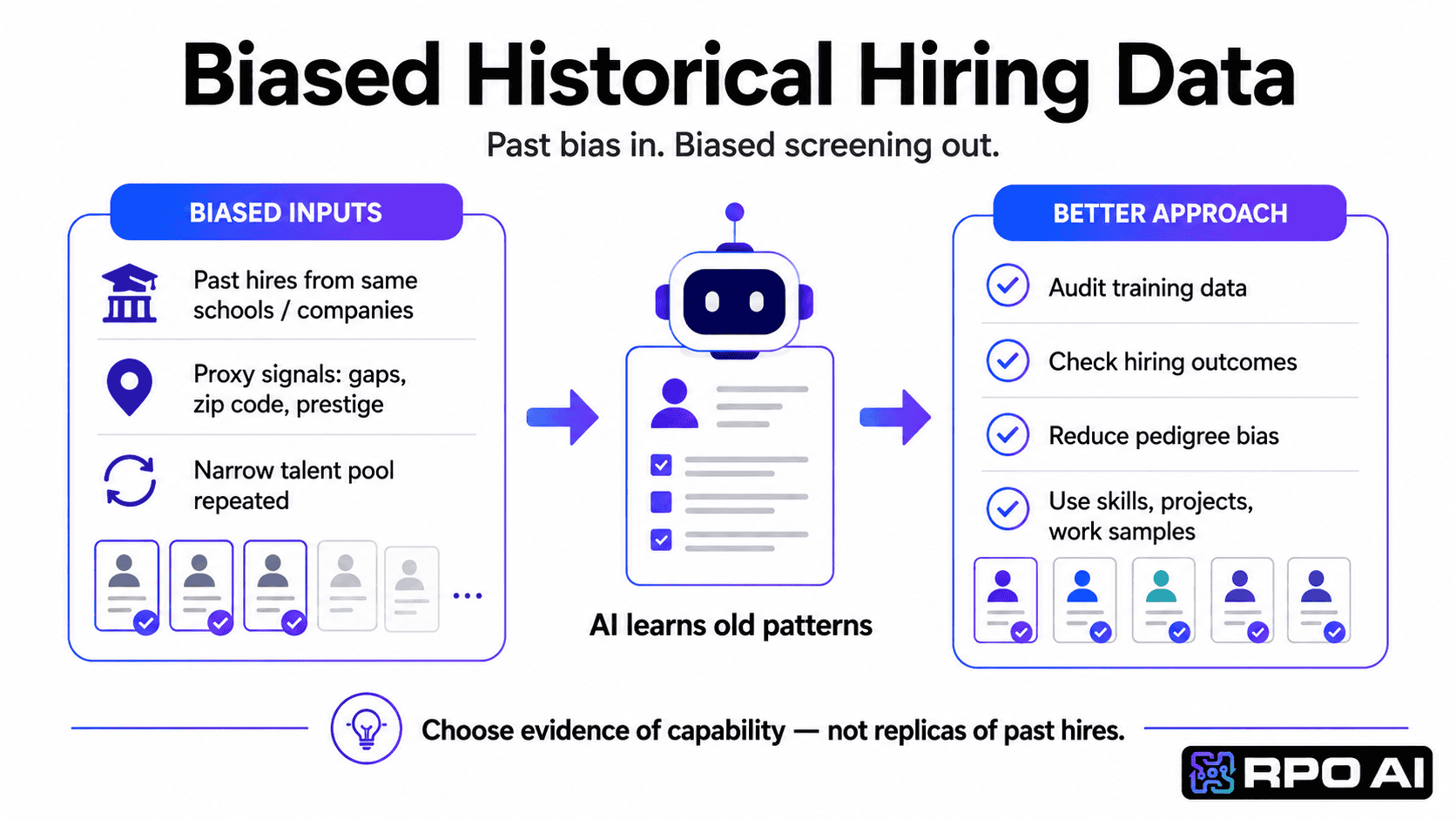
If an AI model trains on biased historical hiring data, it can learn and reinforce the same patterns, inadvertently amplifying bias rather than eliminating it. Researchers have even documented cases where algorithmic models favored candidate profiles that closely resembled patterns in training datasets.

Lack of Human Oversight Is Risky

AI shouldn’t operate in a vacuum. Ethical hiring requires human judgment, especially when it comes to evaluating cultural fit, soft skills, and nuances that machines can’t fully understand.

Transparency and Explainability Matter

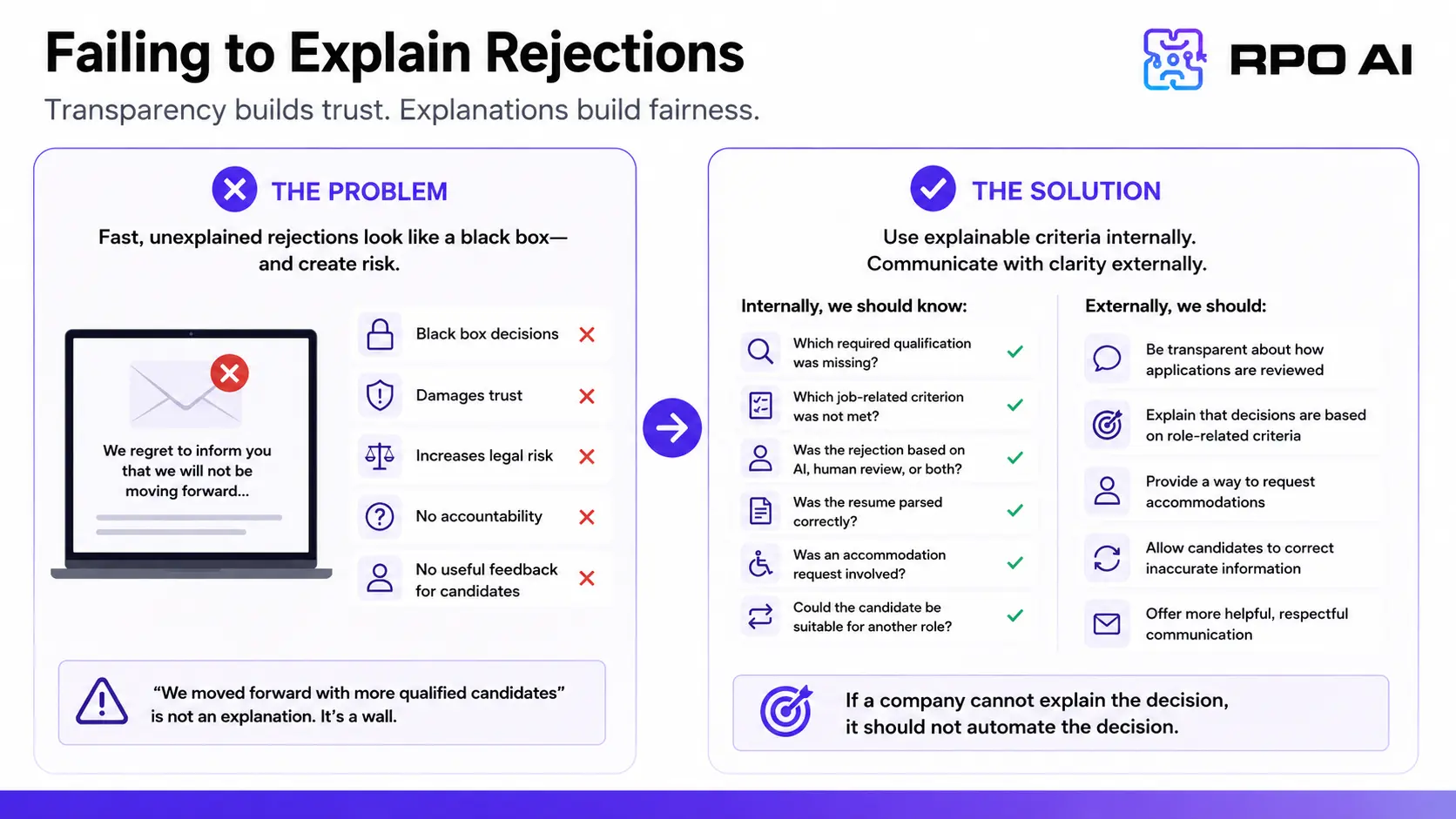
Recruiters and hiring managers should understand why AI is recommending one profile over another. Black-box models that can’t be explained can erode trust and obscure fairness issues.

Best Practices for Unbiased AI Screening

To make AI screening impactful and equitable, companies should adopt these practices:

1. Build Diverse, Bias-Aware Training Data

Ensuring AI systems train on datasets that reflect diverse experiences, backgrounds, and job success profiles helps reduce skew and discrimination.

Regular audits should be conducted to detect and correct any unfair patterns that emerge.

2. Maintain Human + AI Collaboration

AI should do the heavy lifting: data crunching, filtering, ranking, while humans make final calls, especially for qualitative assessments that require empathy and cultural nuance.

This combination helps ensure fairness, accuracy, and human accountability.

3. Set Transparent, Explainable Criteria

Use models with clear scoring and transparent criteria. Recruiters should understand what drives candidate ranking and be able to adjust parameters as needed.

This transparency builds confidence and trust, both internally and with candidates.

4. Continuously Monitor Outcomes

Monitor hiring outcomes over time, compare demographic and performance trends, and adjust screening criteria or models if disparities arise. Ethical AI is an ongoing commitment, not a one-time project.

Beyond Bias Reduction: Business Value of AI Screening

AI screening enhances fairness, but it also delivers strategic business value:

– Faster decision cycles help secure top talent before competitors
– Predictive analytics improve forecasting and hiring strategy
– Higher-quality shortlists boost employee retention and performance
– Reduced admin burden frees recruiters for strategic engagement

Together, these benefits make hiring more efficient, data-driven, and candidate-centric.

AI Screening Is a Powerful Tool When Used Right

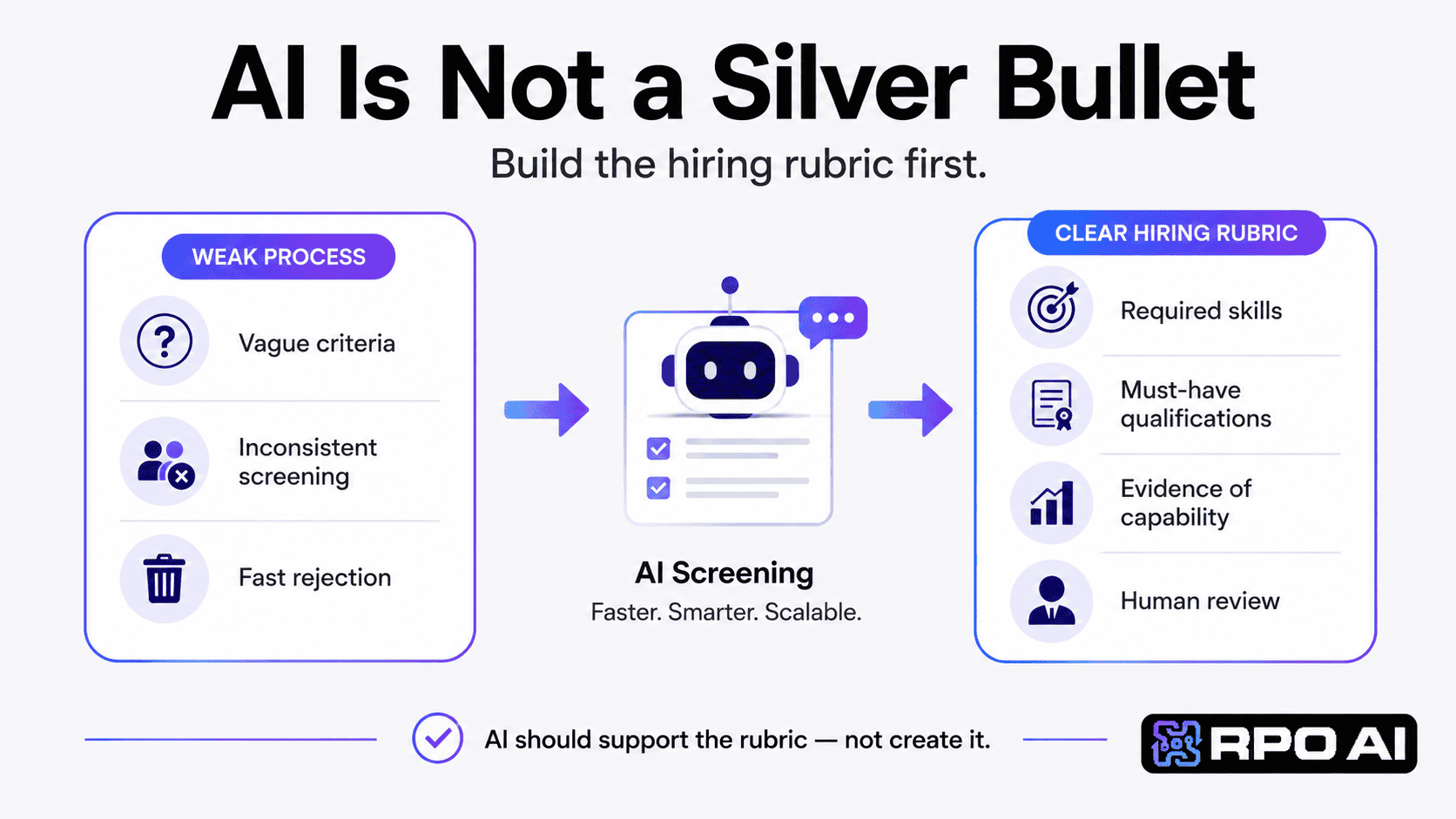
AI screening technology isn’t a magic bullet that eliminates bias entirely. But when approached with intentional design, human oversight, and clear evaluation criteria, it becomes a powerful enabler of fairer, faster, and more consistent hiring.

Organizations that embrace ethical AI screening and pair it with strong governance gain a competitive edge: better candidates, improved employer reputation, and a talent acquisition process built for the future.

Whether you’re still relying on manual review or using fragmented tools, AI screening offers a compelling path forward, one where efficiency and fairness go hand in hand.

Frequently Asked Questions About AI Screening in Hiring

How does AI help in the hiring process?

AI helps by taking over the repetitive, time-consuming parts of recruitment so hiring teams can focus on people, not paperwork. It can quickly screen resumes, match candidates to job requirements, schedule interviews, and even personalize candidate communication. This speeds up hiring, reduces administrative overload, and creates a smoother experience for applicants.

How to ensure AI is unbiased?

AI doesn’t become fair automatically; it becomes fair through careful design and ongoing monitoring. Companies can promote unbiased AI by training models on diverse, representative data, clearly defining job-related evaluation criteria, and regularly auditing outcomes for unintended patterns. Transparency, testing, and continuous adjustment help ensure the system remains aligned with fairness goals.

How does AI help reduce bias in recruitment?

AI helps reduce bias by applying consistent standards to every candidate. Unlike humans, it doesn’t get tired, distracted, or influenced by personal impressions. Well-designed AI tools focus on skills, experience, and qualifications rather than names, backgrounds, or other subjective signals. When combined with thoughtful human review, AI can significantly improve objectivity and fairness in hiring decisions.

Global Hiring Made Simple: Compliance, Payroll & EOR Services

Hiring globally used to be a complex, resource-heavy process reserved for large enterprises with legal teams in every region. Today, companies of all sizes are building distributed teams across continents.

What changed?

Modern compliance frameworks, global payroll platforms, and Employer of Record (EOR) services have removed many of the traditional barriers. Businesses can now hire internationally with speed, predictability, and reduced legal risk.

But “simplified” does not mean “effortless.” Global hiring still requires a clear understanding of compliance obligations, payroll logistics, and workforce management strategies.

This blog breaks down what employers truly need to know.

Why Global Hiring Matters and Why It’s Complicated

Expanding your workforce globally isn’t just a nice perk; it’s a strategic advantage. Businesses are no longer limited by geography when searching for talent. Instead of competing within a single market, companies can tap into global expertise, niche skill sets, and region-specific knowledge.

Accessing diverse talent pools allows organizations to:

– Fill specialized roles faster

– Enter new markets with locally based teams

– Strengthen 24/7 productivity coverage

For many companies, global hiring plays a meaningful role in growth, innovation, and long-term resilience. Distributed teams bring fresh perspectives and specialized expertise.

Broader talent access helps close skill gaps that may be difficult to address locally. Hiring timelines often improve when organizations are not limited by geography.

In highly competitive industries, this flexibility can create a clear and lasting advantage. At the same time, global hiring introduces complexities that are easy to underestimate.

Every country has its own regulatory landscape. Employment laws, tax obligations, payroll requirements, and worker protections vary significantly. Practices that work smoothly in one region may create compliance challenges in another.

Even familiar hiring activities issuing employment contracts, structuring compensation and benefits, or managing payroll that require thoughtful localization to ensure accuracy, consistency, and full compliance.

Missteps can result in:

– Legal penalties and fines

– Unexpected tax liabilities

– Payroll errors

– Worker classification disputes

– Reputational damage

Traditional hiring processes often struggle in this environment. Establishing legal entities, understanding local compliance requirements, and managing multi-country payroll can take weeks or even months.

This is why modern companies are shifting toward structured global hiring solutions.

By combining expertise with automation, organizations can reduce uncertainty and eliminate unnecessary friction. Compliance frameworks, global payroll platforms, and Employer of Record (EOR) services help businesses hire internationally with greater speed, accuracy, and confidence.

Understanding Global Compliance: The Foundation of Safe Hiring

Compliance means more than just following local laws, it means designing your hiring process around risk avoidance and legal obligations from Day 1.

Key Compliance Considerations

When hiring internationally, you must consider:

– Local employment contracts and termination rules

– Minimum wage and mandated benefits

– Tax compliance, reporting requirements, and social security contributions

– Work permits and immigration considerations

Every market’s employment ecosystem is unique. In many countries, payroll taxes, social insurance, and statutory benefits are calculated differently than in the U.S. Without accurate local compliance, you could face fines, retroactive tax liabilities, or even litigation.

Tip: Before you post a job internationally, consult local counsel or compliance specialists to understand baseline requirements.

Global Payroll Management: Managing Compliance, Taxes, and Payments

Payroll isn’t just paying your employees; it’s managing taxes, benefits, reporting, and country‑specific deductions.

Key Payroll Challenges

Here’s what companies typically face when managing payroll across borders:

– Currency exchange and fluctuations

– Local tax withholdings and social contributions

– Benefits compliance and statutory requirements

– Multi‑country reporting obligations

– Integration with local banking systems

Handling all this manually, especially across dozens of markets is a recipe for errors and delays.

How Modern Payroll Platforms Help

Modern global payroll platforms simplify this complexity through automation and centralized management.

These systems support real-time tax calculations, automated compliance reporting to local authorities, multi-currency payroll execution, and accurate benefits administration. By standardizing workflows, organizations gain consistency while still meeting country-specific requirements.

Most importantly, these platforms integrate with existing HR and accounting systems, providing a unified view of payroll operations across regions.

Result: Reduced administrative burden, fewer payroll errors, and greater confidence that employees are paid accurately, compliantly, and on time.

Employer of Record (EOR): The Fast Track to Global Hiring

An Employer of Record (EOR) is a third‑party organization that legally employs talent in a specific country on your behalf while you retain oversight of the work and performance.

How EOR Works

Instead of establishing your own legal entity in a foreign market:

– EOR becomes the legal employer of your workers.

– EOR handles payroll, tax withholdings, statutory benefits, and compliance.

– You manage employee performance, work assignments, and day‑to‑day collaboration.

This model eliminates the need to create a local legal entity, a process that can often take months and incur substantial costs.

Benefits of Using an EOR

– Instant compliance with local employment laws

– Faster time‑to‑hire in new markets

– Payroll, benefits, and tax administration handled correctly

– Lower legal and administrative risk

– Centralized management dashboard for global hires

Hiring through an EOR makes onboarding international talent feel just like hiring locally.

Putting It All Together: A Unified Global Hiring Workflow

Here’s how the entire process should function when done right:

1) Role definition and localization: Customize job descriptions to reflect local norms and legal requirements.

2) Candidate sourcing and screening: Use global sourcing tools plus local market talent channels to find the right fit.

3) Offer generation and employment agreement: Use compliant, local‑law contracts generated automatically.

4) Payroll setup through EOR or automated platform: Ensure multi‑currency payroll runs accurately and on schedule.

5) Onboarding and benefits administration: Provide local benefits packages and integrate new hires into your team.

6) Ongoing compliance checks: Monitor regulatory changes and ensure payroll and tax filings remain up to date.

When these steps are unified into a single workflow, your hiring process becomes scalable and reliable, no matter how many countries you operate in.

The Business Impact of Smart Global Hiring

Businesses that adopt structured global hiring practices see measurable benefits:

1. Faster Hiring Cycles

Automating compliance and payroll, along with leveraging Employer of Record (EOR) services, can reduce hiring timelines. Processes that once required weeks or months from legal preparation to onboarding can now often be completed in just days. 

This enables organizations to respond quickly to talent needs without being delayed by administrative complexity.

2. Cost Savings

Structured global hiring solutions help businesses reduce unnecessary expenses while improving operational efficiency. Companies often lower costs associated with legal entity setup, compliance-related risks, and administrative overhead. 

By consolidating into a unified system, organizations also gain better financial visibility and avoid the inefficiencies of fragmented workflows.

3. Higher Employee Satisfaction

A streamlined global hiring experience has a direct impact on employee satisfaction. Candidates value accuracy, clarity, and consistency throughout the hiring and onboarding process. 

Reliable compensation, transparent benefits, and professional communication foster trust, improve acceptance rates, and strengthen employer brand perception across international markets.

Best Practices for Employers Starting Their Global Hiring Journey

Start with Clear Policies: Create global HR policies that reflect your company values and local expectations.

Choose the Right Partners: EOR providers and global payroll platforms should have deep regional expertise and technology integration.

Invest in Continuous Learning: Employment laws evolve frequently. Ongoing education protects your company and your workforce.

Use Analytics: Track hiring speed, cost‑per‑hire, and compliance metrics to refine your strategy, just like performance metrics are used in recruitment analytics to guide decisions and improve outcomes.

Simplifying Complexity With the Right Framework

Global hiring doesn’t have to be daunting. With the right combination of compliance tools, global payroll automation, and Employer of Record services, companies can:

– Hire the best talent anywhere in the world

– Reduce legal and financial risk

– Speed up onboarding timelines

– Strengthen employee experience worldwide

When strategy and technology work together, global hiring becomes not just possible, but practical and powerful.

Ready to simplify global hiring with RPO.AI? With the right infrastructure, you can hire internationally with speed, accuracy, and confidence. Start building your global workforce today.

Frequently Asked Questions (FAQ)

What is the difference between EOR and setting up a legal entity?

An EOR instantly allows you to legally hire in a country without having to build your own legal entity, saving time and compliance headaches.

Do global payroll platforms handle local tax filings?

Yes, robust payroll platforms automate local tax withholdings and reporting, often integrating directly with government systems.

Can EOR services help full‑time and contract hires?

Yes, depending on the provider, EOR services support both full‑time employees and independent contractors.

Is compliance automated or manual?

Today’s best solutions combine automated compliance updates with expert oversight to ensure accuracy across markets.

AI-Powered Recruitment for Smarter and Faster Hiring

For readers in a hurry:

– Slow hiring leads to lost top talent, lower productivity, and missed revenue.

– Traditional recruitment methods can’t keep pace with today’s fast job market.

– Recruitment AI automates key tasks like resume screening, interview scheduling, and candidate sourcing.

– Real-time insights and predictive analytics help prevent candidate drop-off and speed decision-making.

– Adopting recruitment AI strengthens the employer brand and improves workforce planning.

Hiring delays don’t usually happen because teams lack effort. They happen because modern recruitment processes were never designed for today’s hiring volumes, candidate expectations, or market speed.

As organizations compete for increasingly scarce talent, time-to-hire has become one of the most critical hiring metrics. According to recent data, 87% of companies now use AI in recruitment in some capacity, and one reason dominates all others: speed.

This is where recruitment AI enters the conversation, not as a replacement for recruiters, but as an operating system for faster, more predictable hiring. This article explores how AI-powered recruitment streamlines workflows and empowers teams to hire more efficiently while maintaining high-quality talent standards.

Understanding Recruitment AI: The Game-Changer in Hiring

As the challenges of slow hiring cycles grow more acute, many organizations are turning to recruitment AI as a strategic lever to regain speed, efficiency, and quality in talent acquisition.

But what exactly is recruitment AI, and why is it such a game-changer?

What Recruitment AI Really Means

Recruitment AI refers to software solutions that leverage advanced technologies like machine learning, natural language processing (NLP), and predictive analytics to automate and optimize key parts of the hiring process.

Unlike traditional tools that simply digitize manual steps, AI systems learn from data and continuously improve, enabling smarter decisions at scale.

How AI Transforms Hiring Workflows

At its core, recruitment AI does three things differently:

1. Processes High Volumes Simultaneously
Instead of recruiters reviewing resumes or scheduling interviews one-by-one, AI systems analyze hundreds or thousands of applications in parallel, without fatigue or inconsistency.

2. Understands Context and Patterns
Using NLP, AI interprets skills, experience, and qualifications beyond simple keyword matches, identifying the most relevant candidates with greater precision. Machine learning models detect subtle signals like career progression trends or cultural fit.

3. Predicts and Prescribes Next Steps
AI does not just present data; it forecasts candidate behaviors such as likelihood to accept offers or drop out mid-process and recommends actions to recruiters, turning hiring from reactive to proactive.

8 Ways Recruitment AI Streamlines Hiring Workflows

Modern AI in recruitment delivers time savings across multiple touchpoints in the hiring process. These aren’t just minor improvements; they’re fundamental shifts that compound into dramatic overall efficiency gains.

1. Automated Resume Screening

Traditional resume screening forces recruiters to manually review each application, spending 6-8 seconds per resume while often missing qualified candidates. AI recruitment tools analyze resumes in milliseconds using natural language processing to identify relevant skills and experience with 95% accuracy.

These systems understand context beyond simple keyword matching. They recognize that “led a team of developers” and “managed software engineering staff” represent similar leadership experience. This contextual understanding, combined with machine learning from successful hires, creates screening accuracy that often exceeds human performance while processing 100 times more applications.

The real breakthrough happens when AI-based recruitment platform solutions integrate with existing applicant tracking systems, automatically ranking candidates and flagging top prospects for immediate attention. This transformation moves recruiters from administrative bottlenecks to strategic talent engagement.

2. Smart Interview Scheduling

Interview scheduling traditionally consumes 2-3 hours per candidate as recruiters coordinate between multiple calendars and manage reschedule requests. AI recruitment software eliminates this by providing candidates with real-time availability and handling confirmations automatically.

Advanced scheduling systems learn from your team’s patterns, blocking preparation time before interviews and preventing conflicts. Some platforms can predict and prevent scheduling issues by analyzing email patterns, reducing no-shows by up to 60% through intelligent reminder sequences.

The compound time savings become massive at scale. What once required a full-time scheduler for high-volume hiring now happens automatically, freeing recruiters to focus on candidate relationships rather than calendar coordination. This efficiency leads directly to faster decision-making and improved candidate experience.

3. Intelligent Candidate Sourcing

While most recruiters search obvious talent search, AI recruitment tools continuously scan millions of profiles across platforms to identify passive candidates who aren’t actively job hunting. Organizations like this cybersecurity company in Saudi Arabia reduced their hiring cycle from six weeks to three weeks using AI tools, demonstrating real-world ROI.

AI recruitment algorithms analyze career progression patterns and skill development trajectories to predict when someone might be ready for a career move. They can identify candidates with transferable skills from adjacent industries that human recruiters might overlook.

The most sophisticated systems create detailed candidate personas and continuously learn from successful placements. They become increasingly precise at identifying not just qualified candidates, but those most likely to accept offers and succeed in your specific company culture. This proactive approach transforms sourcing from reactive searching to predictive talent mapping.

4. Predictive Analytics

AI in recruitment can predict with 85% accuracy which candidates are likely to drop out before final offers. By analyzing communication patterns, response times, and engagement metrics, these systems alert recruiters to at-risk candidates who need additional attention.

These predictive models examine subtle signals like longer response times, decreased engagement in follow-up conversations, or LinkedIn activity suggesting they’re interviewing elsewhere. Early warnings allow recruiters to proactively address concerns or accelerate decision timelines.

The most advanced AI recruitment platform solutions integrate salary data and market trends to recommend optimal offer timing and compensation packages. This reduces offer rejection rates by up to 40% and eliminates the costly cycle of starting over with backup candidates. Analytics transform recruitment from reactive to predictive management.

5. Automated Reference

Traditional reference checking can delay final offers by 3-7 days as recruiters coordinate with references across time zones. AI recruitment tools automate the entire process, sending customized requests, collecting responses, and analyzing feedback patterns.

Smart reference systems use dynamic questioning that adapts based on role requirements and candidate backgrounds. They verify employment history and credentials simultaneously, consolidating what were once separate processes into a single workflow.

The time compression is dramatic; comprehensive reference checks that previously required a week now complete in 24-48 hours with more thorough documentation than manual processes typically provide. This acceleration ensures momentum doesn’t stall at the final verification stage.

6. Real-Time Pipeline Analytics

AI recruitment software provides real-time visibility into your entire hiring pipeline, identifying bottlenecks before they cause delays. These systems track candidate progression through each stage, measuring time spent at checkpoints and alerting managers when processes stall.

Advanced analytics reveal patterns invisible to human observation. They identify interview combinations that predict success, optimal timing for different types of outreach, and candidate characteristics that correlate with faster hiring cycles.

The most valuable insights come from predictive pipeline management, where ai in recruitment forecasts completion dates and resource needs. This allows proactive adjustments that maintain momentum rather than reactive fixes after delays have already occurred. Data-driven insights replace guesswork with strategic planning.

7. Multi-Channel Communication

AI recruitment platforms maintain consistent, personalized engagement across email, SMS, and social channels without requiring constant recruiter oversight. These systems send appropriately timed check-ins, interview reminders, and process updates that keep candidates informed.

Smart communication tools adapt messaging tone and frequency based on candidate preferences and response patterns. They escalate to human recruiters when candidates express concerns or ask complex questions requiring personal attention.

The engagement benefit compounds over time. Candidates who receive consistent, helpful communication are three times more likely to complete your hiring process and twice as likely to accept offers. This reduces candidate pool erosion that typically lengthens hiring cycles. Automated engagement becomes a competitive advantage in candidate retention.

8. Integration Ecosystems

Modern AI recruitment platform solutions integrate seamlessly with existing HR technology stacks, eliminating manual data entry and system switching that traditionally slows processes. Candidates enter information once, and it automatically populates across all relevant systems.

Advanced integration creates feedback loops where offer acceptance data informs sourcing algorithms, and successful hire characteristics improve screening accuracy. This interconnected intelligence makes every hiring cycle smarter than the last.

The efficiency gains multiply when systems share insights across the entire employee lifecycle. Recruitment AI that learns from employee performance data becomes exponentially better at identifying candidates who will succeed long-term, reducing both hiring time and turnover rates. Integration transforms recruitment from an isolated function to part of a connected talent management ecosystem.

Hiring Smarter, Not Just Faster

Recruitment AI shortens hiring cycles by removing delays that slow teams down. Screening, scheduling, sourcing, and follow-ups happen faster and with better accuracy, without adding recruiter workload.

This leads to quicker decisions, fewer drop-offs, and stronger candidate engagement. Companies that use AI don’t just hire faster; they hire with more control and predictability. As talent markets tighten, reducing time-to-hire is no longer optional.

Recruitment AI provides a practical way to move at market speed while keeping hiring quality intact.

Common Questions About AI-Powered Hiring Speed

What happens if AI screening misses a good candidate?

Modern systems include feedback loops where recruiters flag missed candidates, continuously improving accuracy while maintaining manual review options for borderline cases.

How do I justify AI recruitment costs to leadership?

Calculate current cost-per-hire, including recruiter time at $50-75/hour, and multiply by positions filled annually. Most AI recruitment software pays for itself within 3-6 months.

Can recruitment AI work for specialized technical roles?

Yes, AI recruitment tools excel at technical role matching because they analyze specific programming languages, certifications, and project experience more comprehensively than human screening.

What about candidate privacy and data security?

Reputable AI recruitment tools comply with GDPR and industry security standards. Look for SOC 2 certification and transparent data usage policies from providers.

Will AI replace human recruiters entirely?

No, AI in recruitment handles repetitive tasks while human recruiters focus on relationship building, cultural assessment, and strategic decision-making for optimal results.

AI Sourcing Tools for Better Candidate Matching

Recruiters do not struggle because they cannot find candidates. They struggle because most sourcing methods surface volume, not quality.

As hiring markets grow more competitive and roles become more specialized, candidate matching has emerged as one of the most expensive failure points in recruitment. Poor matches lead to longer hiring cycles, early attrition, and repeated backfills that drain both time and budget.

AI sourcing tools address this problem at its root. They change how candidates are discovered, evaluated, and prioritized. This article explains how AI sourcing tools improve candidate matching and quality, not through automation alone, but through fundamentally better decision intelligence.

TL;DR
– Poor candidate quality is rarely a sourcing effort problem. It is a matching problem.

– Traditional sourcing relies on keyword searches, manual filtering, and surface-level signals that miss high-potential talent.

– AI sourcing tools analyze skills, career patterns, and contextual data to match candidates with far greater precision.

– Predictive models improve both short-term fit and long-term performance outcomes.

– Organizations using AI sourcing do not just fill roles faster. They build stronger, more reliable talent pipelines.

Understanding AI Sourcing Tools in Modern Recruitment

AI sourcing tools are not advanced search engines. They represent a shift from manual discovery to predictive talent intelligence.

To understand their impact, it is important to clarify what these tools actually do and how they differ from traditional sourcing methods.

What AI Sourcing Tools Really Are

AI sourcing tools use machine learning, natural language processing, and large-scale data modeling to identify and evaluate candidates across multiple data sources.

Instead of searching for exact keywords or job titles, these systems analyze:

– Skills inferred from work history and projects

– Career progression patterns

– Industry adjacency and transferable experience

– Engagement signals and job change likelihood

The result is not a list of resumes. It is a ranked set of candidates evaluated for relevance, readiness, and probability of success.

How AI Changes the Sourcing Function

Traditional sourcing answers one question: Who matches this job description?

AI sourcing answers a more valuable question: Who is most likely to succeed in this role and stay?

This shift moves sourcing from reactive searching to proactive talent mapping. Recruiters stop chasing applicants and start selecting from intelligence-backed shortlists.

Why Traditional Sourcing Produces Low-Quality Matches

Before examining how AI improves quality, it is important to understand why traditional sourcing fails so often.

Keyword Matching Misses Context

Keyword searches assume that candidates describe themselves the same way job descriptions do. In reality, high-quality candidates often use different language to describe similar experiences.

A developer who built distributed systems may never mention the exact framework listed in a job post, even though they are fully qualified. Keyword filters exclude them immediately.

Manual Review Does Not Scale

Recruiters are forced to make rapid decisions under time pressure. When sourcing hundreds of profiles, pattern recognition suffers, and unconscious bias increases.

The result is inconsistent evaluation and missed talent.

Sourcing Focuses on Availability, Not Fit

Traditional tools prioritize who is actively looking, not who is best suited. This biases pipelines toward job seekers rather than top performers who are open to the right opportunity. AI sourcing tools correct these structural flaws.

How AI Sourcing Tools Improve Candidate Matching and Quality

AI sourcing improves outcomes by changing how candidates are identified, evaluated, and ranked. These improvements compound across the hiring lifecycle.

1. Skill-Based Matching Replaces Title-Based Searches

AI sourcing tools extract and normalize skills from resumes, portfolios, and online profiles.

This allows recruiters to identify qualified candidates from adjacent roles and industries. For example, a data analyst with strong Python and statistical modeling experience may be an excellent fit for a machine learning role, even if their title does not reflect it. AI identifies this alignment automatically. This expands talent pools while improving match accuracy.

2. Contextual Understanding Improves Precision

Natural language processing allows AI to understand context, not just keywords. The system recognizes that managing a cross-functional product team and leading agile delivery involve overlapping competencies. It understands progression, responsibility scope, and complexity.

This contextual intelligence produces shortlists that reflect real-world capability, not surface similarity. Recruiters spend less time filtering noise and more time engaging qualified candidates.

3. Career Trajectory Analysis Predicts Readiness

AI sourcing tools analyze career paths across thousands of similar profiles.

They identify patterns such as:

– When candidates typically move into leadership roles

– How skill accumulation correlates with performance outcomes

– Which transitions lead to long-term retention

This allows recruiters to assess not only whether a candidate fits today, but whether they are ready for the role at the required level. Quality improves because hires align with role maturity, not just minimum qualifications.

4. Predictive Fit Scoring Reduces Hiring Risk

AI sourcing platforms assign fit scores based on historical hiring success data. These models learn from past placements, performance reviews, and retention outcomes. Over time, they become increasingly accurate at identifying candidates who succeed in specific environments. This predictive layer reduces reliance on intuition and replaces it with evidence-based prioritization. Recruiters still make final decisions, but with significantly better information.

5. Passive Candidate Identification Improves Quality

Top candidates rarely apply. AI sourcing tools continuously scan talent ecosystems to identify passive candidates whose skills and trajectories align with open roles. By analyzing engagement signals, job stability patterns, and market movement, AI identifies candidates who may be receptive before they enter the job market. This proactive sourcing improves quality by targeting talent before competition intensifies.

6. Bias Reduction Improves Matching Fairness

AI sourcing tools evaluate candidates based on skills and experience rather than demographic proxies. When implemented correctly, these systems reduce bias introduced by name recognition, school prestige, or employment gaps. This leads to more diverse pipelines and better matches driven by capability rather than familiarity. Quality improves when evaluation criteria align with actual job requirements.

7. Continuous Learning Improves Future Matches

Every hiring decision feeds back into the system. When recruiters flag successful placements or identify false positives, AI models adjust. Over time, sourcing accuracy improves automatically. This creates a feedback loop where each hiring cycle strengthens the next. Traditional sourcing resets with every role. AI sourcing compounds intelligence.

8. Integration With Hiring Workflows Preserves Context

AI sourcing tools integrate with applicant tracking systems and interview platforms.
Candidate data flows seamlessly from sourcing to screening to hiring decisions. Recruiters maintain full visibility into why candidates were surfaced and how they performed at each stage. This continuity prevents context loss and supports better final decisions.

Candidate Quality Is a System Outcome, Not a Single Decision

High-quality hiring does not come from one great interview or one strong resume. It comes from systems that consistently surface the right candidates, evaluate them fairly, and prioritize them intelligently. AI sourcing tools improve candidate quality because they address the entire sourcing foundation, not just speed or scale.

Ready to Improve Matching Without Increasing Effort?

AI sourcing tools do not replace recruiters. They remove friction from discovery and replace guesswork with intelligence. Organizations that adopt AI sourcing see stronger pipelines, higher-quality hires, and better long-term outcomes because matching improves at the system level. As roles become more specialized and talent scarcity increases, sourcing quality will determine hiring success. AI provides a practical way to improve matching without increasing workload.

Common Questions About AI Sourcing Tools

1. Do AI sourcing tools eliminate human judgment?

No. They augment decision-making by surfacing better candidates. Recruiters remain responsible for final evaluation and cultural fit.

2. Can AI sourcing work for niche or technical roles?

Yes. AI performs particularly well in technical sourcing because skills and experience can be modeled with high precision.

3. How long does it take to see quality improvements?

Most teams see measurable improvements within the first few hiring cycles as models begin learning from outcomes.

4. Are AI sourcing tools compliant with data privacy regulations?

Reputable platforms comply with GDPR and industry security standards. Data governance should be validated during vendor selection.

5. Will AI sourcing reduce recruiter workload?

Yes. Recruiters spend less time searching and filtering and more time engaging high-quality candidates.

Ready to hire?

Transform your recruitment process with RPO AI. Contact us today to learn more.

Let’s make that happen.

Contact us. We’ll get back to you quickly to answer any questions.