
 Log-In
 Startups grow fast. Hiring needs change quickly. One month, you may need five engineers. The next month, you may pause hiring completely. Traditional recruiting models are not built for this kind of flexibility.
On-demand recruiting gives startups access to professional recruiting support only when they need it. There is no long-term commitment, no full-time recruiter overhead, and no wasted hiring budget. It is a flexible staffing approach designed for companies that need speed, control, and scalability.
This article explains what on-demand recruiting is, how it works, and why startups benefit from flexible staffing.
What Is On-Demand Recruiting?
On-demand recruiting is a flexible hiring model in which companies use recruiting expertise as needed rather than maintaining a full in-house recruiting team.
It allows startups to:
* Quickly scale hiring efforts
* Pause recruiting when demand slows.
* Pay only for the recruiting support they use
* Access experienced recruiters without full-time costs.
This model works especially well for startups that face unpredictable hiring cycles.
How On-Demand Recruiting Works
On-demand recruiting follows a structured but flexible process. It is designed to activate quickly, scale efficiently, and deliver measurable hiring results without long-term contracts.
Here is how it typically works:
1. Define Hiring Requirements
The process starts with a clear understanding of business goals and hiring priorities. This includes the number of roles, required skills, timelines, seniority level, and budget expectations. A detailed intake ensures recruiters align with the startup’s growth stage and urgency.
Clarity at this stage reduces misalignment later and improves candidate quality.
2. Deploy Dedicated Recruiting Support
Based on hiring needs, experienced recruiters are assigned to the project. Support can range from sourcing-only assistance to full-cycle recruitment, including interviews and offer management.
The key difference is flexibility. Startups can increase recruiter capacity during high-growth periods and reduce support when hiring slows.
3. Build and Activate Talent Pipelines
Recruiters begin sourcing candidates using targeted outreach, job boards, professional networks, referrals, and AI-driven tools. Advanced search strategies help identify both active and passive talent.
AI-powered matching tools may assist in ranking candidates based on skills, experience, and role fit. This speeds up the screening process and improves precision.
4. Screen and Shortlist Candidates
Qualified candidates go through structured screening. This may include resume evaluation, skill validation, culture alignment checks, and initial interviews.
Only pre-qualified candidates move forward to hiring managers. This reduces internal review time and improves interview efficiency.
5. Manage Interviews and Offers
The recruiting team coordinates interview scheduling, gathers feedback, and maintains communication with candidates. Offer negotiation and closing support may also be included.
This centralized coordination reduces delays and keeps candidates engaged throughout the process.
6. Track Performance and Optimize
Key hiring metrics such as time-to-fill, candidate quality, cost per hire, and offer acceptance rate are monitored continuously.
Performance data allows startups to adjust hiring strategy quickly and improve future recruiting cycles.
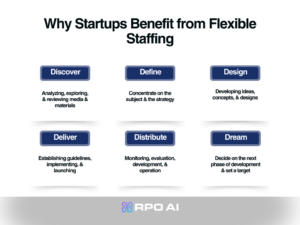
Why Startups Benefit from Flexible Staffing
Startups operate in an environment where priorities shift quickly. Product roadmaps change. Funding timelines move. Market conditions evolve. A rigid hiring structure does not support that level of uncertainty. Flexible staffing allows startups to align recruiting capacity with real business demand.
Here is why that flexibility creates a competitive advantage.
Faster Response to Growth Opportunities
When a startup closes a funding round or launches a new product, hiring demand can increase overnight. Flexible staffing makes it possible to activate recruiting support immediately instead of waiting to hire and onboard internal recruiters.
Speed in hiring directly impacts product delivery, customer acquisition, and revenue growth.
Lower Fixed Costs
Full-time recruiters add salary, benefits, and long-term financial commitment. For early-stage companies, fixed costs reduce runway. Flexible staffing converts those expenses into variable costs.
Startups pay for recruiting support only when hiring is active. When hiring slows, costs decrease accordingly.
Scalable Hiring Without Internal Expansion
Growth is rarely linear. Some months require aggressive hiring, while others require none. Flexible staffing allows startups to scale recruiting resources up or down without restructuring internal teams.
This prevents overstaffing during slow periods and under-resourcing during high-demand phases.
Access to Specialized Expertise
Startups often need niche technical roles, leadership hires, or market-specific talent. Flexible staffing models provide access to experienced recruiters with industry knowledge and established networks.
This improves candidate quality and reduces the risk of poor hiring decisions.
Reduced Operational Burden
Founders and small leadership teams already manage product development, operations, fundraising, and customer growth. Managing recruiting internally adds a significant workload.
Flexible staffing offloads sourcing, screening, scheduling, and candidate communication. Leadership can focus on scaling the business rather than managing hiring logistics.
Improved Hiring Efficiency
Structured recruiting processes, supported by data and modern technology, reduce time-to-fill and improve hiring outcomes. Many flexible staffing providers integrate AI tools that streamline sourcing and candidate matching.
Better efficiency means faster team building and stronger competitive positioning.
When Should Startups Use On-Demand Recruiting?
This model is most effective when:
* Scaling rapidly after investment
* Expanding into new markets
* Hiring for specialized technical roles
* Managing seasonal hiring fluctuations
* Testing new hiring strategies
It provides structured recruiting power without long-term risk.
On-Demand Recruiting vs Traditional Hiring
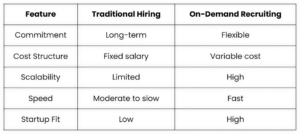
For startups, flexibility and speed are critical. On-demand recruiting addresses both.
How AI Improves On-Demand Recruiting
AI strengthens on-demand recruiting by increasing speed, accuracy, and scalability. It automates repetitive tasks while giving recruiters better data to make informed decisions.
Here are the key ways AI improves the process:
* Faster Candidate Sourcing- AI scans large databases and professional networks in seconds, identifying relevant candidates based on skills, experience, and role requirements.
* Smarter Candidate Matching- Advanced algorithms analyze more than keywords. They evaluate patterns in career progression and skill alignment to rank candidates by fit probability.
* Automated Resume Screening- AI filters applications quickly, removing unqualified profiles and reducing manual review time for recruiters.
* Data-Driven Shortlisting- Structured scoring systems ensure consistent evaluation criteria, improving screening accuracy and reducing subjectivity.
* Real-Time Hiring Analytics- AI dashboards provide visibility into pipeline health, response rates, and time-to-fill, allowing startups to adjust strategies quickly.
* Improved Candidate Engagement- Automated follow-ups, reminders, and status updates keep candidates informed, improving the overall hiring experience.
* Scalable Recruiting Operations- AI enables recruiting teams to handle larger hiring volumes without increasing headcount, making flexible staffing more efficient.
AI enhances recruiter productivity rather than replacing human judgment. In an on-demand recruiting model, this combination of automation and expertise delivers faster, more predictable hiring outcomes for startups.
Key Metrics to Measure Success
Startups should track:
* Time-to-fill
* Cost per hire
* Offer acceptance rate
* Quality of hire
*Hiring manager satisfaction
These indicators show whether the recruiting model supports growth objectives.
Final Thoughts
Startups need hiring models that match their pace of growth. On-demand recruiting provides that flexibility by allowing companies to scale recruiting efforts up or down based on real demand. It reduces fixed costs, shortens time-to-hire, and delivers access to experienced recruiters without long-term commitments.
When supported by AI-driven sourcing and analytics, the model becomes faster and more precise. Startups gain better visibility into hiring performance while maintaining operational focus.
For growing companies that value speed, efficiency, and control, on-demand recruiting offers a practical and scalable approach to building strong teams.
Frequently Asked Questions
1. What is on-demand recruiting?
On-demand recruiting is a flexible hiring model where startups access recruiting expertise as needed, without hiring full-time recruiters. It allows companies to scale hiring efforts in response to current business demand.
2. How is on-demand recruiting different from traditional RPO?
Traditional RPO often involves long-term contracts and broader outsourcing commitments. On-demand recruiting is more flexible, short-term, and scalable, making it better suited for startups with fluctuating hiring needs.
3. Is on-demand recruiting cost-effective for startups?
Yes. It converts fixed recruiting salaries into variable costs. Startups pay only for the recruiting support they use, helping preserve capital and extend financial runway.
4. How does AI support on-demand recruiting?
AI improves candidate sourcing, resume screening, and talent matching. It accelerates hiring timelines while providing data-driven insights that enhance decision-making and pipeline visibility.
5. When should a startup consider on-demand recruiting?
Startups should consider it during rapid growth, funding rounds, market expansion, or hiring spikes when internal recruiting capacity is limited or inconsistent.

Rameet Singh, Founder & CEO of RPO.AI