
 Log-In
Hiring is changing.
It’s not just job posts and applications anymore. It’s sourcing, screening, scheduling, and constant follow-ups.
And when hiring takes over, everything else slows down.
That’s why companies are choosing outsourced hiring, bringing in external recruiters to handle part or all of the workload.
This guide covers the basics: what outsourced hiring is, how it’s different from in-house hiring, and when it makes sense to explore it.
What Is Outsourced Hiring?
Outsourced hiring is when a company partners with an external recruitment expert to manage some or all of its hiring work.
This usually includes:
– Sourcing candidates
– Screening resumes
– Scheduling interviews
– Managing follow-ups
– Coordinating offers
– Supporting onboarding
In simple terms, the outsourced hiring process helps companies move faster by taking care of the repetitive recruiting work while the internal team focuses on decisions.
In-House Vs Outsourced Hiring
Both models work; it depends on what your team needs right now.
Here’s a simple comparison:
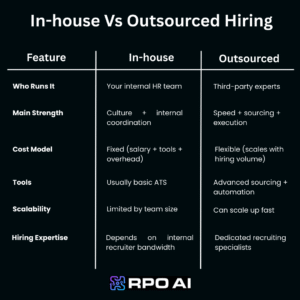
Also, have a read on the Five RPO Myths Debunked: With Real-World Lessons.
When Should Companies Look for Outsourced Hiring?
This is where things get practical.
Most companies don’t explore outsourced hiring because they want to outsource. They do it because hiring starts becoming hard to keep up with.
According to SHRM, the average cost-per-hire is around $4,683 (page 8), and it gets much higher when roles stay open longer than planned.
So, when does it make sense to explore outsourced hiring solutions for companies? Read further…
– Hiring demand is outgrowing your HR capacity: Open roles keep stacking up, recruiters are overloaded, and hiring quality starts slipping.
– Specialized roles aren’t closing: Niche roles (AI, tech, leadership, industry-specific roles) stay open because typical channels aren’t reaching the right talent.
– Recruitment costs keep climbing without better results: Spending rises across job ads, tools, recruiter time, and agency fees, yet time-to-hire and candidate quality don’t improve.
– Hiring cycles are too slow to compete: Delays in screening, scheduling, and decision-making lead to drop-offs and lost candidates.
– Hiring tasks are distracting teams from core work: HR and hiring managers spend too much time coordinating instead of focusing on performance, planning, and growth.
For teams facing these issues, outsourced hiring solutions for companies can help stabilize hiring without adding pressure on internal teams.
What to Look for While Choosing an Outsourced Hiring Company?
When you outsource hiring, you’re choosing a team that will represent your company to candidates. So it’s worth checking a few basics before you sign.
Here are the key things to check before choosing outsourced hiring services:
– Experience in your industry: Pick a partner who has hired for businesses like yours. They’ll understand your role needs, timelines, and the kind of candidates who actually fit.
– Quality of candidates (not just “speed”): Ask how they source talent and how they screen candidates. A good partner doesn’t just send resumes; they send relevant people.
– Clear hiring process: You should know what happens at each step: sourcing → screening → shortlist → interviews → offers. If the process feels unclear now, it won’t get clearer later.
– Communication style and working fit: How often will they update you? Who will you talk to? A great partner is responsive and keeps everyone aligned.
– Ability to scale up or down: Can they support you when you suddenly need 10 hires, and also adjust when hiring slows down?
– The tools and tech they use: Do they use strong sourcing tools, an ATS, reporting dashboards, or AI screening? Better tools usually mean faster and more consistent hiring.
– Data security and compliance: They’ll handle candidate data. Make sure they follow safe practices and can explain how they protect information.
– Cost vs value: Don’t choose the cheapest option. Choose the one that gives you the best outcome, strong hires, faster timelines, and less effort for your team.
Quick Questions To Ask Before You Decide
– Where do you source candidates from (beyond job boards)?
– What does your screening process look like?
– Have you hired for similar roles before?
– Who will work on our account day-to-day?
– What will you report weekly (and how)?
– How do you handle drop-offs or offer declines?
– How is candidate data stored and protected?
Benefits of Outsourced Hiring
So what improves once you outsource hiring? Below are the most common benefits companies get from outsourced hiring services.
1) Faster time-to-hire
A dedicated recruiting team runs sourcing, screening, and scheduling in parallel, so roles move forward without delays.
2) More predictable hiring costs
Instead of carrying fixed recruiting overhead (extra headcount, tools, ads), outsourced hiring lets costs scale with hiring volume, especially useful during spikes.
3) Broader access to candidates
Outsourced partners don’t rely only on applications. They actively source and reach passive candidates through networks and targeted outreach.
4) Easy scaling for hiring sprints
Need 1 hire this month and 15 next month? Outsourced hiring solutions for companies can ramp up capacity quickly, without permanently expanding your internal team.
5) Less admin load for HR and hiring managers
They handle the repetitive work, resume shortlisting, follow-ups, and interview coordination, so your team can focus on interviews and decisions.
If you’re still deciding, reviewing the pros and cons of outsourced hiring can help you choose the right model for your team.
RPO.ai: A Smarter Way to Handle Outsourced Hiring
RPO.ai fits well for teams that want extra hiring capacity with a clear process, real visibility, and less back-and-forth.
Support options include:
– End-to-end RPO support (for ongoing hiring)
– On-demand recruiting (for short-term hiring spikes)
– EOR and contingent workforce support (for global or flexible hiring needs)
To make it crisp, here’s a quick way to see how these outsourced hiring services fit different hiring needs:
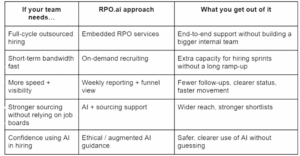
Need support with outsourced hiring?
Wrapping Up
You now have a clear idea of what outsourced hiring is and how it works. The next step is simple: choose based on what your team needs right now.
If hiring volume is increasing, roles are staying open too long, or your internal team is stretched thin, outsourced hiring solutions for companies can be a practical way to keep things moving without adding pressure.
Frequently Asked Questions (FAQs)
1. What costs should I expect with outsourced hiring?
Outsourced hiring typically involves service fees that are more predictable than internal HR costs. Different models include cost-per-hire, subscription, or project-based pricing depending on the provider.
2. Can outsourced hiring impact our company culture?
Yes, and that’s why it’s important to choose a partner who takes time to understand your culture and employer brand before sourcing candidates.
3. How quickly can an outsourced provider start delivering candidates?
For many businesses, initial candidate shortlists can be delivered in weeks rather than months, depending on role complexity and urgency.
4. Is outsourced hiring only for large companies?
Not at all. Small and mid-sized companies, especially startups, benefit greatly when they need hiring expertise without building internal capacity.
5. Does outsourced hiring work for global recruiting?
Yes, many outsourced partners have global reach, helping companies hire talent across regions and navigate local compliance and regulations.

Rameet Singh, Founder & CEO of RPO.AI