How to Attract Qualified Candidates and Improve Hiring Quality

You post a role, applications flood in, and somehow you’re still not seeing the people you actually want to hire. The problem isn’t that great candidates don’t exist. The problem is the system around how you find and evaluate them.

According to recent data, 49% of job seekers turn down offers due to poor candidate experience, which means the problem isn’t just sourcing. It’s the system around it. This guide walks you through a full hiring loop: define what “qualified” means, write better job posts, source smarter, and measure results over time. Each step connects to the next, and that’s what makes it a system.

This guide walks you through a complete system for attracting and hiring qualified candidates: define success up front, optimize your job posts, build high-signal candidate-attraction strategies, source smarter, run structured interviews, and close the loop with quality-of-hire data.

Step 1: Define ‘Qualified’ Before You Post Anything

Most hiring problems aren’t sourcing problems. There are clarity problems. When teams skip defining what ‘qualified’ means before posting a role, every step downstream suffers: screening drags, interviewers disagree, and strong candidates drop off, frustrated.

81% of organizations now believe skill-based hiring will be the future of recruitment, which makes defining outcomes more important than listing credentials. Before you write a single job post, build a one-page success profile with three components:

  1. Three measurable 90-day outcomes: “In 90 days, this person will have shipped X, improved Y, and owned Z.”
  2. Five core competencies: Skills and observable behaviors, not vague traits.
  3. Three hard disqualifiers: Criteria that would lead you to confidently reject a candidate. If you can’t use a requirement to reject someone, move it to ‘nice-to-have’ or remove it entirely.

Turn Your Best Employees Into a Backwards Job Spec

Spend 15 minutes each with one top performer and one hiring manager. 

Ask: 

  • What do they consistently deliver?
  • How do they communicate?
  • What do they handle without hand-holding? 

Those patterns become your competency list and eliminate most of the subjectivity from later screening stages.

This single step does more for hiring quality than any sourcing tactic. When the definition of ‘qualified’ is shared across the team before interviews begin, decisions are faster, fairer, and more defensible.

Step 2: Job Description Optimization: Win or Lose the Funnel Here

Job description optimization is where most hiring quality is won or lost at the top of the funnel. Most job posts are written for compliance, not conversion. They list what candidates must have rather than what they’ll own and build.

Research from Universum Global shows that organizations with a well-defined Employee Value Proposition (EVP) attract 50% more qualified applicants. That starts with how the role is framed on the page.

Rewrite the top third of every job post to answer three questions: What will I own? Why does it matter? What does success look like in 6 to 12 months? Then structure the rest of the post like this:

Match the Title to Market Reality

Search your exact job title on LinkedIn Jobs. If the results don’t reflect your role’s actual scope, fix the title before publishing. A mismatched title filters out the right candidates before they ever read the description.

Lead With Constraints, Not Marketing Copy

Strong candidates want an honest scope. Add salary range, location expectations, time zone requirements, and on-site days in the first section. Include three ‘day-in-the-life’ bullets showing roughly how time is spent, for example: “40% stakeholder collaboration, 30% shipping, 30% analysis and iteration.” This context reduces wrong-fit applications before the first screening call.

For Smaller Brands: Be Specific About Opportunity

If your company doesn’t have strong name recognition, add a short ‘Why join us now?’ section. Something specific: “We’re pre-Series B, rebuilding X, and you’ll own Y from day one.” That honesty draws in the right candidates and sets realistic expectations before they even apply.

Well-optimized job descriptions do double duty as part of your broader employer branding strategy: they attract qualified applicants while filtering out those who genuinely aren’t a fit, saving everyone’s time.

Step 3: Audit Your Careers Page and Apply Flow

Your careers page is a core piece of your candidate attraction strategies and functions as a filter. If the application flow takes more than 10 minutes on mobile or asks for a full work history upfront, you’re losing qualified candidates before they ever submit. Audit your application flow on a phone right now.

Remove Low-Signal Fields, Add High-Signal Questions

Remove fields like home address and full employment history. Replace them with two targeted questions that predict success in the role:

“Describe a time you owned a process end-to-end. What was the outcome?”

“What does a productive first 90 days look like to you?”

This reduces form friction while adding a genuine signal. Two smart questions outperform a 40-field form every time.

Step 4: Build a Sourcing System Around Channel Quality

Effective talent attraction strategies are built around channel quality, not channel volume. The right metric isn’t how many applications a channel generates. It’s the pass-through rate: how many of those applicants become candidates worth interviewing.

Track three numbers per channel: applicants, candidates interviewed, and offers accepted. That gives you a qualified-interview rate by source, the only metric that tells you whether a channel produces real candidates or just noise. 

Sourcing ChannelApplicant VolumeInterview Pass-ThroughHire RateBest For
Employee ReferralsLow–MediumHighHighAll roles
Niche CommunitiesLowHighMediumSpecialized roles
LinkedIn JobsHighMediumMediumMid-senior roles
General Job BoardsVery HighLowLowHigh-volume roles
Silver MedalistsLowVery HighHighAll roles

Referrals: Your Highest-ROI Passive Candidate Sourcing Channel

Passive candidate sourcing through referrals consistently outperforms paid boards, but only when you ask with a profile, not a link.  Instead of simply asking people to share a job link, describe the type of candidate you need.

For example, ask: “Do you know someone who has built X in a company with Y constraints?”

This makes it easier for people to think of the right names and helps pre-qualify referrals before you even review a resume.

Before spending on new job board listings, send a five-line update to past finalists (silver medalists). These are candidates who nearly got the role; their pass-through rate will be significantly higher than any cold channel.

Niche Communities and Outreach

Turn one recruiter into a real community participant in a relevant Slack group, Discord, or professional forum. Post roles with context rather than cold listings. 

Then, for direct outreach, keep messages between 120 and 180 words: 

  • Reference a specific piece of the candidate’s work in two lines.
  • Explain the role challenge in one sentence.
  • Share why the timing is relevant now.
  • End with a low-commitment ask.

Include the salary range. Add a clear, easy out: ‘If this isn’t the right fit, a quick no works great.’ That line increases reply rates because it signals respect for the candidate’s time.

Step 5: Improve Candidate Experience; It’s a Hiring Quality Issue

Research states that companies that focus on improving candidate experience report a 70% improvement in the quality of their hires. That makes process design a quality-of-hire issue, not just a branding concern.

After the first screen, send a process email outlining every step: who they’ll meet, what to prepare, what each stage is designed to evaluate, and a decision date. Candidates who understand the process stay engaged. Candidates who don’t drop off are often the strongest ones because they have the most options.

Give Candidates a Realistic Preview Early

Share a real spec or anonymized project brief before the second interview so that poor-fit candidates can opt out early. 

This saves the interviewer time and keeps the pipeline quality high. Set a 48-hour time-to-feedback target after each interview and track it. That discipline alone keeps strong candidates in your funnel while slower processes drive them away to competitors.

Speed Up Without Lowering the Bar

Every step in your process should do at least one of three things: filter clearly, reduce bias, or increase decision confidence. If a step does none of those, cut it. 

A clean interview plan runs: screen → skills or work sample (30–60 minutes max) → structured values and team interview → same-day debrief and decision. 

Batch interviews Tuesday through Thursday, debrief Friday, send offers the same day. Speed comes from removing ambiguity, not from skipping steps that matter.

See how Crexi hired 12 engineers in under three months using a customized sourcing and outreach strategy.

Step 6: Run Structured Interviews With a Real Scorecard

Research consistently shows that structured interviews are significantly more predictive of job performance than unstructured ones, and they substantially reduce unconscious bias in the process. When every candidate is asked the same core questions and scored against the same criteria, hiring decisions are based on data, not impression management.

Build a Scorecard That Actually Works

Design your interview scorecard with four to six competencies, clear 1-to-5 scoring definitions, and evidence required per score. 

Example categories: Execution, Collaboration, Problem Framing, Craft Quality, Ownership, Customer Thinking. 

Use the same core questions for every candidate in a role, then allow interviewers to probe deeper based on individual answers.

Instead of evaluating “culture add” as a vague impression, define it through specific behaviors such as using data to challenge ideas, documenting decisions, asking thoughtful questions, and improving team thinking. Vague culture assessments introduce bias. Observable behaviors create defensible decisions.

Anonymize portfolios and writing samples before early review. This is where structured interviews and a rigorous scorecard do the most work in protecting hiring quality and in building a more diverse pipeline.

According to SHRM Labs, 48% of HR managers admit that unconscious bias affects their hiring decisions. Structured scorecards are one of the most direct interventions for closing that gap.

For a deeper look at how AI tools support unbiased screening, see How AI Screening Helps Companies Achieve Unbiased Hiring.

Step 7: Build an Employer Branding Strategy That Reinforces Every Step

A strong employer branding strategy doesn’t start with LinkedIn posts or Glassdoor profiles. It starts with clarity: who you are, what you offer, and who specifically will thrive in your environment. The EVP you define internally shapes every external touchpoint. from job posts to offer letters.

For growing companies, an employer brand is built through specificity, not polish. Candidates remember ‘you’ll own the full data infrastructure before we hire your first report’ far longer than they remember a generic ‘collaborative culture’ claim. Make your job posts, your outreach messages, and your process emails all carry the same honest, specific signal.

Your employer brand is also reinforced by how you treat candidates who don’t get the job. A well-structured rejection—timely, respectful, with a brief note on what was strong, is free, and creates lasting goodwill. Past finalists who had a great experience become referral sources, future candidates, and, occasionally, customers.

For deeper guidance on building a recruitment process that scales with your employer brand, explore RPO AI’s talent solutions and on-demand recruiting options.

Step 8: Close the Loop and Measure Quality of Hire Every Month

Quality of hire is the metric that tells you whether your process is actually working. According to a 2025 LinkedIn survey, nearly 89% of talent acquisition professionals say it’s increasingly important to measure quality of hire, yet only 25% feel confident in their organization’s ability to do it well.

Track three numbers consistently:

  • 90-day manager satisfaction: Survey hiring managers at the 90-day mark on performance and fit.
  • Time to first productivity milestone: How quickly does the new hire reach the first defined success marker?
  • 12-month retention by role and hiring manager: Retention problems that correlate to a specific manager or role type signal a clarity problem, not a sourcing problem.

Normalize those into a score and review quarterly. A strong employer branding strategy and smart candidate attraction strategies only work when paired with this kind of outcome data, because brand signals on the wrong channels or for the wrong roles still waste budget.

Run a Retro Every Five Hires

Ask three questions per retro: What predicted success in this hire? What misled us? What should change in the job description or interview process? This closes the feedback loop and catches calibration drift early, before patterns become expensive habits.

On the sourcing side, pause any channel with a low interview pass-through and zero hires in 90 days. Keep only the channels that produce interviewed candidates at a pass-through rate worth the cost.

What Good Hiring Quality Actually Looks Like in Practice

Define ‘qualified’ before you post anything, and everything downstream gets cleaner: better applicants, faster screening, more confident decisions. Use job description optimization, honest sourcing channel data, and structured interviews with a real scorecard to remove guesswork at every stage.

Layer in an employer branding strategy that’s built on specificity rather than polish, run your passive candidate sourcing through referrals and silver medalists before buying new listings, and measure quality of hire monthly so your process improves instead of just repeating.

Pick one open role today. Rewrite the top third of the job post for outcomes. Add two high-signal application questions. Set a 21-day decision target. Then repeat. That’s how ‘attracting qualified candidates’ stops being a hope and starts being a measurable, repeatable result.

Frequently Asked Questions

What Are The 4 R’s For Recruitment?

The 4 R’s of recruitment are right person, right role, right time, and right cost. They help employers hire candidates who fit the job, company needs, hiring timeline, and budget.

What Are The Candidate’s Strongest Qualities?

A candidate’s strongest qualities usually include relevant skills, adaptability, communication, reliability, problem-solving ability, and cultural fit. Strong candidates show both technical capability and the attitude needed to succeed in the role.

What Is One Method To Attract Candidates?

One effective method to attract candidates is writing a clear, compelling job description that highlights responsibilities, benefits, growth opportunities, salary range, and company culture.

What Are The 7 Stages Of Recruitment?

The 7 stages of recruitment are planning, job analysis, sourcing, screening, interviewing, selecting, and onboarding. These steps help employers move from identifying a hiring need to successfully integrating the new employee.

How Can You Reduce Bias and Discrimination at the Application Stage?

Reduce bias by using standardized application forms, blind screening, inclusive job language, structured scoring criteria, and diverse hiring panels. These methods help candidates get evaluated on skills and experience, not personal characteristics.

RPO Vs Staffing Agencies: What We Observed?

You’ve posted the job, screened 200 resumes, made three offers, and you’re still short-staffed. Sound familiar? The confusion between RPO and staffing agencies runs deeper than most comparison articles admit. Both look like recruitment solutions on the surface, but they operate on completely different logic. 

We’ve seen both models play out in real hiring situations, and the differences are far more significant than most vendor pitches suggest. The real impact shows up in execution, consistency, and long-term hiring outcomes. Let’s break down what we observed side by side, clearly and without fluff.

What Nobody Tells You About RPO Vs Staffing

Most comparison articles frame RPO vs staffing as a simple either/or choice, but the reality is messier and more nuanced. The right answer depends on where your business actually is right now, not where you want it to be. That framing shift matters enormously.

Post-pandemic hiring volatility and the rise of hybrid workforces have permanently changed how both models perform. What worked in 2019 doesn’t automatically translate today. According to the World Economic Forum’s The Future of Jobs Report 2025, nearly 60% of the world’s workforce will need training by 2030, which means the talent challenge ahead is only getting more complicated, not less.

We’ll walk through the key dimensions where these two models diverge, so you walk away with a concrete sense of which direction fits your situation. Let’s start with the fundamentals and build from there.

What Each Model Actually Does and Who Owns the Outcome

The real difference between  RPO agencies and traditional firms isn’t in the brochure. It’s about who picks up the phone when a hire goes sideways. Understanding what each model does at the operational level is the only way to make a defensible call. Whether you’re evaluating a staffing RPO agency arrangement for the first time or renegotiating existing contracts, the ownership question is where the comparison starts.

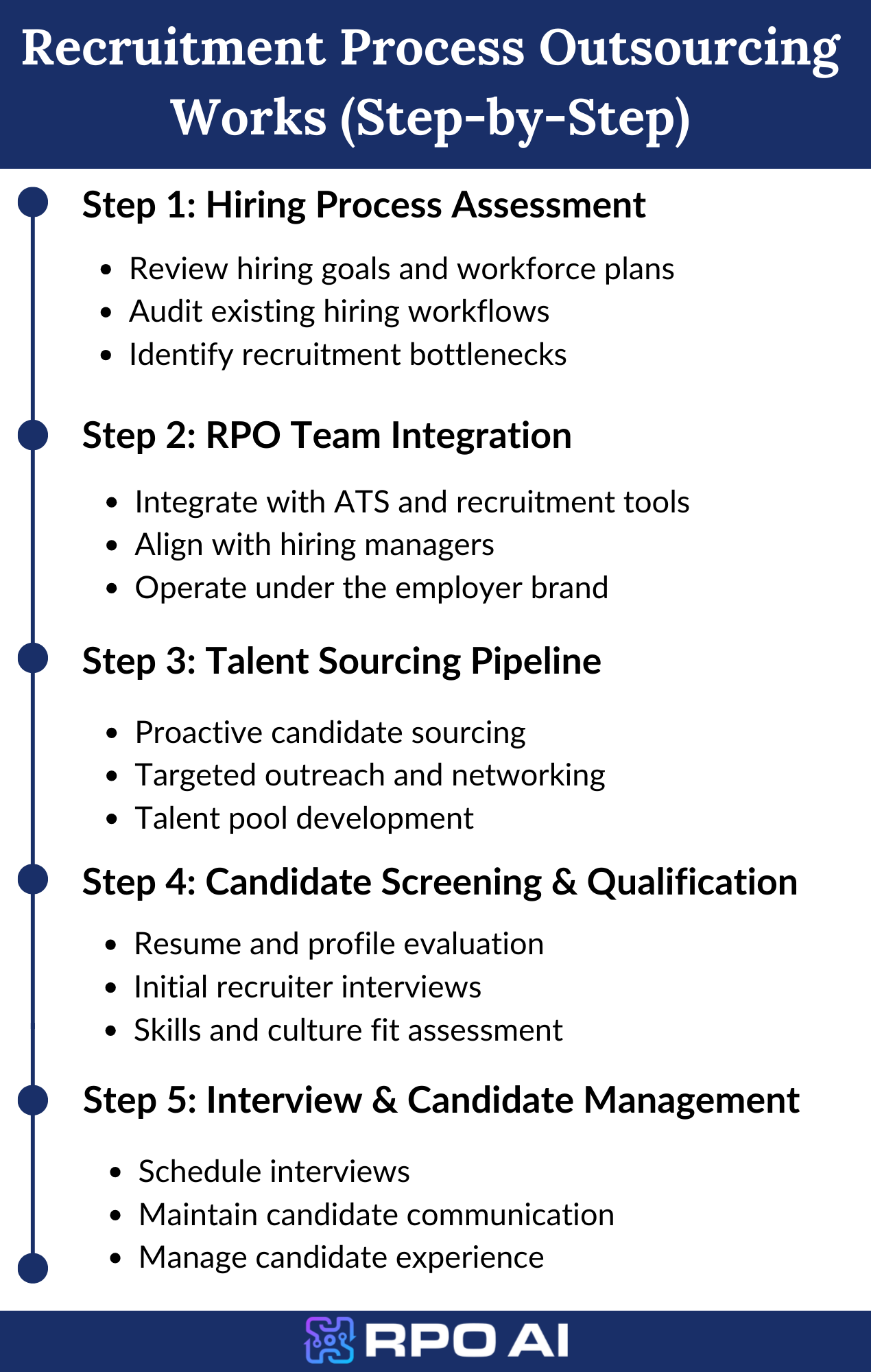
RPO in Practice

An RPO provider embeds into your internal team, using your ATS, your job descriptions, and your employer brand. Dedicated recruiters learn your culture over time and own end-to-end pipeline management, from sourcing through offer management and onboarding. The key distinction is ownership. An RPO provider takes accountability for outcomes, not just placements.

Staffing Agencies in Practice

A staffing agency operates from its own candidate database and network. You send a requisition, they send candidates. For temp roles, the worker often stays on the agency’s payroll service, which shifts employer-of-record liability. It’s a transactional model built for speed and reaction, not deep process integration with your team.

DimensionRPOStaffing Agency
OwnershipEnd-to-end processIndividual placement
IntegrationEmbeds in your systemsOperates independently
Candidate poolActive and passive sourcingPrimarily active seekers
PricingPer-hire or management feeMarkup or contingency
ReportingFull funnel dashboardsLimited or none
Best forOngoing volume hiringUrgent or temp needs

Speed matters, but only if you can afford to keep paying for it.

Speed, Cost, and Quality: Where Each Model Actually Wins

This is where the financial consequences become real. The tradeoffs between models are consistently oversimplified in most content we’ve reviewed, so let’s get specific about where each one actually delivers.

When Staffing Agencies Win

Agencies maintain pre-screened talent pools ready to move within 24 to 72 hours. If a fulfillment company needs 40 warehouse workers before Q4 peak, that’s the right call. Agencies also excel for unexpected departures, project-based contracts, and seasonal spikes where urgency is purely tactical and speed genuinely outweighs everything else.

What We Observed: Companies that defaulted to agencies for speed ended up in a cycle of perpetual rehiring, which cost more over 12 months than an RPO engagement would have.

When RPO Wins

RPO builds talent pipelines before roles open, which means proactive sourcing rather than reactive scrambling. Deloitte research indicates RPO providers can reduce recruitment timelines by up to 30% compared to traditional methods. For roles that repeat across your organization, RPO’s institutional knowledge compounds into a real competitive advantage over time.

What We Observed: RPO-sourced hires consistently outperformed agency placements on 12-month retention metrics across tech and professional services roles we tracked.

The Numbers Nobody Shows You

The total cost picture tells a very different story than upfront fees alone. You also save on the cost of replacing a bad hire, which can range from one-half to two times their annual salary, according to Gallup. 

Agency placement fees typically run 15 to 25% of first-year salary, while RPO cost-per-hire at scale generally lands between $3,000 and $5,000. Companies crossing 100 or more annual hires consistently saved 20 to 30% within six months of switching to RPO, based on what we observed across multiple engagements. Cost and speed are only part of the picture. The control question is where most companies realize too late what they’ve surrendered.

Control Visibility and Technology

With a staffing agency, what happens between your job description and the candidate slate is largely a black box. Limited reporting, no ATS integration, and agency-branded candidate communications mean you’re hiring without real data. You get placements, but not insight into why some work and others don’t.

RPO changes that equation entirely. Full funnel visibility, real-time dashboards, source-of-hire tracking, DEI metrics, and offer acceptance rates all become accessible because the RPO provider runs inside your systems. 

According to Harvard Business Review, hiring teams often probe the same topics across multiple interviews instead of broadening skill assessments, putting employers at risk of hiring without fully vetting a candidate’s qualifications. RPOs’ structured interview frameworks directly address that pattern by enforcing evaluation breadth across the pipeline.

We consistently saw this: companies that had relied on agencies for years had no reliable data on their hiring funnel. Switching to RPO was like turning the lights on. The first 90 days surfaced bottlenecks they didn’t know existed. Data visibility changes the calculus, and so does knowing whether to commit to one model or combine both strategically.

The Hybrid Model and the Smarter Question to Ask

The highest-performing talent acquisition functions we’ve observed don’t frame this as a binary choice. They design a deliberate hybrid, and the split is intentional, not accidental. The real question isn’t which model is better. It’s which model fits which part of your hiring picture.

What a Well-Designed Hybrid Looks Like

RPO handles all permanent, strategic hires, especially roles that directly affect culture and long-term growth. Staffing agencies cover peak-season temps, project-based contracts, and niche specialist coverage. 

A manufacturing firm might use agencies for floor-level temp and temp-to-hire roles while using RPO to build its engineering and leadership pipelines. Companies that designed their hybrid intentionally, rather than arriving there by default, cut total hiring costs by 25% while keeping the flexibility to surge during peak periods.

What Makes Hybrids Fail

Hybrids break down when ownership boundaries aren’t documented before contracts are signed. The three failure modes we saw most consistently were RPO and agency scope overlapping without clear delineation, inconsistent SLAs creating misaligned incentives, and fragmented reporting where finance, HR, and procurement were each working from different numbers with no shared accountability structure.

With the model options clear, a few practical questions still come up consistently. Here’s how we’d answer them.

Making the Right Call on RPO Vs Staffing Agencies

RPO staffing agencies and traditional staffing firms aren’t competitors; they solve different problems at different stages of a company’s growth. If you need someone in the seat by Friday, use a staffing agency. If you need to break the cycle of constant refilling and fix the underlying process, choose RPO. If you need both, design a deliberate hybrid with clearly documented ownership before anyone signs anything.

The companies that treated this as a strategic infrastructure decision, not just a vendor selection, consistently got better outcomes than those who defaulted to whatever was fastest or cheapest in the short term. Pull your last 12 months of cost-per-hire, time-to-fill, and 12-month retention by hire source. That one exercise will clarify the right path faster than any comparison article can.

FAQs About RPO Vs Staffing Agencies

1. Can Small Businesses Realistically Use RPO

Yes. Small businesses can use project-based, on-demand, or selective RPO, even with just 20 to 30 annual hires. It helps reduce recruiting workload, speeds hiring, and works well when internal teams spend over 20% of their time on recruitment.

2. Does RPO Replace My Internal Hr Team

No. RPO supports your internal HR team instead of replacing it. Internal teams usually handle strategic and executive hiring, while RPO manages high-volume recruitment. This often improves HR satisfaction by freeing staff from repetitive hiring tasks and allowing more strategic work.

3. Are Staffing Agencies Better for Niche Roles

Sometimes. Specialized staffing agencies can outperform generalist RPO providers for niche roles needing rare certifications, especially in healthcare, legal, or IT. But for broad or high-volume hiring, RPO often delivers better long-term retention and more consistent results across growing teams.

9 Best Recruitment Workflow Automation Tools

You’ve got seventeen tabs open, three follow-up emails sitting in drafts, and a strong candidate who just accepted an offer elsewhere, partly because your scheduling took four days too long. That’s not bad luck; that’s a process problem. 

Recruiters spend 35% of their time just scheduling interviews, meaning nearly two full days each week vanish before a real conversation happens. This list covers the nine best recruitment workflow automation tools for 2026, what each actually does, and who they’re built for.

Stop Losing Great Candidates to a Broken Hiring Process – These Tools Fix That

Manual recruiting isn’t just slow; it’s expensive. According to SHRM, 80% of recruiters swear by automation for boosting their productivity, and the teams already using these tools aren’t switching back. When cost-per-hire climbs past $5,000 and top candidates accept competing offers because someone else moved faster, the problem is throughput, not talent.

Real recruitment workflow automation means tools that execute steps, not just surface recommendations for humans to act on later. There’s a meaningful gap between a platform that flags a follow-up and one that sends it automatically after a candidate completes a screen. 

The strongest stacks cover five stages: sourcing, screening, outreach, scheduling, and pipeline management. Most effective teams run two to three tools, not ten. 

A Flowlu forecast shows 80% of organizations will use intelligent automation, with recruiting among the fastest-moving areas. This list was built on automation depth, G2 ratings above 4.4, pricing transparency, integration quality, and genuine user outcomes, not feature count.

1. RPO AI, Best for Global Recruiting Support and Embedded Talent Solutions

RPO AI is positioned as an AI-powered recruiting and talent solutions platform for companies that need more than a basic hiring tool. Instead of focusing only on applicant tracking or sourcing automation, it combines recruiting technology with embedded talent services such as Recruitment Process Outsourcing, on-demand recruiting, executive search, contingent labor, and employer of record, plus payroll support. 

The platform’s pitch is straightforward: help businesses hire globally, reduce hiring complexity, and improve accountability through tailored recruiting support, AI-driven insights, weekly progress reports, and visual funnel metrics.

It appears best suited for companies that want a mix of software, recruiting execution, and operational support in one partner, especially teams hiring across regions or scaling quickly. The main watchout is that it reads more like a service-led solution than a lightweight self-serve recruiting tool, so teams looking for a simple plug-and-play SaaS platform may find it heavier than needed.

2. Greenhouse, Best for Structured Bias-Reducing Hiring Workflows

Greenhouse automates interview kits, scorecard management, stage-based workflow triggers, approval flows, offer workflows, and 500+ integrations. Its real value isn’t automation volume, it’s process consistency. That distinction matters more than it sounds. 

Teams that skip scorecard discipline don’t get a hiring system; they get an expensive job tracker. It’s best for scaling companies with 50 to 500 employees, where multiple hiring managers need standardized evaluation. 

Commit fully to structured scorecards before implementation, or the ROI conversation will disappoint you. Custom, quote-based pricing; G2 rating 4.4/5. The honest watch-out: Greenhouse has no robust top-of-funnel sourcing natively, so it pairs best alongside a dedicated sourcing tool.

If consistent evaluation is already handled and your next bottleneck is identifying passive candidates at scale, the following tool is purpose-built for that problem.

3. Workable, Best Fast-Setup ATS for Small Teams

Workable automates job distribution to 200+ boards, AI candidate screening, interview scheduling, pipeline stage triggers, and rejection emails. For teams hiring under 50 people per quarter, it covers more workflow stages than you’ll realistically use, making complexity a non-issue. 

It’s best for SMBs and early-stage startups that need to be hiring within days, not months. Watch the add-on creep carefully: video interviews and SMS texting are sold separately and can push your real monthly cost 40 to 60% above the base price, so calculate total cost before committing. 

Starts at $249/month with a 15-day free trial; G2 rating 4.5/5. The honest watch-out: outreach automation is email-only, with no LinkedIn or SMS sequencing without paid add-ons.

Workable solves the setup speed problem well, but if your core need is finding passive candidates who aren’t actively applying anywhere, the next tool addresses that gap directly.

4. Hireez, Best AI Sourcing Engine for Passive Candidates

hireEZ automates multi-platform candidate search across 800M+ profiles on 45+ sources, including GitHub and Stack Overflow, outreach sequences, reply routing, and fake resume detection. Its “EZ Agent” does autonomous sourcing, initiating and managing outreach without a recruiter triggering each step, which most reviews gloss over entirely. 

It’s best for technical recruiting teams and agencies filling hard-to-fill niche roles where passive candidates dominate. Outreach automation amplifies your messaging quality, so weak copy at scale produces weak results at scale; invest in your sequence templates before activating anything. 

Custom, quote-based pricing; G2 rating 4.6/5. The honest watch-out: hireEZ is a sourcing layer, not a full ATS, so you’ll still need a system of record alongside it.

hireEZ handles top-of-funnel sourcing with precision, but if your bigger bottleneck is the analytics layer, knowing *where* your funnel breaks while hiring is still happening, the next tool is built around exactly that.

5. Ashby, Best for Analytics-Driven Recruiting Teams

Ashby automates stage-based workflow triggers, configurable pipeline rules, AI interview summaries, real-time funnel analytics, and scheduling coordination in one platform. Its true differentiator is analytics depth: it surfaces bottlenecks while hiring is in progress, not in a quarterly review. 

Teams that treat recruiting as a measurable system get disproportionate value here. It’s best for high-velocity recruiting teams at growth-stage tech companies with a data-first culture. Map your default hiring workflow before touching any configuration, because Ashby’s flexibility becomes a distraction without a clearly defined starting process. 

Starts at approximately $400/month with custom enterprise pricing; G2 rating 4.7/5. The honest watch-out: non-technical users can find the configuration depth overwhelming, so verify your team’s comfort level before committing.

Ashby is an outstanding fit for ops-minded teams, but for organizations running high-volume frontline hiring where speed-to-screen is the primary bottleneck, a different approach is needed.

6. Paradox (Olivia), Best Conversational AI for Frontline Hiring

Paradox automates 24/7 SMS and chat-based candidate screening, instant interview scheduling, knockout question routing, candidate FAQ handling, and onboarding task coordination through its Olivia AI assistant. It doesn’t just screen faster; it changes the candidate experience channel entirely. 

Frontline candidates in retail, logistics, and healthcare often won’t complete a traditional application but will text back, and meeting them where they are is the real unlock. It’s best for employers hiring 100+ hourly or frontline roles per month. 

Use Olivia to qualify and route for complex roles, then hand off to a deeper screening tool rather than running the full process through chat alone. Custom enterprise pricing in the $25,000 to $100,000+/year range; G2 rating 4.7/5. The honest watch-out: Paradox has no sourcing capability whatsoever, so it only engages candidates who’ve already found you.

Paradox excels at high-volume engagement, but for smaller teams that need AI assistance without enterprise pricing commitments, the next tool offers a far more accessible entry point.

7. Manatal, Best Affordable Ai Ats for Startups

Manatal automates AI candidate scoring, social profile enrichment from LinkedIn and public sources, job distribution to 2,500+ channels, pipeline management, and automated notifications. Its social enrichment feature quietly does something most pricier tools charge extra for: it auto-builds candidate profiles from public data, reducing the time spent manually researching applicants before outreach. 

It’s best for small agencies, early-stage startups, and solo recruiters who need AI-assisted hiring without enterprise pricing. Research from Flowlu shows 69% of HR managers say automation in hiring saves meaningful time for other tasks, and Manatal is the most accessible tool on this list for capturing that benefit. 

Give the AI scoring model two to three weeks of real hiring data before judging its recommendations, because calibrated accuracy is noticeably stronger than out-of-the-box performance. 

Starts at $15/user/month with a 14-day free trial; G2 rating 4.8/5. The honest watch-out: outreach automation is email-only and lacks the multi-channel sequencing depth of dedicated tools.

Manatal handles individual recruiter productivity well, but teams at staffing agencies managing both candidate pipelines and client relationships simultaneously need something built for that dual-desk reality.

8. Goodtime, Best for Complex Interview Scheduling

GoodTime automates self-scheduling, automated rescheduling, panel interview coordination, time zone management, interviewer load balancing, and ATS sync across complex multi-round hiring processes.

Interview scheduling is the hidden time sink most recruiting teams dramatically underestimate, and GoodTime customers report eliminating 90% of scheduling tasks entirely. At five to eight hours of coordination per week per recruiter, that’s a full workday reclaimed without changing anything else in your stack. 

It’s best for companies running structured multi-round interviews with global panels and scheduling loops. Before putting GoodTime live, audit how consistently your interviewers block focus time and mark availability, because scheduling automation is only as reliable as your team’s calendar hygiene. 

Volume-based pricing; G2 rating is high among scheduling-specific tools. The honest watch-out: this is a point solution that solves scheduling brilliantly, but requires integration with your ATS and sourcing tools to complete the workflow.

GoodTime handles the scheduling layer with real depth, but agencies that need both candidate-side and client-side automation running from the same platform will find the final tool on this list most relevant.

9. Recruiterflow, Best for Agencies Running Ats and Crm Together

Recruiterflow automates end-to-end agency desk tasks through its AIRA suite: call summaries, automatic field updates, job-change alerts, multichannel outreach sequences, pipeline automation, and client relationship tracking. 

Most tools automate recruitment workflow; Recruiterflow embeds automation inside it. AIRA’s job-change alert agent notifies recruiters when candidates switch roles, turning a stale database into a live, actionable one without any manual effort. 

Recruitment workflow automation at this level is especially valuable for agencies where speed-to-submit directly affects revenue. BardWood, a UK recruitment firm, reduced time-to-hire by 50% after adopting Recruiterflow’s ATS, which illustrates the kind of compounding efficiency gains this combination delivers.

Block dedicated setup time and use the migration support fully; teams that rush onboarding don’t see efficiency gains for weeks. Starts at approximately $149/user/month; G2 rating 4.6/5. The honest watch-out: the feature depth designed for agencies can overwhelm in-house TA teams that only need candidate-side workflows.

Quick Comparison of All 9 Tools

ToolBest ForKey AutomationStarting PriceG2 Rating
GemEnterprise consolidationSourcing, outreach, rediscovery, analyticsCustom4.7/5
GreenhouseStructured hiring workflowsInterview kits, scorecards, and offer flowsCustom4.4/5
WorkableSmall teams, fast setupJob distribution, screening, and scheduling$249/mo4.5/5
hireEZPassive candidate sourcingAI sourcing, outreach sequences, routingCustom4.6/5
AshbyAnalytics-driven teamsStage triggers, AI summaries, dashboards~$400/mo4.7/5
Paradox (Olivia)High-volume frontline rolesSMS screening, scheduling, and FAQ routing~$25K+/yr4.7/5
ManatalStartups and small agenciesAI scoring, social enrichment, and distribution$15/user/mo4.8/5
GoodTimeComplex scheduling coordinationPanel coordination, load balancing, ATS syncVolume-basedHigh
RecruiterflowRecruiting agenciesAIRA agents, CRM, multichannel outreach~$149/user/mo4.6/5

Automate Recruitment Workflow in 2026 – The Bottomline

The right recruitment workflow automation tools don’t replace recruiters; they eliminate the administrative work that consumes most of their day so human judgment can focus on the 20% that actually moves hires forward. Map your current hiring funnel, find the single stage consuming the most recruiter hours, and revisit this list with that specific problem in mind. 

If budget is the constraint, start with a free trial from Workable or Manatal. If you’re consolidating a fragmented stack, Gem or Recruiterflow deserves serious evaluation. The teams winning the talent competition in 2026 aren’t the ones with the biggest budgets; they’re the ones who stopped doing by hand what software can do better.

FAQs on Recruitment Automation

1. What’s the difference between an ATS and a recruitment workflow automation tool?

An ATS is a system of record: it tracks applicants already in your pipeline. Recruitment workflow automation tools actively work, sourcing candidates, sending outreach, and scheduling interviews, often before anyone enters your ATS. If your current system requires a human to trigger every next step, you have a tracker, not an automation tool. Ask vendors directly: “What happens without a recruiter clicking anything?”

2. How many recruitment automation tools does a team actually need?

Most effective teams run two to three tools, not ten. The right number depends on where your funnel breaks, not how many features are available. Start with your biggest bottleneck, whether that’s sourcing, screening, or scheduling, solve that first, then add only when you hit the next constraint. More tools mean more integrations to maintain and more data silos to manage.

3. What should I ask during a vendor demo to spot fake automation?

Ask the vendor to walk you through what happens without a recruiter clicking anything, from candidate identification to an interview booked. Watch out for demos that show dashboards and AI recommendations but require human confirmation at every step. A strong follow-up question is: “How does your AI handle candidates we’ve already contacted?” Platforms without a full candidate context will either dodge this or answer vaguely.

Recruitment for Startups: Common Challenges and How to Solve Them

Hiring the right people is one of the most critical and difficult tasks for any startup. Unlike established companies, startups operate with limited resources, low brand visibility, and high growth pressure, making recruitment significantly more complex.

In fact, a majority of startups struggle to attract and retain top talent due to competition, budget constraints, and a lack of structured hiring processes.

This guide breaks down the most common recruitment challenges for startups and provides practical, actionable solutions to help you build a strong team faster.

Why Recruitment for Startups is More Challenging

Before diving into solutions, it’s important to understand the unique hiring environment startups operate in.

Challenge FactorWhy It Matters
Limited budgetCannot compete with large companies on salary
Low brand awarenessCandidates don’t recognize or trust the company
Urgent hiring needsPressure to hire quickly leads to mistakes
Lack of HR expertiseFounders often manage hiring without experience

These challenges make recruitment for startups a high-stakes process where every hire directly impacts growth.

6 Common Recruitment Challenges for Startups and How to Solve Them

1. Limited Budget and Resources

The Challenge: One of the biggest challenges for startups is competing with established companies on salary, benefits, and perks. Early-stage startups often operate with tight budgets, making it difficult to attract experienced professionals.

This directly impacts hiring for startups, especially for critical roles like engineering, product, and leadership.

How to Solve It

  • Offer equity or ESOPs to compensate for lower salaries
  • Highlight learning opportunities and career growth
  • Hire remote or contract talent to reduce costs
  • Focus on candidates motivated by impact rather than compensation

A strong value proposition can often outweigh salary limitations.

2. Lack of Brand Recognition

The Challenge: Unlike large organizations, startups often have little to no employer brand. Candidates are less likely to trust or apply to companies they’ve never heard of.

This makes recruitment for startups heavily dependent on outbound efforts rather than inbound applications.

How to Solve It

  • Build a consistent presence on LinkedIn and industry platforms
  • Share your founder story, mission, and vision
  • Create a clear and compelling careers page
  • Encourage employees to act as brand advocates

Candidates don’t just apply for jobs; they apply for companies they believe in.

3. Balancing Speed vs. Quality in Hiring

The Challenge: Startups need to hire quickly to keep up with growth. However, rushing the process often leads to poor hiring decisions, increasing turnover and long-term costs.

This is a critical issue in startup recruitment strategies, where speed often compromises quality.

How to Solve It

  • Define a structured hiring process before starting
  • Limit interviews to 3–4 focused stages
  • Use pre-defined evaluation criteria
  • Leverage AI recruitment tools to speed up screening

The goal is not just fast hiring, but efficient and accurate hiring.

4. Finding the Right Cultural Fit

The Challenge: Startups require employees who are adaptable, proactive, and aligned with the company’s vision. However, identifying candidates who fit this dynamic environment is difficult.

Many candidates may have the skills but lack the startup mindset.

How to Solve It

  • Clearly define your company culture and expectations
  • Ask behavioral questions focused on:
    • Adaptability
    • Ownership
    • Problem-solving
  • Use real-world tasks or case studies in interviews
  • Prioritize mindset over perfect resumes

In recruitment for startups, attitude and adaptability often matter more than experience.

5. Limited Recruitment Infrastructure

The Challenge: Many startups don’t have dedicated HR teams or structured hiring systems. Recruitment is often handled manually by founders, leading to inefficiencies and inconsistencies.

This makes hiring for a startup a major challenge in the early stages.

How to Solve It

  • Implement a simple Applicant Tracking System (ATS)
  • Standardize interview processes and feedback
  • Use automation tools for sourcing and screening
  • Consider external recruitment partners (RPO)

Even a basic system can significantly improve hiring outcomes.

6. High Attrition Rates

The Challenge: Startups often face higher employee turnover due to:

  • High-pressure environments
  • Uncertainty and risk
  • Better offers from established companies

This creates a continuous hiring cycle, increasing pressure on startup recruitment strategies.

How to Solve It

  • Set clear expectations during hiring
  • Offer growth plans and learning opportunities
  • Build a strong work culture and communication system
  • Conduct regular feedback and engagement check-ins

Retention starts with hiring the right people and setting the right expectations.

Recruitment Strategies for Startups

To succeed, startups need to go beyond fixing problems; they need a repeatable hiring strategy.

Key Strategies:

  • Build a strong Employer Value Proposition (EVP)
  • Focus on culture fit and adaptability
  • Use AI-driven recruitment tools
  • Prioritize candidate experience
  • Create a scalable hiring system

Startups that adopt structured strategies are more likely to attract and retain high-quality talent.

How AI Is Transforming Startup Recruitment

Hiring is one of the biggest challenges early-stage startups face. Without a dedicated HR team, it’s easy to lose top candidates to larger, slower-moving competitors. AI is changing that equation.

Common Hiring ProblemsWhat AI Solves
Resume overload
Hundreds of applications, limited bandwidth to review them
Automated screening
AI filters by skill and fit in seconds
Slow shortlisting
Manual review delays decisions by days or weeks
Faster pipelines
Top candidates surface instantly for review
Poor role matching
Gut-feel hiring leads to high turnover
Data-driven recommendations
Match candidates to roles using objective signals

When to Consider Recruitment Outsourcing (RPO)

Hiring at scale
Multiple open roles at once
No internal expertise
Limited HR or talent experience in-house
Hiring blocks growth
Vacancies are slowing the business down

Ready to streamline your hiring?

If any of the above sounds familiar, AI-powered RPO solutions like RPO.ai can help you scale recruitment and tap into global talent without building a full internal function.

Hire Now

Wrapping Up

Recruitment for startups will always carry pressure that established companies don’t face. Tighter budgets, faster timelines, less brand recognition, and more at stake with every single hire.

But the startups that build exceptional teams aren’t the ones with the most resources. They’re the ones with the clearest process, the most honest employer brand, and the wisdom to know when to bring in the right help.

RPO.ai exists for exactly this. With 20+ years of recruiting expertise, 1,000+ roles filled, and solutions built for every stage from seed to scale, we’re the talent partner that grows alongside you.

Startup Recruitment Questions, Answered

1. What are the biggest recruitment challenges for startups?

The biggest startup hiring challenges include limited budgets, weak employer branding, slow hiring processes, a lack of recruitment expertise, and difficulty attracting qualified candidates in a competitive talent market.

2. How can startups compete with large companies for top talent?

Startups can compete by offering strong growth opportunities, meaningful work, equity, faster career progression, and a clear mission that appeals to candidates who value impact over stability.

3. When should a startup outsource its recruiting?

A startup should outsource recruiting when hiring takes too much founder time, critical roles stay open too long, or rapid growth creates hiring demands beyond internal capacity.

4. What is RPO, and how does it help startups?

RPO, or Recruitment Process Outsourcing, helps startups by providing hiring expertise, sourcing support, and scalable recruitment processes without building a full in-house talent acquisition team. Learn more about RPO.ai’s startup-focused RPO services.

5. How much does startup recruiting cost?

Startup recruiting costs vary by hiring model, role type, and volume. Agency hiring is often expensive, while RPO can offer more cost-effective and scalable support for growing teams.

The Complete Candidate Screening Process: From Resume to Shortlist

Does the candidate screening process actually improve hiring outcomes, or does it slow teams down with unnecessary steps? In most organizations, screening is designed to identify qualified candidates efficiently by filtering out mismatches early and focusing on role-specific criteria. However, with rising application volumes and evolving hiring technologies, many teams struggle to balance speed with accuracy.

Understanding how the candidate screening process works, from resume review to final shortlist, is essential as companies move toward data-driven, skills-based hiring models that prioritize both efficiency and quality.

AI-Powered Recruitment for Faster Hiring

Find qualified candidates faster with intelligent sourcing and automated screening.

Start Hiring Now

Key Summary

  • Candidate screening helps filter unqualified applicants early and improves hiring efficiency.
  • The process includes resume review, knockout questions, phone/video screening, skills tests, work samples, and background checks.
  • AI tools can speed up screening, but human review is still important.
  • Structured scorecards, clear criteria, and faster communication help create better shortlists.

What Is Candidate Screening and Why Does It Matter

Candidate screening is the process of evaluating applicants early in the hiring funnel to determine if they meet the essential requirements of a role. It filters out unqualified candidates before deeper evaluation begins.

A structured screening process directly impacts hiring outcomes in three ways:

  • Reduces hiring risk: A bad hire can cost up to 30% of the employee’s annual salary. Screening minimizes this risk by validating qualifications early.
  • Improves efficiency: Instead of interviewing large volumes, recruiters focus only on the top 5 to 10 candidates.
  • Enhances quality of hire: Data-driven screening identifies candidates who are more likely to perform well and stay longer.

Without proper screening, hiring becomes reactive and inconsistent.

The Complete Candidate Screening Process: Step-by-Step

1. Resume and Application Review

This is the first layer of evaluation. Recruiters assess whether a candidate meets baseline qualifications.

Key elements reviewed include:

  • Relevant experience and job roles
  • Required skills and certifications
  • Education and industry background

Most companies use Applicant Tracking Systems (ATS) to automate this stage. These systems scan resumes for keywords that match the job description.

Common issues at this stage:

  • Keyword manipulation without real expertise
  • Generic resumes with no measurable outcomes
  • Misalignment between role requirements and experience

The goal is simple: eliminate clearly unqualified candidates quickly.

2. Screening Questions (Knockout Filters)

Screening questions are used to disqualify candidates who do not meet non-negotiable criteria.

Typical examples include:

  • Work authorization status
  • Minimum years of experience
  • Willingness to relocate or work specific hours

These questions act as an early filter, reducing manual effort and narrowing the applicant pool before recruiter review.

3. Initial Phone or Video Screening

This is usually a 15 to 30-minute conversation designed to validate key details.

Recruiters focus on:

  • Verifying resume accuracy
  • Assessing communication skills
  • Understanding motivation and career intent
  • Confirming salary expectations and availability

This stage ensures candidates are both qualified and genuinely interested.

4. Skills and Aptitude Assessments

Resumes do not prove capability. Assessments provide objective evidence.

Common formats include:

  • Technical tests for role-specific skills
  • Cognitive or aptitude tests
  • Situational judgment scenarios

These assessments are strong predictors of job performance and reduce reliance on subjective judgment.

5. Work Samples or Case Studies

For specialized roles, candidates may be asked to complete practical assignments.

Examples include:

  • Coding challenges for developers
  • Writing tasks for content roles
  • Business case studies for strategy positions

This stage evaluates how candidates approach real-world problems, not just theoretical knowledge.

6. Background and Reference Checks

This is the final validation layer before shortlisting or offer decisions.

It includes:

  • Employment verification
  • Educational credentials
  • Professional references

This step reduces risk by confirming that candidate claims are accurate.

From Resume to Shortlist: How Candidates Are Narrowed Down

1. Automated Filtering (First Cut)

Before a recruiter reviews applications, many resumes pass through an ATS or screening system.

This stage checks for:

Screening FactorWhat It Looks For
Keyword matchSkills, tools, job titles, certifications
Knockout questionsWork authorization, location, and required experience
Basic eligibilityMinimum qualifications for the role

Result: A large number of unqualified or mismatched applications are removed early.

2. Manual Resume Review (Fast Scan)

Recruiters spend only a few seconds on an initial scan.

What stands out:

  • Clear achievements with measurable results
  • Structured, easy-to-read formatting
  • Relevant and focused experience

Red flags include vague descriptions, inconsistent timelines, and poor presentation.

3. Longlisting Candidates

Candidates who pass the initial resume review are moved into a longlist. This is a broader group of applicants who appear qualified and potentially suitable for the role.

Recruiters may compare these candidates against a scorecard, review how closely they match essential and preferred criteria, and sometimes conduct short screening calls. These calls help confirm interest, communication style, salary expectations, availability, and overall fit.

The longlist is not the final selection. It is the pool of candidates who are strong enough to be considered seriously.

4. Final Shortlisting

The final shortlist is created by narrowing the longlist into a smaller group, usually around three to ten candidates. Recruiters and hiring managers work together to compare the strongest profiles and decide who should move into formal interviews.

At this stage, the focus is on role alignment, quality of experience, skills match, and overall suitability. Some companies may also use skill assessments, portfolio reviews, or additional validation before confirming the shortlist.

The outcome is a refined group of candidates who are ready for in-depth interviews.

Modern Candidate Screening Techniques

Modern candidate screening has moved beyond simply reading resumes and deciding who looks relevant. Hiring teams now use a mix of technology, structured evaluation, and digital context to identify stronger candidates faster, especially when applicant volume is high.

AI-Powered Screening Tools

AI-powered tools are often used at the earliest stage of screening, where recruiters need to process a large number of applications quickly. These tools can extract information from resumes, compare candidate profiles against job requirements, score applicants based on predefined criteria, and support initial chat or voice-based screening.

The real value of AI in screening is not that it makes hiring decisions on its own. Its value is that it helps recruiters organize large applicant pools, identify likely matches faster, and apply screening criteria more consistently. Human review is still important, especially for judging context, career progression, transferable skills, and overall role fit.

Asynchronous Video Interviews

Asynchronous video interviews allow candidates to record answers to predefined questions instead of attending a live first-round call. This is especially useful for high-volume hiring, where scheduling dozens or hundreds of screening calls can slow the process down.

Because every candidate responds to the same questions, recruiters can compare answers more consistently. It also gives hiring teams a better sense of communication style, confidence, and motivation before investing time in live interviews. However, these interviews work best when the questions are relevant, the format is simple, and candidates are not judged on presentation quality alone.

Social and Digital Profile Screening

Recruiters may also review a candidate’s professional presence online to better understand their experience and credibility. This usually includes LinkedIn profiles, portfolios, GitHub repositories, published work, case studies, certifications, or other public professional activity.

This step adds context that a resume alone may not provide. For example, a portfolio can show the quality of someone’s work, a LinkedIn profile can support career history, and public projects can demonstrate practical skills. The goal is not to judge candidates casually based on their online presence, but to validate professional claims and understand the candidate’s work more fully.

Common Candidate Screening Methods

MethodPurpose
Resume ScreeningVerify minimum qualifications
Phone/Video ScreeningAssess communication and intent
Skills AssessmentValidate technical capability
Background ChecksConfirm accuracy of claims
Psychometric TestsEvaluate personality and cognitive traits

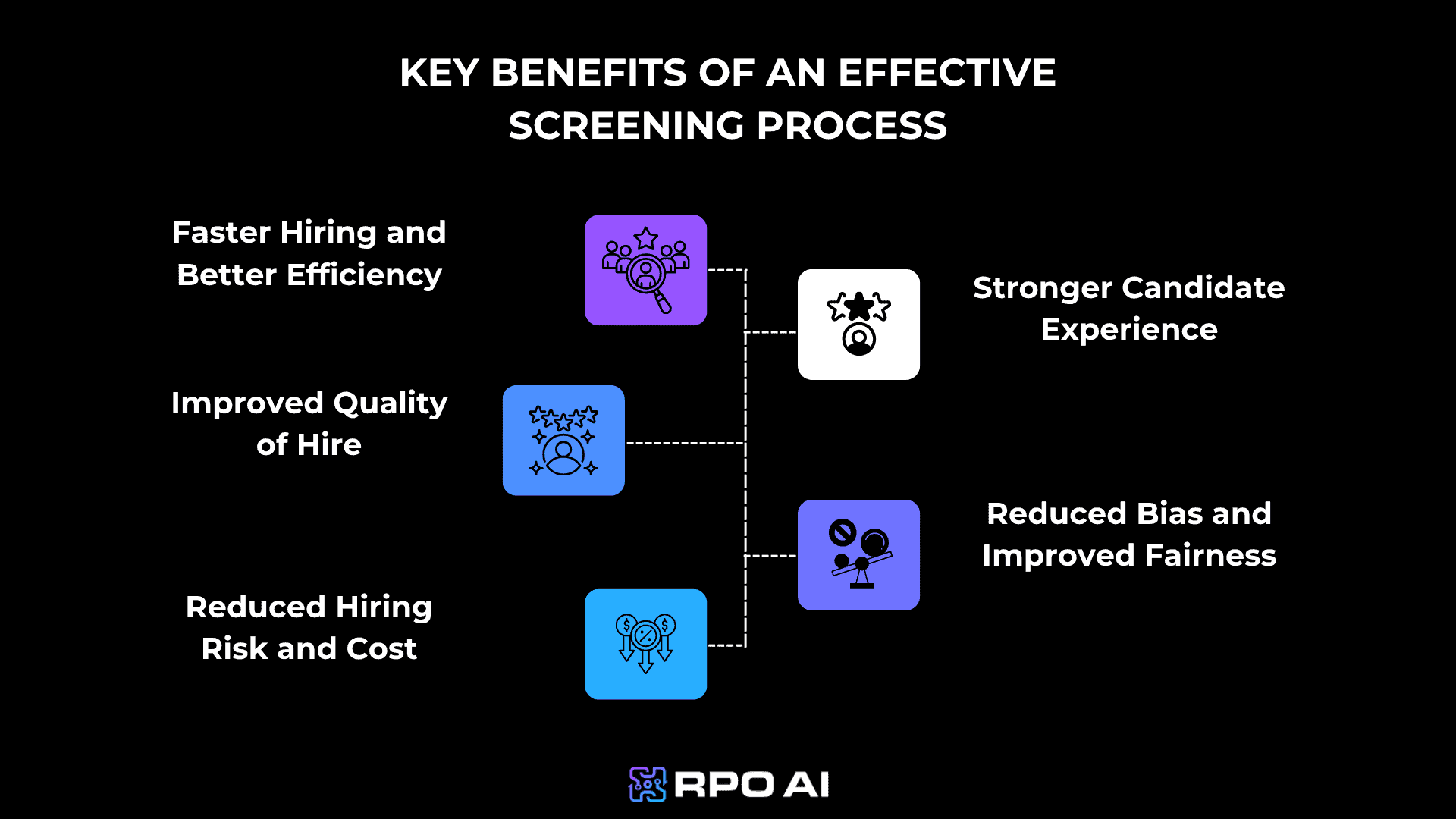
Key Benefits of an Effective Screening Process

Challenges in the Candidate Screening Process

1. High Application Volume

Recruiters often deal with hundreds of applications per role, making it difficult to identify qualified candidates quickly. This leads to time pressure and reduced screening accuracy.

Solution:

  • Use ATS filters and knockout questions to eliminate irrelevant applications early
  • Implement AI-assisted resume screening to prioritize high-fit candidates
  • Define clear “must-have” criteria before screening begins

Example: Instead of manually reviewing 300 resumes, automated filters reduce the pool to 70 candidates who meet core requirements, allowing recruiters to focus on quality over quantity.

2. Candidate Ghosting and Drop-Off

Delays in screening and a lack of communication cause candidates to disengage. Many drop out if the process extends beyond two weeks.

Solution:

  • Set a defined screening timeline (ideally under 14 days)
  • Use automated updates to keep candidates informed
  • Schedule screening calls quickly after application review

Example: A company that schedules screening calls within 48 hours of shortlisting sees significantly lower drop-off compared to one that takes a week to respond.

3. AI and Automation Limitations

AI tools can introduce bias or over-reliance on keyword matching, which may overlook strong candidates with non-traditional backgrounds.

Solution:

  • Combine AI screening with human review
  • Regularly audit AI filters for bias and accuracy
  • Focus on skills-based assessments instead of keyword dependency

Example: A candidate switching industries may not match exact keywords, but performs well in a skills test. Human review ensures such candidates are not filtered out incorrectly.

4. Internal Process Bottlenecks

Lack of alignment between recruiters and hiring managers leads to delays, rejections, and repeated work.

Solution:

  • Define clear role requirements before screening begins
  • Use structured scorecards shared across teams
  • Limit approval layers to speed up decision-making

Example: If both the recruiter and the hiring manager agree on the top 5 evaluation criteria upfront, shortlisted candidates are less likely to be rejected later due to misalignment.

5. Fraud and Authenticity Risks

Candidates may misrepresent skills or use tools to manipulate interviews, making it harder to assess real capability.

Solution:

  • Use live problem-solving assessments instead of theoretical questions
  • Conduct identity verification during video interviews
  • Include role-specific practical tests

Example: Instead of relying on verbal answers, a live coding or task-based test reveals whether a candidate can perform independently without external assistance.

How to Optimize Your Candidate Screening Process

An effective screening process is not about adding more steps. It is about making each step clearer, faster, and more consistent. The goal is to reduce unnecessary effort while improving decision quality.

1. Separate Must-Haves from Nice-to-Haves

Screening becomes easier when everyone knows what truly matters.

Must-have criteria are the requirements a candidate needs to perform the role successfully. These may include core skills, required experience, certifications, work authorization, or specific technical knowledge.

Nice-to-have criteria are useful, but not essential. These may include experience with additional tools, exposure to a certain industry, or secondary skills that can be learned later.

This distinction prevents hiring teams from rejecting strong candidates simply because they do not match every preference on the job description.

2. Use One Evaluation Framework

Unstructured screening leads to inconsistent decisions. One recruiter may focus on experience, another may focus on communication, and a hiring manager may prioritize something else entirely.

A structured scorecard solves this by giving everyone the same evaluation framework. Candidates can be assessed across areas such as skills, experience, communication, motivation, and role fit.

This makes it easier to compare candidates fairly and reduces decision-making based on gut feeling alone.

3. Let AI Handle Volume, Not Judgment

AI tools can speed up early screening by parsing resumes, matching candidates to job requirements, ranking profiles, and identifying likely matches.

But AI should support the screening process, not control it.

Recruiters should still review context that automation may miss, such as career transitions, transferable skills, unusual experience paths, communication quality, and growth potential. Regular checks are also needed to make sure AI outputs are accurate and do not unfairly filter out promising candidates.

The best approach is to use AI for speed and humans for judgment.

4. Ask the Same Core Questions

Screening calls become more useful when candidates are asked the same core questions for the same role.

This does not mean every conversation has to feel scripted. It means each candidate should be evaluated against the same baseline.

Good screening questions usually focus on role-specific experience, problem-solving, motivation, availability, expectations, and communication. Vague questions lead to vague answers, so the questions should be specific enough to reveal whether the candidate can actually succeed in the role.

5. Move Quickly After Application

A slow screening process can cause strong candidates to lose interest or accept another offer.

Recruiters should review applications quickly, schedule screening calls without unnecessary delay, and communicate next steps clearly. Even a simple update can help keep candidates engaged.

Speed matters because screening is not just an internal evaluation step. It is also part of the candidate experience.

6. Align Before Screening Starts

Many screening problems happen because recruiters and hiring managers are not aligned from the beginning.

Before reviewing candidates, both sides should agree on what the role really requires, what a strong candidate looks like, which criteria matter most, and how candidates will be evaluated.

This avoids rejected shortlists, repeated sourcing, and unnecessary delays later in the process.

Conclusion

The effectiveness of a candidate screening process largely depends on how structured and consistent it is. Organizations that use standardized screening criteria, structured interviews, and skills-based assessments can evaluate candidates more accurately and reduce hiring errors. AI-powered recruitment platforms further improve this by automating sourcing, filtering, and initial evaluations.

Solutions like AI-driven hiring systems enable companies to identify qualified candidates faster while maintaining focus on measurable skills, role fit, and real performance.

To explore how we support growing teams

Talk to Us

FAQs on Candidate Screening Process

1. What is the purpose of candidate screening?

The purpose of candidate screening is to evaluate applicants early in the hiring process and filter out those who do not meet essential role requirements. This ensures only qualified candidates move forward, saving time and improving overall hiring efficiency.

2. How long should the screening process take?

The candidate screening process should ideally take between 7 and 14 days. This timeframe allows recruiters to evaluate candidates thoroughly while maintaining engagement, reducing the risk of drop-offs, and ensuring top talent is not lost to faster-moving competitors.

3. What tools are used in candidate screening?

Common tools used in candidate screening include Applicant Tracking Systems for resume filtering, AI-based screening tools for candidate matching, assessment platforms for skill evaluation, and video interview software for initial screening and communication.

Does DEI Help or Hurt Merit-Based Hiring Outcomes?

Do Diversity, Equity, and Inclusion (DEI) initiatives affect merit-based hiring? In most organizations, DEI is designed to improve how merit is identified by reducing bias in hiring processes and expanding access to qualified candidates.

However, debates continue about whether certain implementations shift attention away from individual qualifications. Understanding how DEI interacts with modern hiring systems is essential as companies move toward skills-based and competency-driven evaluation models.

AI-Powered Recruitment for Faster Hiring

Find qualified candidates faster with intelligent sourcing and automated screening.

Start Hiring Now

Key Summary

  • DEI can support merit-based hiring by reducing bias and widening candidate access.
  • Structured interviews, blind screening, and skills assessments help evaluate real ability.
  • DEI may weaken hiring if representation targets override competency standards.
  • The blog concludes that transparent, skills-based hiring systems help DEI and merit coexist.

What DEI Means in Modern Hiring Systems

In hiring, Diversity, Equity, and Inclusion (DEI) focuses on how organizations design recruitment and evaluation processes to ensure fair access to opportunities. Rather than changing hiring standards, DEI initiatives often aim to reduce bias in sourcing, screening, and interviewing candidates.

Many companies apply practices such as structured interviews, blind resume screening, and broader recruiting channels to ensure that hiring decisions focus on measurable skills, competencies, and job-related performance rather than background signals.

Core Components of DEI

DEI in hiring systems usually focuses on three operational principles:

  • Diversity: Representation of candidates from varied educational, professional, and demographic backgrounds.
  • Equity: Hiring processes designed to ensure candidates are evaluated under comparable conditions.
  • Inclusion: Workplace structures that allow employees to participate in decision-making and team collaboration.

These elements influence recruitment channels, evaluation methods, and how organizations structure candidate assessment.

How the Definition of Merit Is Changing in Hiring

In hiring research, the meaning of merit has gradually shifted from background indicators to measurable capability. By 2026, the concept is often described through two evaluation models.

Traditional Merit (Proxy Model)

This model relies on past signals believed to predict future performance.

Common indicators include:

  • Academic credentials such as degrees from selective universities
  • Employer pedigree, including roles at well-known companies
  • Years of experience within a specific industry
  • Perceived cultural fit, often assessed through interviews

These factors act as proxies rather than direct evidence of job performance.

Modern Merit (Evidence Model)

A newer approach prioritizes measurable ability and outcomes.

Key evaluation factors include:

  • Verified skills and competencies through assessments or simulations
  • Performance outcomes tied to measurable KPIs
  • Problem-solving ability and adaptability
  • Learning trajectory and growth potential

Hiring Infrastructure

Many systems now support merit evaluation through structured processes:

  • Standardized scoring rubrics
  • Blind resume screening
  • Job-related performance assessments

Comparison of Modern Hiring Models

Hiring ModelKey MethodCompanies Using ItStrengthsRisks
Traditional MeritCredentials, employer pedigree, years of experienceMany legacy corporate hiring systemsSimple benchmarking across candidatesMay overlook capable candidates without elite credentials
DEI-Informed HiringBias-aware screening, broader sourcing, structured interviewsLarge enterprises adopting inclusive hiring frameworksExpands candidate pools and reduces evaluation biasPerception concerns whether the hiring criteria are not transparent
Skills-Based HiringJob simulations, competency tests, portfolio evaluationIBM, Google, and many tech firmsDirect measurement of job-relevant abilityRequires well-designed and validated assessments

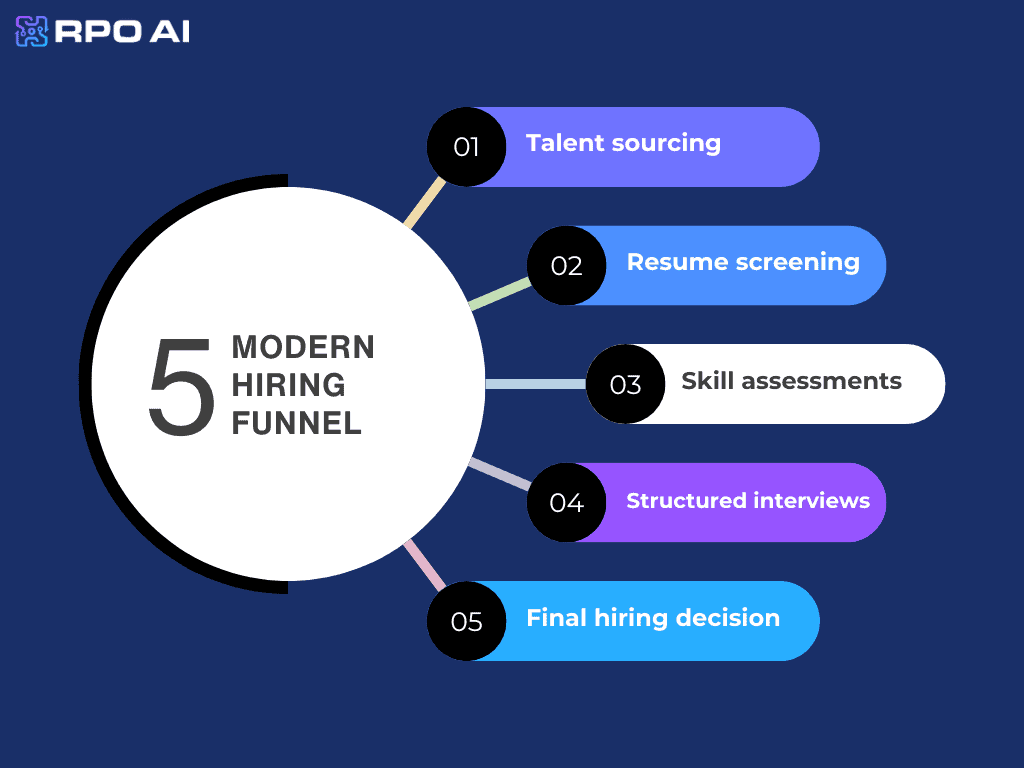
5 Modern Hiring Funnel

How DEI Can Support Merit-Based Hiring Outcomes

Supporters argue that DEI can strengthen merit-based hiring when it improves how candidates are sourced and evaluated. Many organizations use structured hiring methods to reduce bias and focus on measurable ability.

Key ways DEI supports merit-based hiring include:

  • Expanded sourcing pipelines: Companies recruit beyond traditional universities or networks, increasing access to qualified candidates who may otherwise be overlooked.
  • Bias-reduction screening methods: Practices such as blind resume screening remove identifiers like names or demographics so recruiters focus on experience and skills.
  • Structured evaluation metrics: Standardized interview rubrics, work simulations, and skills assessments allow hiring teams to compare candidates using consistent performance criteria.

Research in hiring behavior also shows that structured interviews and standardized scoring systems often produce more reliable hiring decisions than informal interviews.

How DEI May Affect Merit-Based Hiring Outcomes

Critics argue that certain DEI implementations can complicate merit-based evaluation when demographic goals begin to influence hiring decisions. The concern is not about diversity itself, but about how hiring frameworks are applied.

Common arguments include:

  • Target-driven hiring pressure: When organizations prioritize diversity metrics, some critics argue that hiring teams may feel pressure to meet representation targets during recruitment.
  • Perception of identity-based decisions: If employees believe hiring decisions are influenced by demographic factors, workplace trust and perceptions of fairness may be affected.
  • Concerns about evaluation standards: Some critics argue that reducing emphasis on traditional credentials or testing could weaken consistent skill assessment.

These critiques often emphasize the importance of maintaining transparent and competency-based hiring processes.

Research Findings on DEI and Hiring Performance

Several research organizations have studied how workforce diversity and inclusive hiring systems influence business outcomes and talent performance.

  • McKinsey & Company – Diversity Wins Report: McKinsey analyzed over 1,000 companies across multiple industries and found that organizations with higher ethnic diversity in leadership teams were 36% more likely to outperform competitors financially. The study linked diversity to broader decision-making perspectives and stronger innovation outcomes.
  • Harvard Business Review research: Studies published in Harvard Business Review show that diverse teams often examine problems from multiple viewpoints, which can improve decision quality in areas such as hiring, product development, and strategy.
  • MIT Sloan School of Management: Research from MIT Sloan indicates that organizations with inclusive workplace cultures tend to report higher employee engagement and retention, which directly affects long-term hiring success and workforce stability.

World Economic Forum workforce studies: Global workforce analyses suggest that companies expanding access to talent pools often increase innovation capacity and productivity by bringing in candidates with varied expertise and experiences.

Common Misconceptions About DEI in Hiring

Public discussions about DEI often include assumptions that do not reflect how most hiring systems actually operate. Clarifying these points helps separate policy debates from hiring mechanics.

  • DEI lowers hiring standards: Most organizations still rely on competency frameworks, skills testing, and structured interviews. DEI initiatives typically expand candidate sourcing rather than change performance criteria.
  • DEI requires hiring quotas: In many companies, DEI programs focus on widening recruiting pipelines and reducing bias in screening processes, not mandating fixed demographic hiring targets.
  • DEI replaces merit-based evaluation: Modern hiring models increasingly use standardized assessments and role-specific scoring systems to evaluate measurable skills.

DEI prioritizes identity over capability: In structured hiring systems, candidate capability, experience, and demonstrated performance remain central to final hiring decisions.

Examples of Merit-Based Hiring Systems Used Today

Many organizations apply structured hiring systems to evaluate candidates using measurable skills and consistent criteria rather than informal judgments.

  • Google structured interviews: Google uses standardized interview rubrics where candidates are evaluated against predefined competencies. Interviewers score responses using consistent criteria to reduce subjective bias.
  • Amazon leadership principle scoring: Amazon evaluates candidates using its leadership principles framework. Interviewers assess responses against behaviors such as ownership, problem-solving, and customer focus.
  • Skills-based hiring models: Many organizations now prioritize job-relevant skills through coding tests, simulations, or work samples instead of relying primarily on degrees or employer pedigree.

Blind resume screening systems: Some hiring platforms remove personal identifiers such as names or demographics during early screening to focus attention on qualifications and experience.

When DEI Strengthens Merit-Based Hiring

In practice, DEI tends to support merit-based hiring when it improves the hiring system rather than replacing it.

Examples include:

  • Structured interviews that score candidates against the same competency rubric
  • Blind resume screening that removes irrelevant identity signals
  • Expanded recruitment pipelines that increase access to qualified candidates

In these cases, DEI operates as a process correction tool, reducing noise in candidate evaluation.

When DEI Weakens Merit-Based Hiring

Hiring outcomes can become distorted when DEI goals shift from process design to representation targets.

Examples include:

  • Hiring quotas that override competency scoring
  • Informal pressure on recruiters to meet demographic metrics
  • Reduced emphasis on validated skill assessments

In these cases, the hiring system may move away from performance-based evaluation.

The Real Determinant: Hiring System Design

The impact of DEI on merit-based hiring depends less on ideology and more on how hiring systems are structured.

Organizations that rely on:

  • standardized assessments,
  • measurable performance indicators, and
  • transparent evaluation criteria.

They are more likely to identify high-performing candidates regardless of the label attached to their hiring philosophy.

The debate, therefore, centers less on whether DEI exists and more on whether hiring systems accurately measure capability.

Wrapping Up

The impact of DEI on merit-based hiring often depends on how structured the hiring process is. Organizations that use standardized interviews, competency frameworks, and skills-based assessments can evaluate candidates more accurately. AI-powered recruitment platforms make this process faster by automating sourcing and screening. 

Solutions like AI-driven hiring systems enable companies to identify qualified candidates efficiently while keeping the focus on measurable skills and real performance.

To explore how we support growing teams

Talk to Us

FAQs on Merit Based Hiring

  1. Does DEI reduce hiring standards?

Most organizations continue to use structured hiring criteria such as competency frameworks, role-specific assessments, and interview scoring systems. DEI initiatives generally focus on widening candidate sourcing and reducing bias in screening rather than changing performance standards.

  1. Can merit-based hiring and DEI coexist?

Yes. Many organizations combine broad talent sourcing with structured evaluation systems. This approach allows companies to expand access to candidates while still selecting hires based on demonstrated skills, experience, and performance indicators.

  1. What is skills-based hiring?

Skills-based hiring evaluates candidates using measurable abilities such as technical tests, work simulations, or portfolio reviews. Instead of relying mainly on academic credentials or employer history, hiring decisions are based on job-relevant competencies.

  1. Why are companies shifting to competency-based hiring?

Organizations increasingly prioritize competency-based hiring because it focuses on verified skills and measurable outcomes. This approach can improve hiring accuracy by aligning candidate capabilities with the actual requirements of a role.

  1. Where to place this section:

Add the FAQ section just before the conclusion of the article. This placement strengthens SEO by capturing People Also Ask queries while maintaining a logical flow from discussion → evidence → hiring systems → final summary.

How Does Recruitment Process Outsourcing Work? A Complete Guide

Looking to optimize your hiring process and make it move faster?

We’ve all been there: The extended hours, the never-ending swamp of LinkedIn DMs, and conducting dozens of interviews only for the perfect candidate to vanish at the last moment.

And the cycle starts: follow-ups, more reschedules, and that quiet little thud feeling when a strong candidate drops out again.

That’s why moving toward a recruitment process outsourcing model isn’t just a “fix”; it’s a strategic pivot. 

To give you a clear view of how recruitment process outsourcing works, let’s break down the mechanics of the recruitment process outsourcing services model.

Before we get into the details, it helps to see the difference at a glance.

A quick glimpse at how recruitment process outsourcing works compared to traditional hiring:

Hiring AspectTraditional HiringRecruitment Process Outsourcing (RPO)
Hiring StructureInternal HR teams handle recruiting, often supported by external agencies for urgent roles.A dedicated recruiting team operates as an embedded extension of your company’s hiring function.
Talent Sourcing ApproachMostly reactive: job postings, inbound applications, and agency submissions.Proactive sourcing using talent pipelines, targeted outreach, and continuous candidate discovery.
Process OwnershipHiring responsibility is spread across HR teams, hiring managers, and agencies.A centralized system where the RPO team manages and optimizes the entire recruiting workflow.
ScalabilityHiring capacity depends on internal team bandwidth and agency availability.Recruiting capacity can scale up or down based on hiring needs.
Cost StructureAgency placements often involve high one-time fees per hire and unpredictable costs.More predictable hiring investment aligned with recruiting scope and hiring volume.
Candidate PipelineOften built role-by-role, leading to inconsistent candidate flow.Continuous talent pipelines are built in advance for key roles and skill sets.
Hiring VisibilityLimited insight into funnel performance and sourcing effectiveness.Data-driven recruiting with visibility into pipeline health, conversion rates, and hiring metrics.
Employer Brand ExperienceCandidate communication may vary across recruiters or agencies.Consistent candidate experience aligned with your employer brand.

The Idea Behind the RPO Model

The idea behind the RPO model is simple: turn hiring from a reactive activity into a structured system.

Instead of rebuilding the recruiting process every time a role opens, an RPO setup creates a consistent workflow that keeps talent pipelines moving and hiring decisions faster.

This is why many organizations today consider outsourcing talent acquisition as a scalable hiring strategy.

At its core, the model is designed to solve three common hiring challenges.

The Three Problems RPO Typically Solves

  • Slow Hiring Cycles

When hiring starts from scratch each time, roles take longer to fill. RPO outsourcing focuses on building continuous talent pipelines so hiring moves faster.

  • Unpredictable Recruiting Costs

Agency-based hiring often comes with high placement fees. Recruitment outsourcing solutions shift hiring toward a more structured and predictable cost model.

  • Inconsistent Candidate Quality

When recruiting is fragmented across teams and vendors, candidate quality varies. Outsourced recruitment introduces standardized sourcing, screening, and evaluation processes.

Is your hiring process a bridge or a bottleneck?

If you’re feeling the “Scalability Rollercoaster” right now, let’s talk about building a more stable engine. 

[Get Started with Hiring]

How Recruitment Process Outsourcing Works (Step by Step)

Now let’s get practical.

Once a company works with an RPO partner, the focus shifts from filling roles to building a repeatable hiring process.

While setups vary by company, most RPO engagements follow a similar sequence of steps.

Recruitment Process Outsourcing Works (Step-by-Step)

Step 1: Hiring Process Assessment

The first step is understanding how hiring currently works inside the company.

Reviewing Hiring Goals

The RPO team works with leadership and hiring managers to understand upcoming hiring plans, role priorities, and growth targets.

Auditing the Existing Hiring Process

This includes reviewing job descriptions, sourcing channels, interview stages, and candidate pipelines to identify bottlenecks.

Identifying Hiring Gaps

At this stage, common issues such as slow screening, limited sourcing channels, or unclear interview workflows are mapped out.

The objective here is simple: understand what needs fixing before scaling the hiring process.

Step 2: Integrating the RPO Team With Your Hiring Setup

Once the assessment is complete, the RPO team integrates with the company’s existing hiring environment.

Working Within Your Tools

RPO teams typically plug into the company’s Applicant Tracking System (ATS), communication tools, and hiring workflows.

Aligning With Hiring Managers

Hiring managers and internal HR teams work closely with the RPO team to define role expectations, candidate profiles, and interview criteria.

Operating Under Your Employer Brand

Candidates interact with the RPO team as representatives of your company, ensuring a consistent employer brand experience through professional outsourcing recruitment services.

At this stage, the RPO team becomes an embedded extension of your recruiting function.

Step 3: Building the Talent Sourcing Pipeline

Instead of waiting for applications, the RPO team focuses on building a consistent pipeline of candidates.

Proactive Talent Sourcing

Recruiters actively search for candidates through professional networks, talent databases, and industry communities.

Targeted Outreach

Qualified candidates are approached directly through platforms such as LinkedIn, professional groups, and referrals.

Talent Pool Development

Over time, the RPO team builds a structured talent pool so future roles can be filled faster.

This approach ensures companies always have candidates moving through the pipeline, rather than starting from zero every time.

Step 4: Candidate Screening and Qualification

Once candidates enter the pipeline, the RPO team begins the evaluation process.

Resume and Profile Review

Candidates are screened based on role requirements, skills, and experience.

Initial Recruiter Conversations

Preliminary interviews help assess communication, interest in the role, and overall alignment.

Skills and Cultural Fit Checks

Candidates who move forward are evaluated for technical capabilities and alignment with the company’s work culture.

Only the most relevant candidates are forwarded to hiring managers, saving valuable time during the interview stage.

Step 5: Managing Interviews and Candidate Communication

Recruitment operations involve more than just finding candidates.

Interview Scheduling

The RPO team coordinates interview times between candidates and internal stakeholders.

Communication and Follow-Ups

Candidates receive timely updates, feedback, and next-step information.

Candidate Experience Management

Clear communication and structured interactions help maintain a positive employer brand throughout the hiring journey.

Step 6: Hiring Metrics and Process Optimization

One of the biggest advantages of recruitment process outsourcing is the use of hiring data to improve results.

Tracking Key Hiring Metrics

Important metrics such as time-to-fill, source effectiveness, and candidate conversion rates are monitored.

Identifying Hiring Bottlenecks

If interviews are delayed or candidate drop-offs occur, the RPO team identifies and addresses the problem quickly.

Continuous Process Improvements

Based on these insights, the hiring workflow is refined to make the process faster and more efficient over time.

Business Benefits of Recruitment Process Outsourcing

By this point, you’ve seen how the RPO model works structurally. But many leaders still ask a practical question: what changes for the business once this system is in place?

To answer that question, here are some of the most noticeable benefits of the recruitment process that outsourcing companies experience.

  • Scalability Without the Overhead

Hiring needs fluctuate. This RPO outsourcing allows you to scale your recruiting horsepower up during a growth spurt and dial it back down during a “steady state,” all without hiring or laying off internal HR staff.

  • Reduced Cost-per-Hire

By moving away from high-percentage agency placement fees (often 20-30% of salary) to a structured recruitment process outsourcing solution, companies typically see a significant reduction in total recruiting spend while gaining more predictable monthly costs.

  • Enhanced Candidate Experience (Which Protects Your Brand)

Candidates don’t just evaluate the job; they evaluate the process. Outsourced recruitment services improve communication, scheduling, and follow-through so candidates stay engaged.

  • Data-Driven Hiring

RPO makes hiring easier to measure, providing real-time dashboards on “Time-to-Fill” and “Quality-of-Hire,” turning recruiting from a “gut feeling” into a predictable science.

The RPO.ai Advantage

Since you’re exploring recruitment process outsourcing providers, here’s how RPO.ai is different from a typical RPO provider. Most RPO teams focus mainly on adding recruiters to fill roles. 

We go a step further; we help you build a repeatable hiring system that stays consistent across roles, teams, and hiring waves. 

From day one, we align on your hiring goals and success criteria, then plug into your workflow to run structured sourcing, screening, interview coordination, and feedback loops, so you get control, speed, and consistency (not chaos).

Take a closer look at how our service is set up.

The difference becomes clearer in the results. For example, when Coursera needed to scale hiring across multiple departments and regions, our embedded recruiting team supported sourcing, engagement, and hiring across tech, product, people operations, sales, marketing, and finance roles. 

Within the first year, we helped fill over 100 roles across North America and India, enabling the company to scale its teams quickly while maintaining hiring quality.

Wrapping Up

By now, you’ve seen how the RPO model works and why many growing companies rely on outsourced recruitment to scale hiring.

If you’re wondering how this approach could fit your hiring goals, a short conversation is the best place to start.

To explore how we support growing teams

Talk to Us

FAQs

1) How is RPO different from in-house recruiting?

RPO uses an external recruiting team embedded into your hiring process to run sourcing, screening, and coordination. In-house recruiting relies on your internal HR/recruiters to manage the full workload.

2) How long does it take to implement an RPO model?

Most RPO setups go live in 2–6 weeks, depending on hiring volume, roles, and tool/ATS integration.

3) Can RPO handle high-volume hiring?

Yes. RPO is built for scale by using continuous talent pipelines, structured screening, and centralized interview coordination.

4) Who should use recruitment process outsourcing?

RPO is best for companies that need repeatable, scalable hiring, fast-growing teams, multi-role hiring, or hiring across multiple locations.

Contingent Staffing – Why It Makes Sense for Growing Companies

Growth rarely follows a straight line. For most companies, it comes in bursts: new clients, sudden project demands, market expansions, or product launches. The challenge isn’t just growth itself; it’s building a workforce that can keep up without creating long-term financial strain. 

That’s where contingent staffing comes in.

Instead of relying solely on traditional hiring, companies are increasingly turning to flexible talent models to stay agile. Whether it’s scaling teams quickly or accessing niche expertise, businesses are rethinking how work gets done and who does it.

But before diving in, it’s important to clearly understand what is contingent workforce and how it fits into a broader hiring strategy.

What Is Contingent Staffing? A Clear, Practical Definition

Contingent staffing means hiring workers on a non-permanent basis to meet specific business needs. In simple terms, it gives companies access to the right skills without long-term employment commitments.

You may also hear this called contingent labor, which refers to temporary, contract, freelance, or project-based workers. Together, these professionals form the contingent workforce, a flexible talent model used by companies to manage workload, fill skill gaps, and scale teams faster.

This is where RPO AI can support businesses by helping them source, screen, and manage contingent talent through a combination of recruitment expertise and AI-powered hiring workflows.

Common Types of Contingent Workers

A contingent worker is anyone who works with a company without being a full-time employee. The right type depends on the project scope, timeline, and expertise needed.

Freelancers/Gig Workers:  Independent professionals hired for short-term, task-based work.
Independent Contractors:  Self-employed specialists engaged for structured projects without full-time commitment.
Temporary Workers:  Workers hired for a fixed period, often through staffing or recruitment partners, to manage seasonal demand or workload spikes.
Consultants:  Experts brought in to solve strategic, technical, or operational business challenges.

For companies that need flexible hiring support, RPO AI helps simplify this process by combining AI-enabled recruiting, staffing support, and talent acquisition expertise to connect businesses with the right contingent workforce faster.

How Contingent Staffing Works in Practice

For growing companies, speed and precision matter. A well-structured approach to contingent workforce staffing typically follows a streamlined process:

Identify the need:  Determine whether the requirement is short-term, project-based, or highly specialized.
Define scope and deliverables:  Outline expectations, timelines, and success metrics clearly.
Source the right talent:  This may involve staffing agencies, freelance platforms, or direct networks.
Onboard quickly:  Minimal onboarding ensures faster time-to-productivity.
Execute and manage output:  Focus on deliverables rather than hours worked.
Evaluate and scale:  Extend contracts, rotate talent, or transition to full-time if needed.

This structured approach is the foundation of effective contingent workforce management, ensuring that flexibility doesn’t come at the cost of control.

Why Growing Companies Are Investing in Contingent Staffing

The shift toward flexible talent isn’t a trend; it’s a strategic response to changing business realities. A well-executed contingent workforce strategy offers measurable advantages across cost, speed, and capability.

1. Workforce Flexibility Without Long-Term Risk
Traditional hiring locks companies into fixed costs. In contrast, contingent staffing allows businesses to:

Scale teams up during peak demand
Reduce workforce size during slow periods
Adapt quickly to market changes

This level of agility is especially valuable for companies navigating uncertain growth trajectories.

2. Cost Efficiency That Aligns with Output
Full-time employees come with salaries, benefits, training costs, and overhead. Contingent workers, on the other hand, are typically engaged for specific deliverables. This means:

Lower fixed costs
Better budget predictability
Higher ROI on talent investments

For companies managing tight margins or fluctuating revenue, this model provides financial control without sacrificing productivity.

3. On-Demand Access to Specialized Skills
Some roles don’t require full-time hires; they require expertise at the right moment. A strong contingent workforce program enables businesses to:

Bring in niche experts for short-term needs
Fill critical skill gaps quickly
Avoid long hiring cycles for specialized roles

This is particularly valuable in industries where technology, compliance, or innovation evolves rapidly.

4. Faster Hiring Cycles and Execution Speed
Time-to-hire is a major bottleneck in traditional recruitment. This significantly reduces this timeline. Instead of months-long hiring processes, companies can:

Identify and onboard talent within days or weeks
Accelerate project timelines
Maintain momentum during critical growth phases

5. Reduced Hiring Risk
Hiring mistakes are costly, not just financially but operationally. It minimizes risk by:

Allowing short-term engagements before long-term commitments
Providing flexibility to pivot if business needs change
Enabling “try-before-you-hire” scenarios

When Contingent Staffing Makes Strategic Sense

Not every situation calls for full-time hiring. In many cases, contingent staffing is the smarter, more efficient choice.

Best Use Cases for Contingent Staffing

Rapid growth phases: When demand outpaces hiring capacity
Project-based work: Product launches, system implementations, or marketing campaigns
Seasonal demand spikes: Retail, logistics, or customer support surges
Testing new roles or markets: Validate ROI before committing to full-time hires
Budget constraints: Maintain productivity without increasing fixed costs

In these scenarios, understanding what is contingent labor becomes essential for making informed workforce decisions.

When Contingent Staffing May Not Be the Right Fit

Despite its advantages, contingent staffing isn’t a one-size-fits-all solution.

It may not be ideal for:

Core business functions requiring long-term ownership
Roles that depend heavily on company culture and collaboration
Positions involving sensitive data or strict compliance requirements

In these cases, full-time employees often provide greater stability and alignment.

Contingent Staffing vs Traditional Hiring

Here’s a clear comparison to help decision-makers evaluate both models:

FactorsContingent StaffingFull-Time Hiring
FlexibilityHighLow
Cost StructureVariableFixed
Hiring SpeedFastSlower
CommitmentShort-termLong-term
Benefits & OverheadNot includedIncluded

Challenges to Consider Before Scaling a Contingent Workforce

While the benefits are compelling, companies must approach with a structured mindset.

Common Challenges:

Limited control over external workers
Communication gaps across distributed teams
Compliance risks related to worker classification
Knowledge loss when contracts end

Without a clear system in place, these challenges can reduce the effectiveness of your contingent workforce management efforts.

Best Practices for Managing Contingent Workers Effectively

To maximize ROI, companies need more than access to talent; they need a framework.

Define Roles and Deliverables Clearly: Ambiguity leads to misalignment. Set expectations upfront.
Use Standardized Contracts: Ensure legal clarity and protect both parties.
Build a Structured Communication Process: Regular check-ins and clear reporting improve outcomes.
Integrate Without Over-Assimilating: Include contingent workers in workflows, but maintain boundaries.
Track Performance with Data: Measure output, efficiency, and impact using defined KPIs.

For organizations scaling this model, understanding what contingent workforce management is is critical to maintaining consistency and performance across multiple engagements.

The Future of Contingent Staffing: A Blended Workforce Model

The workforce is evolving, and flexibility is becoming a competitive advantage. Key trends shaping the future include:

Increased reliance on global and remote talent pools
Growth of freelance and gig economy platforms
Integration of AI in talent sourcing and matching
Adoption of hybrid workforce models (full-time + contingent)

Forward-thinking companies are no longer asking if they should adopt contingent staffing; they’re refining how to do it better.

Building a Smarter, More Flexible Workforce

Contingent staffing isn’t just a tactical solution; it’s a strategic advantage when used correctly.
For growing companies, it offers:

Flexibility without long-term risk
Access to specialized skills on demand
Faster execution in competitive markets

However, success depends on intentional planning. A well-defined contingent workforce strategy ensures that flexibility translates into measurable business outcomes, not operational complexity.

As workforce models continue to evolve, companies that embrace a balanced approach, blending full-time stability with contingent agility, will be better positioned to scale, adapt, and lead.

FAQ: Contingent Staffing Explained

1. What is contingent workforce in simple terms?

A contingent workforce is a group of non-permanent workers hired for specific tasks or time periods instead of full-time roles.

2. What is contingent workforce management?

It refers to the systems and processes used to source, manage, and optimize non-permanent workers effectively.

3. Is contingent staffing cost-effective for growing companies?

Yes. It reduces fixed costs and allows businesses to pay only for the work they need, improving financial efficiency.

4. What industries benefit most from contingent staffing solutions?

Technology, healthcare, marketing, construction, and consulting industries often rely on contingent staffing solutions to stay agile.

On-Demand Recruiting: How Startups Benefit from Flexible Staffing

Startups grow fast. Hiring needs change quickly. One month, you may need five engineers. The next month, you may pause hiring completely. Traditional recruiting models are not built for this kind of flexibility.

On-demand recruiting gives startups access to professional recruiting support only when they need it. There is no long-term commitment, no full-time recruiter overhead, and no wasted hiring budget. It is a flexible staffing approach designed for companies that need speed, control, and scalability.

This article explains what on-demand recruiting is, how it works, and why startups benefit from flexible staffing.

Benefits of flexible staffing

What Is On-Demand Recruiting?

On-demand recruiting is a flexible hiring model in which companies use recruiting expertise as needed rather than maintaining a full in-house recruiting team.

It allows startups to:

* Quickly scale hiring efforts

* Pause recruiting when demand slows.

* Pay only for the recruiting support they use

* Access experienced recruiters without full-time costs.

This model works especially well for startups that face unpredictable hiring cycles.

How On-Demand Recruiting Works

On-demand recruiting follows a structured but flexible process. It is designed to activate quickly, scale efficiently, and deliver measurable hiring results without long-term contracts.

Here is how it typically works:

1. Define Hiring Requirements

The process starts with a clear understanding of business goals and hiring priorities. This includes the number of roles, required skills, timelines, seniority level, and budget expectations. A detailed intake ensures recruiters align with the startup’s growth stage and urgency.

Clarity at this stage reduces misalignment later and improves candidate quality.

2. Deploy Dedicated Recruiting Support

Based on hiring needs, experienced recruiters are assigned to the project. Support can range from sourcing-only assistance to full-cycle recruitment, including interviews and offer management.

The key difference is flexibility. Startups can increase recruiter capacity during high-growth periods and reduce support when hiring slows.

3. Build and Activate Talent Pipelines

Recruiters begin sourcing candidates using targeted outreach, job boards, professional networks, referrals, and AI-driven tools. Advanced search strategies help identify both active and passive talent.

AI-powered matching tools may assist in ranking candidates based on skills, experience, and role fit. This speeds up the screening process and improves precision.

4. Screen and Shortlist Candidates

Qualified candidates go through structured screening. This may include resume evaluation, skill validation, culture alignment checks, and initial interviews.

Only pre-qualified candidates move forward to hiring managers. This reduces internal review time and improves interview efficiency.

5. Manage Interviews and Offers

The recruiting team coordinates interview scheduling, gathers feedback, and maintains communication with candidates. Offer negotiation and closing support may also be included.

This centralized coordination reduces delays and keeps candidates engaged throughout the process.

6. Track Performance and Optimize

Key hiring metrics such as time-to-fill, candidate quality, cost per hire, and offer acceptance rate are monitored continuously.

Performance data allows startups to adjust hiring strategy quickly and improve future recruiting cycles.

Why Startups Benefit from Flexible Staffing

Startups operate in an environment where priorities shift quickly. Product roadmaps change. Funding timelines move. Market conditions evolve. A rigid hiring structure does not support that level of uncertainty. Flexible staffing allows startups to align recruiting capacity with real business demand.

Here is why that flexibility creates a competitive advantage.

Faster Response to Growth Opportunities

When a startup closes a funding round or launches a new product, hiring demand can increase overnight. Flexible staffing makes it possible to activate recruiting support immediately instead of waiting to hire and onboard internal recruiters.
Speed in hiring directly impacts product delivery, customer acquisition, and revenue growth.

Lower Fixed Costs

Full-time recruiters add salary, benefits, and long-term financial commitment. For early-stage companies, fixed costs reduce runway. Flexible staffing converts those expenses into variable costs.
Startups pay for recruiting support only when hiring is active. When hiring slows, costs decrease accordingly.

Scalable Hiring Without Internal Expansion

Growth is rarely linear. Some months require aggressive hiring, while others require none. Flexible staffing allows startups to scale recruiting resources up or down without restructuring internal teams.

This prevents overstaffing during slow periods and under-resourcing during high-demand phases.

Access to Specialized Expertise

Startups often need niche technical roles, leadership hires, or market-specific talent. Flexible staffing models provide access to experienced recruiters with industry knowledge and established networks.

This improves candidate quality and reduces the risk of poor hiring decisions.

Reduced Operational Burden

Founders and small leadership teams already manage product development, operations, fundraising, and customer growth. Managing recruiting internally adds a significant workload.
Flexible staffing offloads sourcing, screening, scheduling, and candidate communication. Leadership can focus on scaling the business rather than managing hiring logistics.

Improved Hiring Efficiency

Structured recruiting processes, supported by data and modern technology, reduce time-to-fill and improve hiring outcomes. Many flexible staffing providers integrate AI tools that streamline sourcing and candidate matching.

Better efficiency means faster team building and stronger competitive positioning.

When Should Startups Use On-Demand Recruiting?

This model is most effective when:

* Scaling rapidly after investment

* Expanding into new markets

* Hiring for specialized technical roles

* Managing seasonal hiring fluctuations

* Testing new hiring strategies

It provides structured recruiting power without long-term risk.

On-Demand Recruiting vs Traditional Hiring

Traditional vs Ondemand hiring

For startups, flexibility and speed are critical. On-demand recruiting addresses both.

How AI Improves On-Demand Recruiting

AI strengthens on-demand recruiting by increasing speed, accuracy, and scalability. It automates repetitive tasks while giving recruiters better data to make informed decisions.

Here are the key ways AI improves the process:

* Faster Candidate Sourcing- AI scans large databases and professional networks in seconds, identifying relevant candidates based on skills, experience, and role requirements.

* Smarter Candidate Matching- Advanced algorithms analyze more than keywords. They evaluate patterns in career progression and skill alignment to rank candidates by fit probability.

* Automated Resume Screening- AI filters applications quickly, removing unqualified profiles and reducing manual review time for recruiters.

* Data-Driven Shortlisting- Structured scoring systems ensure consistent evaluation criteria, improving screening accuracy and reducing subjectivity.

* Real-Time Hiring Analytics- AI dashboards provide visibility into pipeline health, response rates, and time-to-fill, allowing startups to adjust strategies quickly.

* Improved Candidate Engagement- Automated follow-ups, reminders, and status updates keep candidates informed, improving the overall hiring experience.

* Scalable Recruiting Operations- AI enables recruiting teams to handle larger hiring volumes without increasing headcount, making flexible staffing more efficient.

AI enhances recruiter productivity rather than replacing human judgment. In an on-demand recruiting model, this combination of automation and expertise delivers faster, more predictable hiring outcomes for startups.

Key Metrics to Measure Success

Startups should track:

* Time-to-fill

* Cost per hire

* Offer acceptance rate

* Quality of hire

*Hiring manager satisfaction

These indicators show whether the recruiting model supports growth objectives.

Final Thoughts

Startups need hiring models that match their pace of growth. On-demand recruiting provides that flexibility by allowing companies to scale recruiting efforts up or down based on real demand. It reduces fixed costs, shortens time-to-hire, and delivers access to experienced recruiters without long-term commitments.

When supported by AI-driven sourcing and analytics, the model becomes faster and more precise. Startups gain better visibility into hiring performance while maintaining operational focus.

For growing companies that value speed, efficiency, and control, on-demand recruiting offers a practical and scalable approach to building strong teams.

Frequently Asked Questions

1. What is on-demand recruiting?

On-demand recruiting is a flexible hiring model where startups access recruiting expertise as needed, without hiring full-time recruiters. It allows companies to scale hiring efforts in response to current business demand.

2. How is on-demand recruiting different from traditional RPO?

Traditional RPO often involves long-term contracts and broader outsourcing commitments. On-demand recruiting is more flexible, short-term, and scalable, making it better suited for startups with fluctuating hiring needs.

3. Is on-demand recruiting cost-effective for startups?

Yes. It converts fixed recruiting salaries into variable costs. Startups pay only for the recruiting support they use, helping preserve capital and extend financial runway.

4. How does AI support on-demand recruiting?

AI improves candidate sourcing, resume screening, and talent matching. It accelerates hiring timelines while providing data-driven insights that enhance decision-making and pipeline visibility.

5. When should a startup consider on-demand recruiting?

Startups should consider it during rapid growth, funding rounds, market expansion, or hiring spikes when internal recruiting capacity is limited or inconsistent.

Ready to hire?

Transform your recruitment process with RPO AI. Contact us today to learn more.

Let’s make that happen.

Contact us. We’ll get back to you quickly to answer any questions.