
 Log-In
Looking to optimize your hiring process and make it move faster?
We’ve all been there: The extended hours, the never-ending swamp of LinkedIn DMs, and conducting dozens of interviews only for the perfect candidate to vanish at the last moment.
And the cycle starts: follow-ups, more reschedules, and that quiet little thud feeling when a strong candidate drops out again.
That’s why moving toward a recruitment process outsourcing model isn’t just a “fix”; it’s a strategic pivot.
To give you a clear view of how recruitment process outsourcing works, let’s break down the mechanics of the recruitment process outsourcing services model.
Before we get into the details, it helps to see the difference at a glance.
A quick glimpse at how recruitment process outsourcing works compared to traditional hiring:
| Hiring Aspect | Traditional Hiring | Recruitment Process Outsourcing (RPO) |
| Hiring Structure | Internal HR teams handle recruiting, often supported by external agencies for urgent roles. | A dedicated recruiting team operates as an embedded extension of your company’s hiring function. |
| Talent Sourcing Approach | Mostly reactive: job postings, inbound applications, and agency submissions. | Proactive sourcing using talent pipelines, targeted outreach, and continuous candidate discovery. |
| Process Ownership | Hiring responsibility is spread across HR teams, hiring managers, and agencies. | A centralized system where the RPO team manages and optimizes the entire recruiting workflow. |
| Scalability | Hiring capacity depends on internal team bandwidth and agency availability. | Recruiting capacity can scale up or down based on hiring needs. |
| Cost Structure | Agency placements often involve high one-time fees per hire and unpredictable costs. | More predictable hiring investment aligned with recruiting scope and hiring volume. |
| Candidate Pipeline | Often built role-by-role, leading to inconsistent candidate flow. | Continuous talent pipelines are built in advance for key roles and skill sets. |
| Hiring Visibility | Limited insight into funnel performance and sourcing effectiveness. | Data-driven recruiting with visibility into pipeline health, conversion rates, and hiring metrics. |
| Employer Brand Experience | Candidate communication may vary across recruiters or agencies. | Consistent candidate experience aligned with your employer brand. |
The Idea Behind the RPO Model
The idea behind the RPO model is simple: turn hiring from a reactive activity into a structured system.
Instead of rebuilding the recruiting process every time a role opens, an RPO setup creates a consistent workflow that keeps talent pipelines moving and hiring decisions faster.
This is why many organizations today consider outsourcing talent acquisition as a scalable hiring strategy.
At its core, the model is designed to solve three common hiring challenges.
The Three Problems RPO Typically Solves
-
Slow Hiring Cycles
When hiring starts from scratch each time, roles take longer to fill. RPO outsourcing focuses on building continuous talent pipelines so hiring moves faster.
-
Unpredictable Recruiting Costs
Agency-based hiring often comes with high placement fees. Recruitment outsourcing solutions shift hiring toward a more structured and predictable cost model.
-
Inconsistent Candidate Quality
When recruiting is fragmented across teams and vendors, candidate quality varies. Outsourced recruitment introduces standardized sourcing, screening, and evaluation processes.
Is your hiring process a bridge or a bottleneck?
If you’re feeling the “Scalability Rollercoaster” right now, let’s talk about building a more stable engine.
How Recruitment Process Outsourcing Works (Step by Step)
Now let’s get practical.
Once a company works with an RPO partner, the focus shifts from filling roles to building a repeatable hiring process.
While setups vary by company, most RPO engagements follow a similar sequence of steps.
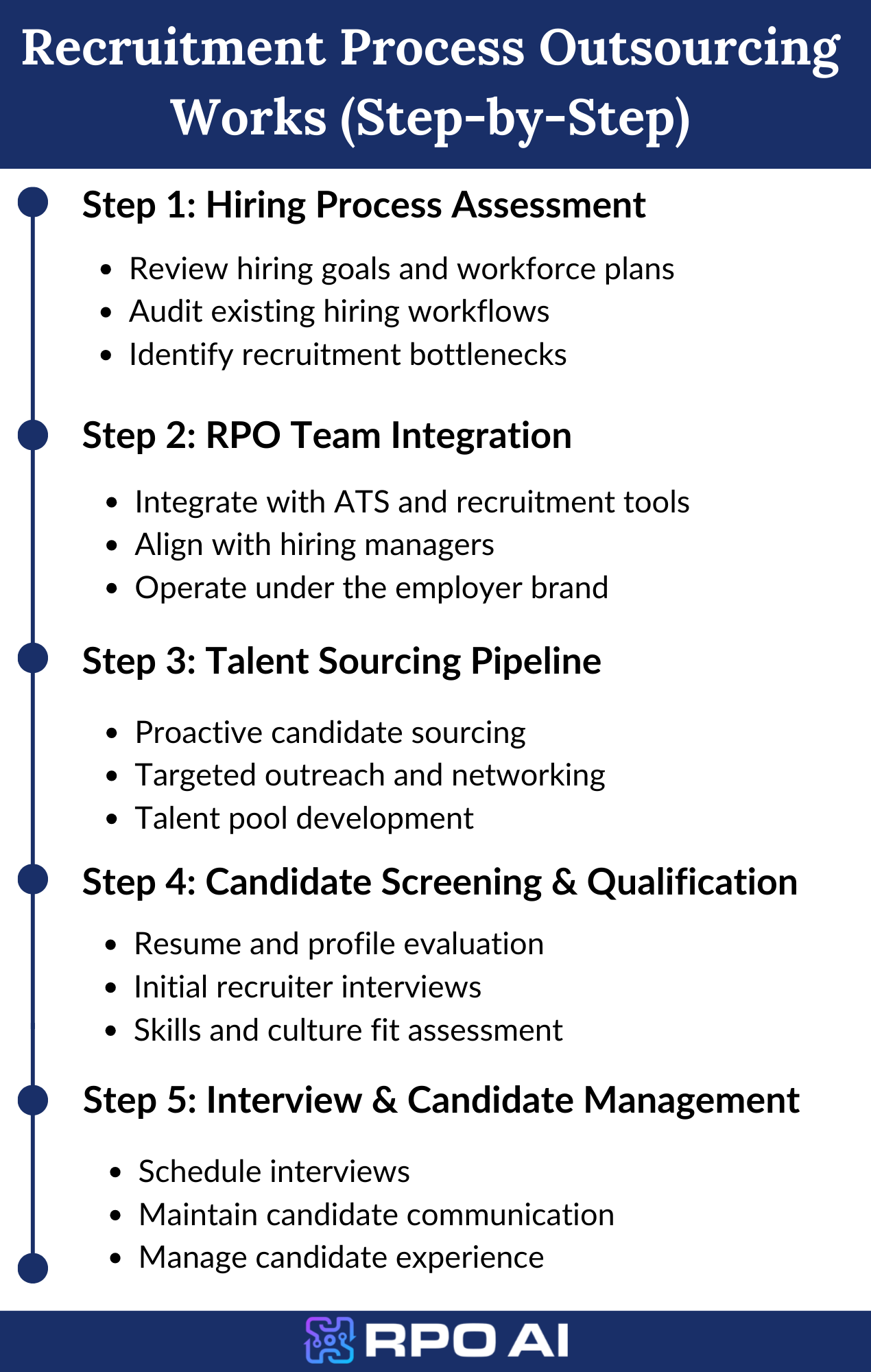
Step 1: Hiring Process Assessment
The first step is understanding how hiring currently works inside the company.
Reviewing Hiring Goals
The RPO team works with leadership and hiring managers to understand upcoming hiring plans, role priorities, and growth targets.
Auditing the Existing Hiring Process
This includes reviewing job descriptions, sourcing channels, interview stages, and candidate pipelines to identify bottlenecks.
Identifying Hiring Gaps
At this stage, common issues such as slow screening, limited sourcing channels, or unclear interview workflows are mapped out.
The objective here is simple: understand what needs fixing before scaling the hiring process.
Step 2: Integrating the RPO Team With Your Hiring Setup
Once the assessment is complete, the RPO team integrates with the company’s existing hiring environment.
Working Within Your Tools
RPO teams typically plug into the company’s Applicant Tracking System (ATS), communication tools, and hiring workflows.
Aligning With Hiring Managers
Hiring managers and internal HR teams work closely with the RPO team to define role expectations, candidate profiles, and interview criteria.
Operating Under Your Employer Brand
Candidates interact with the RPO team as representatives of your company, ensuring a consistent employer brand experience through professional outsourcing recruitment services.
At this stage, the RPO team becomes an embedded extension of your recruiting function.
Step 3: Building the Talent Sourcing Pipeline
Instead of waiting for applications, the RPO team focuses on building a consistent pipeline of candidates.
Proactive Talent Sourcing
Recruiters actively search for candidates through professional networks, talent databases, and industry communities.
Targeted Outreach
Qualified candidates are approached directly through platforms such as LinkedIn, professional groups, and referrals.
Talent Pool Development
Over time, the RPO team builds a structured talent pool so future roles can be filled faster.
This approach ensures companies always have candidates moving through the pipeline, rather than starting from zero every time.
Step 4: Candidate Screening and Qualification
Once candidates enter the pipeline, the RPO team begins the evaluation process.
Resume and Profile Review
Candidates are screened based on role requirements, skills, and experience.
Initial Recruiter Conversations
Preliminary interviews help assess communication, interest in the role, and overall alignment.
Skills and Cultural Fit Checks
Candidates who move forward are evaluated for technical capabilities and alignment with the company’s work culture.
Only the most relevant candidates are forwarded to hiring managers, saving valuable time during the interview stage.
Step 5: Managing Interviews and Candidate Communication
Recruitment operations involve more than just finding candidates.
Interview Scheduling
The RPO team coordinates interview times between candidates and internal stakeholders.
Communication and Follow-Ups
Candidates receive timely updates, feedback, and next-step information.
Candidate Experience Management
Clear communication and structured interactions help maintain a positive employer brand throughout the hiring journey.
Step 6: Hiring Metrics and Process Optimization
One of the biggest advantages of recruitment process outsourcing is the use of hiring data to improve results.
Tracking Key Hiring Metrics
Important metrics such as time-to-fill, source effectiveness, and candidate conversion rates are monitored.
Identifying Hiring Bottlenecks
If interviews are delayed or candidate drop-offs occur, the RPO team identifies and addresses the problem quickly.
Continuous Process Improvements
Based on these insights, the hiring workflow is refined to make the process faster and more efficient over time.
Business Benefits of Recruitment Process Outsourcing
By this point, you’ve seen how the RPO model works structurally. But many leaders still ask a practical question: what changes for the business once this system is in place?
To answer that question, here are some of the most noticeable benefits of the recruitment process that outsourcing companies experience.
- Scalability Without the Overhead
Hiring needs fluctuate. This RPO outsourcing allows you to scale your recruiting horsepower up during a growth spurt and dial it back down during a “steady state,” all without hiring or laying off internal HR staff.
- Reduced Cost-per-Hire
By moving away from high-percentage agency placement fees (often 20-30% of salary) to a structured recruitment process outsourcing solution, companies typically see a significant reduction in total recruiting spend while gaining more predictable monthly costs.
- Enhanced Candidate Experience (Which Protects Your Brand)
Candidates don’t just evaluate the job; they evaluate the process. Outsourced recruitment services improve communication, scheduling, and follow-through so candidates stay engaged.
- Data-Driven Hiring
RPO makes hiring easier to measure, providing real-time dashboards on “Time-to-Fill” and “Quality-of-Hire,” turning recruiting from a “gut feeling” into a predictable science.
The RPO.ai Advantage
Since you’re exploring recruitment process outsourcing providers, here’s how RPO.ai is different from a typical RPO provider. Most RPO teams focus mainly on adding recruiters to fill roles.
We go a step further; we help you build a repeatable hiring system that stays consistent across roles, teams, and hiring waves.
From day one, we align on your hiring goals and success criteria, then plug into your workflow to run structured sourcing, screening, interview coordination, and feedback loops, so you get control, speed, and consistency (not chaos).
Take a closer look at how our service is set up.
The difference becomes clearer in the results. For example, when Coursera needed to scale hiring across multiple departments and regions, our embedded recruiting team supported sourcing, engagement, and hiring across tech, product, people operations, sales, marketing, and finance roles.
Within the first year, we helped fill over 100 roles across North America and India, enabling the company to scale its teams quickly while maintaining hiring quality.
Wrapping Up
By now, you’ve seen how the RPO model works and why many growing companies rely on outsourced recruitment to scale hiring.
If you’re wondering how this approach could fit your hiring goals, a short conversation is the best place to start.
To explore how we support growing teams
| Talk to Us |
FAQs
1) How is RPO different from in-house recruiting?
RPO uses an external recruiting team embedded into your hiring process to run sourcing, screening, and coordination. In-house recruiting relies on your internal HR/recruiters to manage the full workload.
2) How long does it take to implement an RPO model?
Most RPO setups go live in 2–6 weeks, depending on hiring volume, roles, and tool/ATS integration.
3) Can RPO handle high-volume hiring?
Yes. RPO is built for scale by using continuous talent pipelines, structured screening, and centralized interview coordination.
4) Who should use recruitment process outsourcing?
RPO is best for companies that need repeatable, scalable hiring, fast-growing teams, multi-role hiring, or hiring across multiple locations.

Rameet Singh, Founder & CEO of RPO.AI