
 Log-In
Does the candidate screening process actually improve hiring outcomes, or does it slow teams down with unnecessary steps? In most organizations, screening is designed to identify qualified candidates efficiently by filtering out mismatches early and focusing on role-specific criteria. However, with rising application volumes and evolving hiring technologies, many teams struggle to balance speed with accuracy.
Understanding how the candidate screening process works, from resume review to final shortlist, is essential as companies move toward data-driven, skills-based hiring models that prioritize both efficiency and quality.
AI-Powered Recruitment for Faster Hiring
Find qualified candidates faster with intelligent sourcing and automated screening.
Key Summary
- Candidate screening helps filter unqualified applicants early and improves hiring efficiency.
- The process includes resume review, knockout questions, phone/video screening, skills tests, work samples, and background checks.
- AI tools can speed up screening, but human review is still important.
- Structured scorecards, clear criteria, and faster communication help create better shortlists.
What Is Candidate Screening and Why Does It Matter
Candidate screening is the process of evaluating applicants early in the hiring funnel to determine if they meet the essential requirements of a role. It filters out unqualified candidates before deeper evaluation begins.
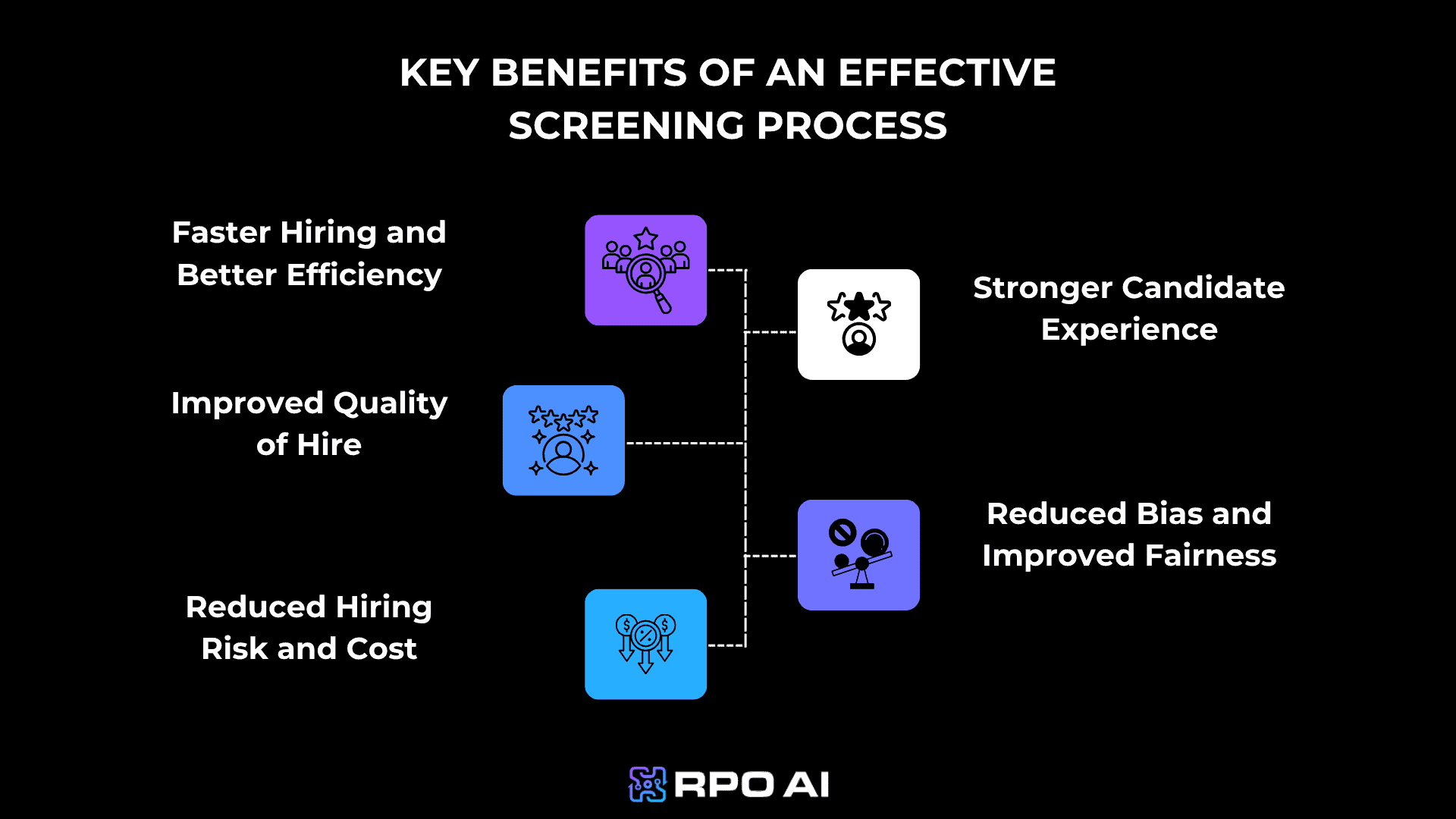
A structured screening process directly impacts hiring outcomes in three ways:
- Reduces hiring risk: A bad hire can cost up to 30% of the employee’s annual salary. Screening minimizes this risk by validating qualifications early.
- Improves efficiency: Instead of interviewing large volumes, recruiters focus only on the top 5 to 10 candidates.
- Enhances quality of hire: Data-driven screening identifies candidates who are more likely to perform well and stay longer.
Without proper screening, hiring becomes reactive and inconsistent.
The Complete Candidate Screening Process: Step-by-Step
1. Resume and Application Review
This is the first layer of evaluation. Recruiters assess whether a candidate meets baseline qualifications.
Key elements reviewed include:
- Relevant experience and job roles
- Required skills and certifications
- Education and industry background
Most companies use Applicant Tracking Systems (ATS) to automate this stage. These systems scan resumes for keywords that match the job description.
Common issues at this stage:
- Keyword manipulation without real expertise
- Generic resumes with no measurable outcomes
- Misalignment between role requirements and experience
The goal is simple: eliminate clearly unqualified candidates quickly.
2. Screening Questions (Knockout Filters)
Screening questions are used to disqualify candidates who do not meet non-negotiable criteria.
Typical examples include:
- Work authorization status
- Minimum years of experience
- Willingness to relocate or work specific hours
These questions act as an early filter, reducing manual effort and narrowing the applicant pool before recruiter review.
3. Initial Phone or Video Screening
This is usually a 15 to 30-minute conversation designed to validate key details.
Recruiters focus on:
- Verifying resume accuracy
- Assessing communication skills
- Understanding motivation and career intent
- Confirming salary expectations and availability
This stage ensures candidates are both qualified and genuinely interested.
4. Skills and Aptitude Assessments
Resumes do not prove capability. Assessments provide objective evidence.
Common formats include:
- Technical tests for role-specific skills
- Cognitive or aptitude tests
- Situational judgment scenarios
These assessments are strong predictors of job performance and reduce reliance on subjective judgment.
5. Work Samples or Case Studies
For specialized roles, candidates may be asked to complete practical assignments.
Examples include:
- Coding challenges for developers
- Writing tasks for content roles
- Business case studies for strategy positions
This stage evaluates how candidates approach real-world problems, not just theoretical knowledge.
6. Background and Reference Checks
This is the final validation layer before shortlisting or offer decisions.
It includes:
- Employment verification
- Educational credentials
- Professional references
This step reduces risk by confirming that candidate claims are accurate.
From Resume to Shortlist: How Candidates Are Narrowed Down
1. Automated Filtering (First Cut)
Before a recruiter reviews applications, many resumes pass through an ATS or screening system.
This stage checks for:
| Screening Factor | What It Looks For |
| Keyword match | Skills, tools, job titles, certifications |
| Knockout questions | Work authorization, location, and required experience |
| Basic eligibility | Minimum qualifications for the role |
Result: A large number of unqualified or mismatched applications are removed early.
2. Manual Resume Review (Fast Scan)
Recruiters spend only a few seconds on an initial scan.
What stands out:
- Clear achievements with measurable results
- Structured, easy-to-read formatting
- Relevant and focused experience
Red flags include vague descriptions, inconsistent timelines, and poor presentation.
3. Longlisting Candidates
Candidates who pass the initial resume review are moved into a longlist. This is a broader group of applicants who appear qualified and potentially suitable for the role.
Recruiters may compare these candidates against a scorecard, review how closely they match essential and preferred criteria, and sometimes conduct short screening calls. These calls help confirm interest, communication style, salary expectations, availability, and overall fit.
The longlist is not the final selection. It is the pool of candidates who are strong enough to be considered seriously.
4. Final Shortlisting
The final shortlist is created by narrowing the longlist into a smaller group, usually around three to ten candidates. Recruiters and hiring managers work together to compare the strongest profiles and decide who should move into formal interviews.
At this stage, the focus is on role alignment, quality of experience, skills match, and overall suitability. Some companies may also use skill assessments, portfolio reviews, or additional validation before confirming the shortlist.
The outcome is a refined group of candidates who are ready for in-depth interviews.
Modern Candidate Screening Techniques
Modern candidate screening has moved beyond simply reading resumes and deciding who looks relevant. Hiring teams now use a mix of technology, structured evaluation, and digital context to identify stronger candidates faster, especially when applicant volume is high.
AI-Powered Screening Tools
AI-powered tools are often used at the earliest stage of screening, where recruiters need to process a large number of applications quickly. These tools can extract information from resumes, compare candidate profiles against job requirements, score applicants based on predefined criteria, and support initial chat or voice-based screening.
The real value of AI in screening is not that it makes hiring decisions on its own. Its value is that it helps recruiters organize large applicant pools, identify likely matches faster, and apply screening criteria more consistently. Human review is still important, especially for judging context, career progression, transferable skills, and overall role fit.
Asynchronous Video Interviews
Asynchronous video interviews allow candidates to record answers to predefined questions instead of attending a live first-round call. This is especially useful for high-volume hiring, where scheduling dozens or hundreds of screening calls can slow the process down.
Because every candidate responds to the same questions, recruiters can compare answers more consistently. It also gives hiring teams a better sense of communication style, confidence, and motivation before investing time in live interviews. However, these interviews work best when the questions are relevant, the format is simple, and candidates are not judged on presentation quality alone.
Social and Digital Profile Screening
Recruiters may also review a candidate’s professional presence online to better understand their experience and credibility. This usually includes LinkedIn profiles, portfolios, GitHub repositories, published work, case studies, certifications, or other public professional activity.
This step adds context that a resume alone may not provide. For example, a portfolio can show the quality of someone’s work, a LinkedIn profile can support career history, and public projects can demonstrate practical skills. The goal is not to judge candidates casually based on their online presence, but to validate professional claims and understand the candidate’s work more fully.
Common Candidate Screening Methods
| Method | Purpose |
| Resume Screening | Verify minimum qualifications |
| Phone/Video Screening | Assess communication and intent |
| Skills Assessment | Validate technical capability |
| Background Checks | Confirm accuracy of claims |
| Psychometric Tests | Evaluate personality and cognitive traits |
Challenges in the Candidate Screening Process
1. High Application Volume
Recruiters often deal with hundreds of applications per role, making it difficult to identify qualified candidates quickly. This leads to time pressure and reduced screening accuracy.
Solution:
- Use ATS filters and knockout questions to eliminate irrelevant applications early
- Implement AI-assisted resume screening to prioritize high-fit candidates
- Define clear “must-have” criteria before screening begins
Example: Instead of manually reviewing 300 resumes, automated filters reduce the pool to 70 candidates who meet core requirements, allowing recruiters to focus on quality over quantity.
2. Candidate Ghosting and Drop-Off
Delays in screening and a lack of communication cause candidates to disengage. Many drop out if the process extends beyond two weeks.
Solution:
- Set a defined screening timeline (ideally under 14 days)
- Use automated updates to keep candidates informed
- Schedule screening calls quickly after application review
Example: A company that schedules screening calls within 48 hours of shortlisting sees significantly lower drop-off compared to one that takes a week to respond.
3. AI and Automation Limitations
AI tools can introduce bias or over-reliance on keyword matching, which may overlook strong candidates with non-traditional backgrounds.
Solution:
- Combine AI screening with human review
- Regularly audit AI filters for bias and accuracy
- Focus on skills-based assessments instead of keyword dependency
Example: A candidate switching industries may not match exact keywords, but performs well in a skills test. Human review ensures such candidates are not filtered out incorrectly.
4. Internal Process Bottlenecks
Lack of alignment between recruiters and hiring managers leads to delays, rejections, and repeated work.
Solution:
- Define clear role requirements before screening begins
- Use structured scorecards shared across teams
- Limit approval layers to speed up decision-making
Example: If both the recruiter and the hiring manager agree on the top 5 evaluation criteria upfront, shortlisted candidates are less likely to be rejected later due to misalignment.
5. Fraud and Authenticity Risks
Candidates may misrepresent skills or use tools to manipulate interviews, making it harder to assess real capability.
Solution:
- Use live problem-solving assessments instead of theoretical questions
- Conduct identity verification during video interviews
- Include role-specific practical tests
Example: Instead of relying on verbal answers, a live coding or task-based test reveals whether a candidate can perform independently without external assistance.
How to Optimize Your Candidate Screening Process
An effective screening process is not about adding more steps. It is about making each step clearer, faster, and more consistent. The goal is to reduce unnecessary effort while improving decision quality.
1. Separate Must-Haves from Nice-to-Haves
Screening becomes easier when everyone knows what truly matters.
Must-have criteria are the requirements a candidate needs to perform the role successfully. These may include core skills, required experience, certifications, work authorization, or specific technical knowledge.
Nice-to-have criteria are useful, but not essential. These may include experience with additional tools, exposure to a certain industry, or secondary skills that can be learned later.
This distinction prevents hiring teams from rejecting strong candidates simply because they do not match every preference on the job description.
2. Use One Evaluation Framework
Unstructured screening leads to inconsistent decisions. One recruiter may focus on experience, another may focus on communication, and a hiring manager may prioritize something else entirely.
A structured scorecard solves this by giving everyone the same evaluation framework. Candidates can be assessed across areas such as skills, experience, communication, motivation, and role fit.
This makes it easier to compare candidates fairly and reduces decision-making based on gut feeling alone.
3. Let AI Handle Volume, Not Judgment
AI tools can speed up early screening by parsing resumes, matching candidates to job requirements, ranking profiles, and identifying likely matches.
But AI should support the screening process, not control it.
Recruiters should still review context that automation may miss, such as career transitions, transferable skills, unusual experience paths, communication quality, and growth potential. Regular checks are also needed to make sure AI outputs are accurate and do not unfairly filter out promising candidates.
The best approach is to use AI for speed and humans for judgment.
4. Ask the Same Core Questions
Screening calls become more useful when candidates are asked the same core questions for the same role.
This does not mean every conversation has to feel scripted. It means each candidate should be evaluated against the same baseline.
Good screening questions usually focus on role-specific experience, problem-solving, motivation, availability, expectations, and communication. Vague questions lead to vague answers, so the questions should be specific enough to reveal whether the candidate can actually succeed in the role.
5. Move Quickly After Application
A slow screening process can cause strong candidates to lose interest or accept another offer.
Recruiters should review applications quickly, schedule screening calls without unnecessary delay, and communicate next steps clearly. Even a simple update can help keep candidates engaged.
Speed matters because screening is not just an internal evaluation step. It is also part of the candidate experience.
6. Align Before Screening Starts
Many screening problems happen because recruiters and hiring managers are not aligned from the beginning.
Before reviewing candidates, both sides should agree on what the role really requires, what a strong candidate looks like, which criteria matter most, and how candidates will be evaluated.
This avoids rejected shortlists, repeated sourcing, and unnecessary delays later in the process.
Conclusion
The effectiveness of a candidate screening process largely depends on how structured and consistent it is. Organizations that use standardized screening criteria, structured interviews, and skills-based assessments can evaluate candidates more accurately and reduce hiring errors. AI-powered recruitment platforms further improve this by automating sourcing, filtering, and initial evaluations.
Solutions like AI-driven hiring systems enable companies to identify qualified candidates faster while maintaining focus on measurable skills, role fit, and real performance.
To explore how we support growing teams
FAQs on Candidate Screening Process
1. What is the purpose of candidate screening?
The purpose of candidate screening is to evaluate applicants early in the hiring process and filter out those who do not meet essential role requirements. This ensures only qualified candidates move forward, saving time and improving overall hiring efficiency.
2. How long should the screening process take?
The candidate screening process should ideally take between 7 and 14 days. This timeframe allows recruiters to evaluate candidates thoroughly while maintaining engagement, reducing the risk of drop-offs, and ensuring top talent is not lost to faster-moving competitors.
3. What tools are used in candidate screening?
Common tools used in candidate screening include Applicant Tracking Systems for resume filtering, AI-based screening tools for candidate matching, assessment platforms for skill evaluation, and video interview software for initial screening and communication.

Rameet Singh, Founder & CEO of RPO.AI