
 Log-In
Hiring has never been easy, but it didn’t always feel this risky. Today, every extra week a role stays open, slows teams down, adds pressure on employees, and gives competitors a head start. Candidates also expect faster updates and smoother interviews. When the process drags, they move on.
That’s why more companies are rethinking recruitment outsourcing. Traditional RPO can provide support, but it can’t always fix delays within the hiring flow. AI-powered RPO is different.
It combines expert recruiters with automation to keep hiring moving, reduce drop-offs, and bring more control to the process. For many companies, this shift isn’t a trend.
It’s the future of hiring, because it fixes the parts of recruiting that slow everything down.
What AI-Powered RPO Actually Means
RPO stands for Recruitment Process Outsourcing, a model where an external partner manages part or all of a company’s hiring process. In the past, RPO was often associated with high-volume hiring support, temporary recruiting help, or outsourcing to handle operational load.
And that still exists. But AI-powered RPO changes the way outsourcing works.
What Changes When AI is Added
Instead of relying primarily on recruiter effort to move candidates through the funnel, AI-powered RPO combines human recruiting expertise with automation across the tasks that usually slow hiring down: screening, outreach, scheduling, follow-ups, coordination, pipeline visibility, and reporting.
In other words, the difference isn’t just who does the work. It’s how the work gets done.
From Extra Support to a Hiring Engine
Traditional recruitment outsourcing can still feel like a manual process executed by someone outside your organization. AI-powered RPO is closer to an integrated hiring engine: one that runs continuously, adapts to demand, and reduces delays by removing the friction points that cause hiring to stall.
That’s why companies don’t adopt AI-powered RPO simply to “outsource recruiting.”
They adopt it to outsource the workload and modernize the workflow at the same time.
Why Recruitment Outsourcing Has Changed
Most hiring delays don’t happen because recruiters are slow or hiring managers don’t care.
They happen because recruitment workflows were never designed for the current reality of hiring.
Today’s recruitment environment includes:
– high application volume with inconsistent quality
– candidates expecting faster timelines and clearer communication
– teams hiring across regions, time zones, and remote setups
– competitive offer cycles where top candidates disappear quickly
– Internal hiring teams are balancing too many open roles at once
What Companies Do Next
The pressure builds quietly. Recruiters start triaging instead of recruiting. Hiring managers start delaying decisions because every role feels urgent. Candidates stop responding because the process feels uncertain.
At that point, the business typically tries one of three things:
– Hire more recruiters internally
– Ask existing recruiters to “push harder.”
– Outsource recruitment to get immediate capacity
The first option takes time. The second option burns teams out. The third option works, but only if outsourcing improves the actual system, not just the headcount.
That’s why AI-powered RPO is gaining traction. It doesn’t just increase effort. It increases throughput.
The Speed Advantage of AI-Powered RPO
Speed is the most visible benefit of AI-powered RPO, but not in a superficial way.
Companies don’t just want hiring to be faster.
They want it to be consistently fast.
One of the most frustrating things about recruitment is that timelines often look fine until they suddenly collapse. A role can move smoothly through sourcing and screening, then stall for a week because interview scheduling becomes a mess. Or the panel interview finishes, and the feedback takes too long. Or a candidate reaches the offer stage and disappears because the process dragged on.
AI-powered RPO reduces time-to-hire by removing the slowest parts of hiring: the parts that don’t require human judgment but still consume huge amounts of human time.
What AI Speeds Up Behind the Scenes
Resume screening is a good example. Most companies still rely on manual review or basic keyword filters. That creates two problems: it’s slow, and it’s inconsistent. AI-driven screening doesn’t just speed up review, it can evaluate context, recognize related skills, and surface candidates that might otherwise get overlooked.
Scheduling is another hidden time sink. It’s easy to underestimate how many hours get lost coordinating calendars, sending availability requests, rescheduling, and confirming attendance. AI-powered scheduling workflows remove that friction, which compresses timelines without forcing recruiters to work overtime.
When these improvements happen across multiple stages, the effect compounds. Hiring becomes less like pushing a boulder uphill and more like a structured pipeline that keeps moving.
It’s Not Just Faster Hiring, It’s Fewer Drop-Offs
Many companies think their hiring problem is “we need more applicants.”
But often, the real issue is they’re leaking candidates mid-process.
Candidates drop out for predictable reasons:
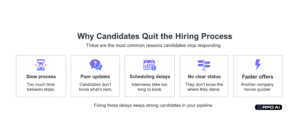
Traditional recruitment outsourcing can help fill the top of the funnel, but it doesn’t always fix the middle, the part where candidate experience breaks down.
AI-powered RPO is designed to protect momentum.
Automation ensures candidates aren’t left waiting days for updates. Communication workflows can keep candidates engaged without recruiters manually checking in every time. Real-time pipeline tracking helps teams see where candidates are getting stuck, rather than discovering the issue after the best candidates are already gone.
This is why companies often experience not only shorter time-to-hire, but also smoother hiring outcomes: fewer ghosting incidents, fewer late-stage withdrawals, and fewer “we need to restart the search” situations.
Hiring becomes less reactive and more controlled.
Scale Hiring Without Lowering the Bar
Scaling hiring isn’t just filling more roles. It’s keeping quality steady while volume rises, candidate experience stays clean, and internal teams don’t burn out.
Most models fail here because overload changes recruiter behavior. Time shifts from candidate conversations to sorting resumes, chasing schedules, and sending follow-ups. Outreach gets less personal. Screening gets rushed. Interviews move forward even when the role isn’t fully aligned. Speed starts replacing judgment.
AI-powered RPO reduces that pressure by automating the work that slows decisions, downscreening, scheduling, follow-ups, and pipeline tracking, so recruiters can spend time where it matters: engaging strong candidates, aligning with hiring managers, and closing hires with fewer misses.
Gives Leadership Visibility Into Hiring
One of the most overlooked reasons companies choose AI-powered RPO is that it makes hiring measurable in real time.
In many organizations, hiring data exists, but it’s fragmented. It sits in different systems. It’s updated inconsistently. It’s reported too late. And by the time leadership sees the numbers, the quarter is already off track.
AI-powered RPO changes that by treating recruitment like a live operational system.
Instead of asking, “Why is hiring slow?” after the fact, companies can see:
– Which stage is delaying progress
– Which roles are at risk of going unfilled
– Where candidates are dropping off
– How long does each interview loop actually takes
– Which sources deliver quality hires faster
This matters because hiring isn’t only an HR function; it’s business execution.
When companies have pipeline visibility, they can plan better. They can allocate interviewers earlier. They can adjust role requirements sooner. They can forecast hiring outcomes more accurately.
And that predictability is often the real ROI.
Integration That Removes Friction
A common fear with AI in recruitment is more clutter: another tool, another login, another dashboard no one checks. AI-powered RPO works when it does the opposite. It connects to what you already use, your ATS, calendars, email/SMS, assessments, and onboarding, so hiring runs as one flow.
That cuts a major time drain: moving data between systems and chasing updates. With connected workflows, status changes update automatically, interviews get triggered at the right time, follow-ups don’t slip, and reporting stays accurate without manual work. It feels less like “outsourcing” and more like a hiring system that runs.
Why This Is Taking Off Now
Recruitment outsourcing has been around for years, but the market has changed. Candidates move faster, competition is tighter, and slow processes get punished. The companies winning talent aren’t always the biggest names. They’re the ones who communicate clearly, schedule quickly, and decide without delays.
AI-powered RPO fits this reality because it speeds up execution without lowering standards. It helps teams avoid two bad options: moving slowly and losing great candidates, or moving fast and making weak hires. The better path is controlled speed, fast hiring with a process that doesn’t break under pressure.
Smarter Outsourcing for Faster Hiring
AI-powered RPO isn’t about handing recruiting off. It’s about removing the slow, manual work that blocks hiring from moving. When hiring demand rises, internal teams get stretched, decisions slow down, and good candidates drop out. AI-powered RPO keeps the pipeline moving with faster screening, smoother scheduling, consistent follow-ups, and clear visibility across roles. The result is quicker hires, fewer resets, and a process that holds up under pressure, without burning out recruiters or creating a messy candidate experience.
FAQs
Why are companies using AI for hiring?
AI speeds up screening and cuts manual work, reducing hiring costs. It improves shortlists using data-driven matching and predictive signals. Chatbots keep candidates updated anytime, improving experience. Skills-based assessment can support fairer evaluation. AI also finds and engages passive talent early, not just applicants.
What are the benefits of using AI in recruitment?
Key benefits include reduced hiring costs, faster time-to-hire, reduced human bias, enhanced candidate engagement, and improved talent sourcing.
How can AI help recruitment agencies?
AI helps recruitment agencies increase efficiency, reduce time-to-hire, and improve candidate quality by automating repetitive tasks, sourcing talent, and matching skills to job descriptions.
What are the benefits of creating an AI-assisted project in recruitment?
Creating an AI-assisted project in LinkedIn Recruiter leverages generative AI to streamline talent acquisition, enabling recruiters to move from manual, time-consuming processes to a more strategic, efficient workflow.

Rameet Singh, Founder & CEO of RPO.AI