Log-In

Hiring has become more complex than ever.
Companies are expected to fill positions faster, compete for top talent globally, improve candidate experiences, reduce hiring costs, and maintain workforce quality, all while managing business growth.
Traditional recruitment methods often struggle to keep up with these demands. Internal HR teams become overwhelmed, hiring timelines stretch, and critical positions remain vacant longer than expected.
This is why talent acquisition outsourcing has become a strategic solution for businesses looking to scale efficiently.
Rather than simply filling open roles, talent acquisition outsourcing helps organizations build structured hiring processes, access larger talent pools, improve recruitment outcomes, and scale their workforce without overburdening internal teams.
In this article, we’ll explore how talent acquisition outsourcing is transforming modern hiring and why more organizations are incorporating it into their growth strategies.
What Is Talent Acquisition Outsourcing?
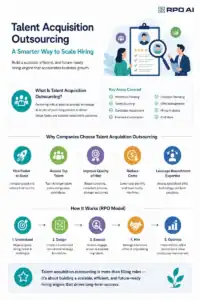
Talent acquisition outsourcing is the practice of partnering with an external provider to manage part or all of an organization’s hiring process.
Unlike traditional staffing agencies that focus on filling individual vacancies, talent acquisition outsourcing providers typically take a more strategic approach to recruitment.
Their responsibilities may include:
– Workforce planning
– Employer branding
– Candidate sourcing
– Talent pipeline development
– Recruitment marketing
– Interview coordination
– Candidate assessment
– Offer management
– Hiring analytics
The goal is not simply to hire faster but to create a scalable recruitment function that aligns with long-term business objectives.
Why Traditional Hiring Models Are Struggling
Many organizations continue to rely on internal recruiters to manage growing hiring demands.
While this approach works for stable hiring environments, challenges arise when organizations experience rapid growth, seasonal hiring spikes, or expansion into new markets.
Common issues include:
| Hiring Challenge | Business Impact |
| Limited recruiter capacity | Slower hiring cycles |
| Growing talent shortages | Increased competition for candidates |
| Poor candidate experience | Higher offer rejection rates |
| Lack of specialized recruiting expertise | Difficulty hiring niche talent |
| High recruitment costs | Reduced hiring efficiency |
| Inconsistent hiring processes | Lower quality of hire |
As hiring demands increase, internal teams often struggle to maintain speed and quality simultaneously.
This is where talent acquisition outsourcing creates value.
How Talent Acquisition Outsourcing Supports Business Growth
1. Enables Faster Hiring at Scale
One of the biggest advantages of talent acquisition outsourcing is the ability to scale hiring quickly.
When companies experience growth, internal recruiting teams often become bottlenecks. An outsourcing partner can immediately expand recruiting capacity without requiring the company to hire additional recruiters.
This allows organizations to:
– Fill positions faster
– Reduce time-to-hire
– Accelerate onboarding
– Support expansion initiatives
– Avoid prolonged vacancies
For fast-growing companies, speed often becomes a competitive advantage.
2. Access to Larger Talent Pools
Finding qualified candidates has become increasingly difficult across many industries.
Talent acquisition outsourcing providers typically maintain:
– Extensive candidate databases
– Industry-specific talent networks
– Passive candidate pools
– Specialized sourcing capabilities
– Global recruiting resources
This broader reach helps companies connect with candidates who may not actively be searching for jobs but are open to the right opportunity.
Access to passive talent is often one of the biggest differentiators between average hiring results and exceptional hiring outcomes.
3. Improves Hiring Quality
Scaling hiring should never come at the expense of quality.
A strong talent acquisition outsourcing strategy focuses on improving:
– Candidate screening
– Skills assessment
– Cultural alignment
– Hiring consistency
– Interview effectiveness
Instead of rushing to fill positions, outsourcing partners often implement structured hiring frameworks that improve decision-making.
This can lead to:
– Better employee performance
– Higher retention rates
– Reduced turnover costs
– Stronger workforce quality
4. Reduces Recruitment Costs
Talent acquisition outsourcing helps companies reduce recruitment costs by minimizing the need for large in-house hiring teams, paid sourcing tools, and multiple external vendors. With an outsourcing partner managing sourcing, screening, and coordination, companies can streamline the hiring process and avoid unnecessary spending.
This also reduces time-to-hire, helping businesses fill roles faster while keeping recruitment costs under control. In reality, talent acquisition outsourcing often lowers overall recruitment expenses by improving efficiency.
Potential savings may come from:
– Reduced agency spending
– Lower advertising costs
– Fewer hiring mistakes
– Shorter vacancy periods
– Streamlined recruiting operations
Cost Comparison
| Cost Factor | Traditional Hiring | Talent Acquisition Outsourcing |
| Recruiter expansion | High | Lower |
| Technology investment | Internal responsibility | Often included |
| Candidate sourcing | Limited resources | Dedicated sourcing teams |
| Hiring scalability | Difficult | Flexible |
| Recruitment efficiency | Variable | Optimized processes |
The result is often a lower cost-per-hire and improved recruiting performance.
5. Provides Recruitment Expertise
Recruitment has evolved significantly over the last decade.
Modern hiring requires expertise in:
– Recruitment marketing
– Employer branding
– Candidate engagement
– Hiring technology
– Talent analytics
– Diversity recruiting
Many organizations cannot justify building deep expertise across all these areas internally.
Talent acquisition outsourcing providers bring specialized knowledge that helps companies remain competitive in today’s hiring landscape.
The Role of Recruitment Process Outsourcing (RPO)
When discussing talent acquisition outsourcing, the term Recruitment Process Outsourcing (RPO) frequently appears.
RPO is a form of talent acquisition outsourcing where an external provider manages some or all recruitment activities on behalf of the company.
Typical RPO services include:
– Candidate sourcing
– Screening
– Interview scheduling
– Offer management
– Recruitment reporting
– Workforce planning
Many growing organizations use RPO solutions to create scalable hiring operations without significantly increasing internal HR headcount.
How Talent Acquisition Outsourcing Enhances Candidate Experience
Candidate experience plays a major role in attracting top talent.
Poor communication, slow hiring processes, and inconsistent interviews can damage an employer’s reputation.
Talent acquisition outsourcing providers often improve candidate experience through:
– Faster response times
– Clear communication
– Streamlined interview processes
– Consistent employer branding
– Better candidate engagement
When candidates have a positive experience, organizations benefit from:
– Higher offer acceptance rates
– Stronger employer reputation
– Improved referral generation
– Better long-term talent attraction
Talent Acquisition Outsourcing and Employer Branding
Today’s candidates evaluate employers just as much as employers evaluate candidates. A strong employer brand can significantly improve hiring outcomes.
Talent acquisition outsourcing partners often support employer branding initiatives by:
– Optimizing career pages
– Improving job descriptions
– Creating recruitment marketing campaigns
– Enhancing social recruiting efforts
– Promoting company culture
These efforts help attract higher-quality applicants while reducing recruitment friction.
Is Talent Acquisition Outsourcing Right for Every Company?
Not necessarily. Talent acquisition outsourcing is most effective for organizations that:
Are Experiencing Rapid Growth
Growing companies often need recruiting support faster than internal teams can provide.
Have High-Volume Hiring Needs
Industries such as healthcare, technology, manufacturing, retail, and logistics frequently benefit from outsourcing recruitment functions.
Need Specialized Talent
When hiring highly skilled or niche professionals, external recruiting expertise can significantly improve outcomes.
Want Predictable Hiring Performance
Companies seeking consistent hiring metrics, reporting, and scalability often see strong results from outsourcing partnerships.
Key Metrics to Measure Success
Organizations should evaluate the effectiveness of talent acquisition outsourcing using measurable KPIs.
Important Recruitment Metrics
| Metric | Why It Matters |
| Time-to-Hire | Measures hiring speed |
| Cost-per-Hire | Evaluates recruitment efficiency |
| Quality of Hire | Assesses employee performance |
| Candidate Satisfaction | Measures candidate experience |
| Offer Acceptance Rate | Indicates hiring effectiveness |
| Retention Rate | Tracks long-term hiring success |
The most successful talent acquisition outsourcing partnerships focus on continuous improvement across these metrics.
The Future of Talent Acquisition Outsourcing
As competition for talent continues to intensify, organizations will increasingly rely on external expertise to maintain hiring agility.
Future trends include:
– AI-powered candidate sourcing
– Predictive hiring analytics
– Skills-based recruitment
– Global talent acquisition
– Enhanced employer branding strategies
– Automated recruitment workflows
Companies that embrace modern recruitment strategies will be better positioned to attract, hire, and retain top talent.
Talent acquisition outsourcing is no longer simply a cost-saving initiative. It has become a strategic workforce solution that supports business growth and organizational scalability.
Conclusion
Hiring success is no longer determined solely by the size of an HR team.
Organizations need scalable recruitment strategies that can adapt to changing workforce demands, competitive labor markets, and evolving business goals.
Talent acquisition outsourcing provides companies with the flexibility, expertise, and recruiting capacity needed to scale hiring efficiently while maintaining quality.
From reducing time-to-hire and improving candidate experience to enhancing employer branding and accessing larger talent pools, outsourcing recruitment has become a powerful tool for modern workforce growth.
For organizations looking to build high-performing teams without overwhelming internal resources, talent acquisition outsourcing offers a strategic path forward.
Frequently Asked Questions
1. What is talent acquisition outsourcing?
Talent acquisition outsourcing is the process of partnering with an external provider to manage some or all aspects of recruitment, including sourcing, screening, interviewing, and hiring candidates.
2. How is talent acquisition outsourcing different from staffing agencies?
Staffing agencies typically focus on filling specific roles, while talent acquisition outsourcing providers often manage broader recruitment strategies, workforce planning, employer branding, and hiring processes.
3. What are the benefits of talent acquisition outsourcing?
Benefits include faster hiring, access to larger talent pools, reduced recruitment costs, improved candidate experience, enhanced hiring quality, and greater scalability.
4. What is Recruitment Process Outsourcing (RPO)?
Recruitment Process Outsourcing (RPO) is a type of talent acquisition outsourcing where an external provider manages part or all of an organization’s recruitment function.
5. Which companies benefit most from talent acquisition outsourcing?
Fast-growing businesses, organizations with high-volume hiring needs, companies seeking specialized talent, and businesses looking to improve recruitment efficiency often benefit the most.

Rameet Singh, Founder & CEO of RPO.AI