
 Log-In
Are traditional remote staffing services helping fast-growing companies scale, or are they creating hidden bottlenecks in productivity, retention, and team alignment? In many organizations, remote staffing was originally designed to reduce hiring costs and expand access to global talent. However, as companies grow faster and teams become more distributed, leaders are finding that cost savings alone are not enough.
Understanding why fast-growing companies are rethinking remote staffing services is essential as businesses move away from generic outsourcing and toward strategic staffing models built around nearshore talent, AI-driven recruitment, stronger security, cultural alignment, and long-term workforce stability.
|
Strategic Remote Staffing for Scalable Growth Build high-performing remote teams with nearshore talent, intelligent hiring, and integrated workforce support. |
What Are Remote Staffing Services?
Remote staffing services help companies hire professionals who work outside a traditional office. These services may include sourcing, screening, onboarding, payroll support, compliance, workforce coordination, and ongoing talent management.
Remote staffing can include:
– Offshore staffing
– Nearshore staffing
– Contract staffing
– Employer-of-record hiring
– Dedicated remote teams
– Specialized remote talent placement
– Long-term global in-housing
The issue is not remote staffing itself. The issue is that many traditional remote staffing models are too transactional for companies that need to scale quickly.
Why Fast-Growing Companies Are Rethinking Remote Staffing
Fast-growing companies are rethinking remote staffing because growth creates operational pressure. A staffing model that works for short-term support may fail when the company needs speed, quality, security, and continuity at the same time.
The main reasons are:
– High turnover causes loss of institutional knowledge.
– Weak cultural alignment slows collaboration.
– Manual hiring systems delay growth.
– Security risks increase across distributed teams.
– Productivity tracking often focuses on activity instead of outcomes.
– Cheap labor does not always create scalable business value.
– Time zone gaps reduce execution speed.
Research on remote and hybrid companies shows that companies offering remote or hybrid work can grow their workforce faster than in-person-only companies. But workforce growth alone does not guarantee better operating performance. The staffing model must be built for retention, alignment, and measurable outcomes.
1. Traditional Remote Staffing Often Causes Loss of Institutional Knowledge
Fast-growing companies depend on accumulated knowledge. Product context, customer patterns, technical decisions, workflows, and internal processes all become more valuable as the company scales.
Traditional remote staffing agencies often rely on short-term contracts or role replacement. This creates a knowledge drain when workers leave before they fully understand the business.
When turnover is high, companies lose:
– Product knowledge
– Customer context
– Technical history
– Process memory
– Internal relationship networks
– Team-specific communication habits
This creates repeated onboarding cycles and slows execution.
For growth-stage companies, continuity is not a luxury. It is a scaling requirement.
2. Culture and Alignment Gaps Reduce Team Speed
Remote staffing fails when remote workers are treated as outside resources instead of integrated team members.
Fast-growing companies rely on shared priorities, fast communication, and high trust. If remote staff operate separately from the core team, collaboration becomes fragmented.
Common alignment problems include:
– Delayed responses
– Unclear ownership
– Limited participation in planning
– Weak connection to company goals
– Poor documentation habits
– Lack of trust between internal and external teams
Remote staffing works best when talent is embedded into the company’s operating system. That means shared tools, shared rituals, clear goals, and direct communication with internal stakeholders.
3. Manual Sourcing Is Too Slow for Scaling Companies
Traditional staffing models often depend on manual resume screening and recruiter-led matching. This can work for standard hiring needs, but it becomes a bottleneck when a company needs to scale quickly.
Fast-growing companies often need to hire for product, engineering, customer support, sales, marketing, finance, and operations at the same time. Waiting weeks for candidate screening can delay product launches, customer response times, and revenue targets.
Modern remote staffing services are shifting toward AI-supported recruitment to improve:
– Candidate discovery
– Resume screening
– Skill matching
– Technical assessment
– Candidate ranking
– Time-to-shortlist
– Hiring consistency
AI does not replace hiring judgment. It reduces manual bottlenecks and helps staffing teams identify qualified candidates faster.
4. Security Risks Increase in Distributed Staffing Models
Remote staffing expands the company’s digital perimeter. Workers may access company systems from different devices, locations, and networks. If staffing providers do not enforce strong security standards, the company faces a higher risk.
Key risks include:
– Unmanaged personal devices
– Weak access controls
– Poor identity management
– Inconsistent endpoint security
– Sensitive data exposure
– Compliance failures
– Lack of centralized monitoring
Cybersecurity risk is not theoretical. IBM’s 2024 Cost of a Data Breach Report found that the global average cost of a data breach reached USD 4.88 million, a 10% increase from the previous year.
Fast-growing companies cannot treat security as an afterthought. Remote staffing partners must support access control, device policies, data protection, compliance workflows, and secure onboarding.
5. Remote Productivity Requires Outcome-Based Management
Many companies tried to manage remote teams by tracking activity: hours online, messages sent, meetings attended, or screen time. This approach does not solve productivity problems.
Remote work requires outcome-based management.
Instead of asking whether someone appears busy, companies need to ask whether the work is moving the business forward.
Better remote staffing performance metrics include:
– Completed deliverables
– Quality of output
– Customer impact
– Time-to-resolution
– Revenue contribution
– Project velocity
– SLA performance
– Retention and continuity
– Team-level outcomes
Microsoft’s Work Trend Index has highlighted the problem of “digital debt,” where excessive communication and tool overload reduce focus and innovation.
For remote staffing to work, companies need clear priorities, fewer unnecessary meetings, better documentation, and measurable business outcomes.
6. Cheap Labor Is No Longer the Main Goal
Cost reduction still matters. But fast-growing companies are realizing that cheap labor can become expensive when it creates rework, poor quality, slow onboarding, or high turnover.
A low-cost remote worker who requires constant management may create more drag than value.
This is why companies are moving from labor arbitrage to capability building.
Instead of asking, “Where can we hire the cheapest remote staff?” growth-stage companies are asking:
– Who can ramp quickly?
– Who can own outcomes?
– Who can work autonomously?
– Who can stay long enough to build system knowledge?
– Who has the right technical or industry expertise?
– Who can collaborate in our time zone?
Senior remote talent often creates more value because experienced professionals need less supervision, communicate better, and make stronger decisions with limited context.
7. Nearshore Staffing Is Replacing Broad Global Arbitrage
Nearshore staffing is becoming more attractive because it solves one of the biggest problems in remote work: time zone misalignment.
For U.S.-based companies, Latin America is a common nearshore option because many professionals work within similar or overlapping business hours.
Nearshore staffing supports:
– Real-time collaboration
– Faster feedback loops
– Easier daily standups
– Better customer coverage
– Stronger cultural alignment
– Less async delay
– Higher team integration
Offshore staffing can still work for specific functions. But for roles that require collaboration, problem-solving, or frequent communication, nearshore staffing often provides a better operating model.
Traditional Remote Staffing vs. Strategic Remote Staffing
| Traditional Remote Staffing | Strategic Remote Staffing |
| Focuses on cost reduction | Focuses on business outcomes |
| Uses broad global sourcing | Uses targeted nearshore and specialized talent pools |
| Prioritizes quick placements | Prioritizes retention and capability |
| Relies on manual screening | Uses AI-supported recruitment and assessment |
| Measures activity | Measures outcomes |
| Treats workers as external resources | Integrates workers into company systems |
| Creates agency dependency | Builds long-term team continuity |
| Often lacks security maturity | Includes stronger access and compliance controls |
How Remote Staffing Services Are Evolving
Remote staffing is not disappearing. It is becoming more strategic.
Fast-growing companies are shifting toward staffing models that support long-term business execution instead of short-term labor supply.
AI-Driven Recruitment
AI is being used to improve sourcing, screening, and matching. This helps companies reduce hiring delays without relying only on manual resume review.
AI-supported staffing can help identify candidates based on:
– Skills
– Experience
– Role fit
– Assessment results
– Availability
– Communication quality
– Industry background
– Historical performance signals
The strongest staffing providers use AI to support recruiters, not replace human evaluation.
Specialized Staffing Providers
General staffing marketplaces are less effective for companies that need specific expertise.
Fast-growing companies increasingly prefer specialized staffing partners for functions such as:
– Software development
– IT support
– Cybersecurity
– Digital marketing
– Healthcare operations
– Finance and accounting
– Customer experience
– Revenue operations
– Data analytics
Specialized providers understand role requirements better and can deliver candidates who are closer to the company’s actual needs.
Hybrid Team Blending
Some companies are also moving toward hybrid team structures. This does not mean forcing every employee back into an office. It means deciding which roles should be remote, which should be hybrid, and which require more direct physical collaboration.
Hybrid team blending may include:
– Remote execution teams
– Nearshore customer support teams
– In-office leadership roles
– Hybrid product strategy teams
– Remote-first technical teams
– Periodic onsite planning sessions
Research on hybrid work shows there is no universal model that works for every company or every role. The right structure depends on team needs, business function, collaboration intensity, and employee preferences.
Permanent Global In-Housing
Another major shift is the move from agency-owned workers to more integrated employment models.
Companies are using employer-of-record services, direct global hiring, and long-term remote team structures to build stronger loyalty and continuity.
This helps companies reduce dependency on staffing agencies and gives remote workers a clearer connection to the company’s mission, team, and growth path.
What Fast-Growing Companies Should Look for in Remote Staffing Services
Fast-growing companies should evaluate remote staffing providers based on operational value, not just hourly cost.
A strong remote staffing partner should offer:
– Specialized candidate vetting
– Strong retention processes
– Time zone alignment
– Security and compliance support
– AI-enabled sourcing
– Transparent performance metrics
– Clear onboarding systems
– Role-specific assessments
– Cultural integration support
– Employer-of-record or direct hiring options
– Outcome-based workforce management
The best remote staffing services act like growth partners. They help companies build stable, skilled, secure, and scalable teams.
When Traditional Remote Staffing Still Makes Sense
Traditional remote staffing can still work for limited use cases.
It may be suitable for:
– Short-term projects
– Temporary admin support
– Low-complexity repetitive tasks
– Seasonal customer support
– One-time data cleanup
– Basic operational overflow
But it is usually weaker for roles that require deep company knowledge, long-term ownership, security access, customer sensitivity, or strategic decision-making.
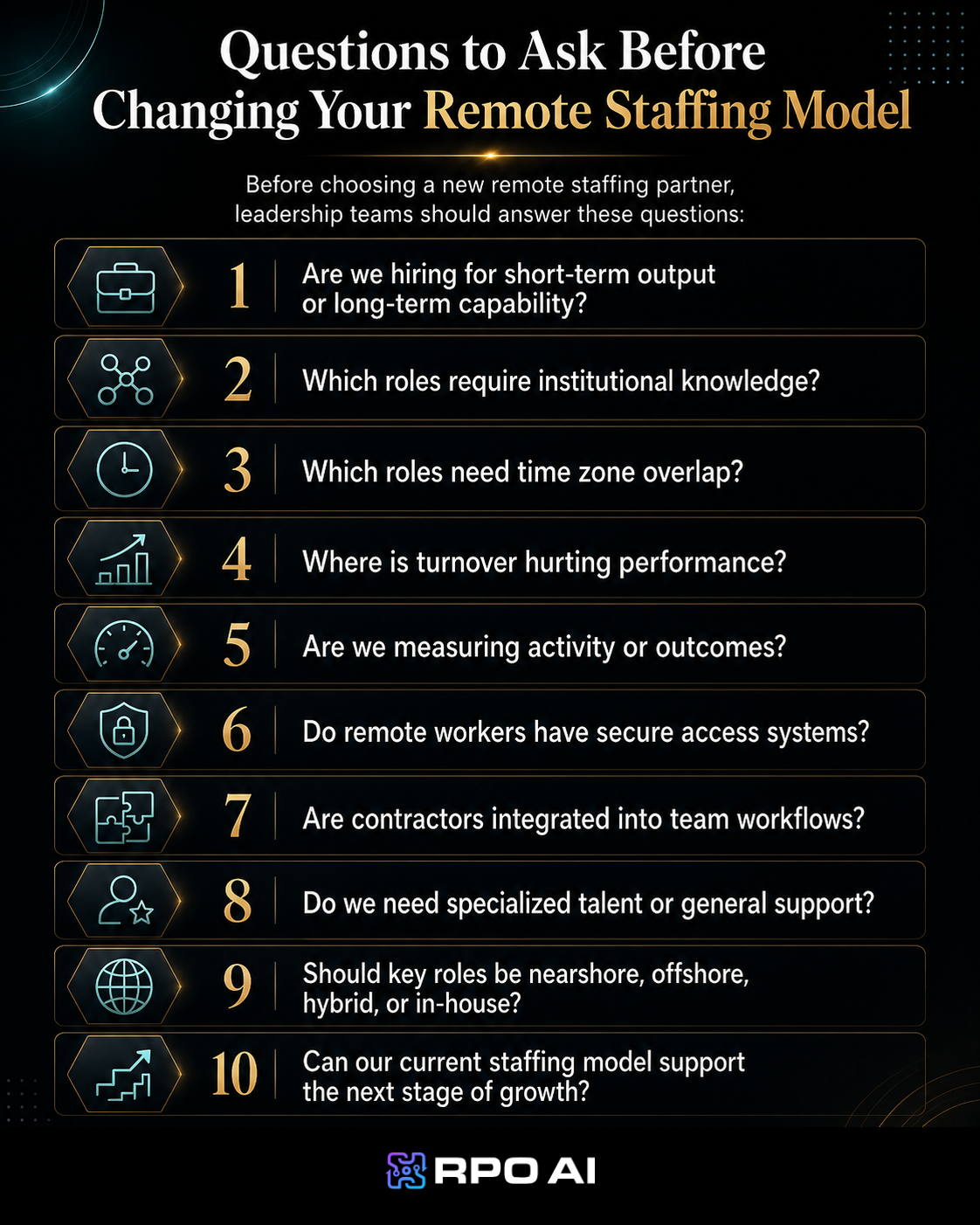
The Future of Remote Staffing Is Direct, Intelligent, and Integrated
Fast-growing companies are not rejecting remote work. They are rejecting outdated remote staffing models.
The future of remote staffing services will be defined by:
– Nearshore talent strategies
– AI-supported recruitment
– Specialized staffing providers
– Stronger cybersecurity controls
– Outcome-based management
– Better retention planning
– Long-term global in-housing
– Hybrid team design
– Stronger cultural integration
Remote staffing is no longer just a cost-saving tactic. For scaling companies, it is an operating strategy.
Conclusion
Fast-growing companies are rethinking remote staffing services because traditional agency models often fail to deliver the speed, stability, security, and alignment required for aggressive growth.
The old model focused on filling seats. The new model focuses on building capability.
Companies that want to scale effectively need remote staffing partners that can deliver skilled talent, protect institutional knowledge, reduce security risk, improve collaboration, and support measurable business outcomes.
The companies that win with remote staffing will not be the ones that hire the cheapest workers. They will be the ones who build the most integrated, stable, and high-performing distributed teams.
To explore how we support growing teams
| Talk to Us |
FAQs on Remote Staffing Services
1. What are remote staffing services?
Remote staffing services help companies hire professionals who work remotely. These services may include sourcing, screening, onboarding, payroll support, compliance, and workforce management.
2. Why are fast-growing companies rethinking remote staffing services?
Fast-growing companies are rethinking remote staffing because traditional agency models often create problems with turnover, communication, security, productivity, and long-term alignment.
3. Is remote staffing still a good option for growing companies?
Yes. Remote staffing can be highly effective when companies use the right model. The best results come from specialized talent, strong onboarding, time zone alignment, secure systems, and outcome-based management.
4. What is the difference between offshore and nearshore staffing?
Offshore staffing usually involves hiring talent from distant countries with larger time zone differences. Nearshore staffing uses talent from nearby regions with closer working hours, which improves real-time collaboration.
5. Why is nearshore staffing becoming more popular?
Nearshore staffing is becoming more popular because it offers better time zone overlap, faster communication, stronger collaboration, and easier team integration.

Rameet Singh, Founder & CEO of RPO.AI