
 Log-In
Recruitment process outsourcing has moved well beyond handing open roles to an external recruiting team.
The strongest recruitment process outsourcing companies now combine recruiting expertise, technology, analytics, process design, talent intelligence, and workforce planning into scalable hiring operating models.
That shift changes how companies should evaluate the best RPO companies in 2026.
Everest Group’s RPO State of the Market research describes the market as moving toward more strategic and technology-led recruitment orchestration. Buyers increasingly expect consultative support, workforce insights, AI-enabled recruiting, and modular or project-based RPO models that can adapt as hiring demand changes.
Instead of asking, “Which RPO company is the biggest?” a more useful question is:
Which provider’s operating model best matches how our organization needs to hire?
Quick Comparison of the Best RPO Companies in 2026
| RPO Provider | Best Fit | Key Operating Model Strength |
| RPO AI | AI-enabled and flexible recruiting | Embedded recruiters plus proprietary AI |
| Cielo | Large enterprise programs | Enterprise, project, and modular RPO |
| Korn Ferry | Workforce transformation | RPO plus talent advisory |
| KellyOCG + Sevenstep | Complex enterprise programs | Large-scale and flexible RPO |
| PeopleScout | Global enterprise hiring | Scalable full-cycle and project RPO |
| Hudson Talent Solutions | Multiregional hiring | Flexible and customized talent solutions |
| WilsonHCG | Customized enterprise programs | Strategic and adaptable RPO |
| Allegis Global Solutions | Integrated workforce programs | RPO plus workforce technology |
| AgileOne | Flexible workforce programs | Full-cycle and on-demand RPO |
| ManpowerGroup Talent Solutions | Global hiring programs | Scalable international delivery |
This is a strategic comparison rather than a universal ranking. Every provider has different strengths, and the best choice depends on hiring volume, locations, internal capabilities, technology, and business objectives.
What Makes an RPO Company Stand Out in 2026?
A strong RPO provider should improve the recruiting operating system, not simply provide additional recruiters.
When comparing RPO providers, evaluate these areas:
– Operating model fit: Determine whether the provider can become an extension of your internal talent acquisition function.
– Scalability: Check whether recruiting capacity can expand or contract as hiring demand changes.
– Technology: Evaluate automation across sourcing, screening, scheduling, candidate engagement, and reporting.
– Talent expertise: Look for experience within your industries, job families, and hiring markets.
– Analytics: Ensure hiring leaders can monitor pipeline health, hiring velocity, conversion rates, and recruiter performance.
– Flexibility: Confirm that the engagement can change as business priorities evolve.
This flexibility is increasingly important. Everest Group notes that organizations are looking for modular, project-based, and adaptable recruitment process outsourcing services rather than relying exclusively on rigid long-term outsourcing structures.
10 RPO Companies to Compare in 2026
1. RPO AI
RPO AI is best suited to companies that want recruiting expertise and automation to operate as one system.
Its Recruitment Process Outsourcing services embed recruiting professionals into a company’s existing talent acquisition function. Support can span sourcing, screening, interviews, offers, and onboarding while scaling according to hiring demand.
The company’s main differentiator is its technology model.
Instead of relying entirely on third-party recruiting software, its AI Lab develops AI recruiting agents that support sourcing, candidate outreach, matching, screening, scheduling, and workflow management.
This combination can work particularly well for organizations that need:
– Embedded recruiting capacity
– Flexible hiring support
– AI-assisted recruiting workflows
– Rapid scaling
– Support across multiple roles or regions
For short-term demand spikes, companies can also use on-demand recruiting services instead of building permanent internal recruiter capacity.
RPO AI also reports results including more than 200 hires for Coursera across North America and India and 12 engineering hires in three months for Crexi.
Best fit: Growing and enterprise companies looking for a flexible People + AI recruiting model.
2. Cielo
Cielo is one of the most established enterprise recruitment process outsourcing providers.
Its RPO offering includes enterprise RPO, project RPO, modular RPO, hybrid RPO, and high-volume recruiting models. This range makes it suitable for organizations that need to redesign an entire talent acquisition function or strengthen selected portions of one.
Cielo ranked first overall in HRO Today’s 2025 Enterprise RPO customer satisfaction ratings.
Best fit: Large enterprises with complex or multinational recruiting requirements.
3. Korn Ferry
Korn Ferry combines recruitment outsourcing with broader talent and organizational expertise.
Its RPO portfolio includes full and hybrid outsourcing, project recruitment, flexible recruitment services, AI-supported recruitment technology, and talent acquisition consulting.
This makes Korn Ferry particularly relevant when recruitment transformation is connected to a larger workforce strategy.
Best fit: Enterprises linking talent acquisition with workforce planning and organizational transformation.
4. KellyOCG + Sevenstep
KellyOCG + Sevenstep is suited to organizations managing significant or changing recruitment demand.
KellyOCG positions its RPO programs around flexible talent acquisition, predictive workforce intelligence, and the ability to respond to changing skills requirements.
The provider ranked third overall and first for deal size in HRO Today’s latest enterprise RPO ranking.
Best fit: Large enterprises with complex, high-volume, or rapidly changing workforce requirements.
5. PeopleScout
PeopleScout provides full-cycle and project-based RPO services for organizations ranging from growing businesses to multinational enterprises.
Its model emphasizes scalability, market intelligence, recruiting technology, and flexibility across professional, specialist, leadership, and volume roles.
It can therefore suit organizations looking for standardized recruiting operations while still supporting multiple hiring environments.
Best fit: Companies requiring scalable recruitment across roles, business units, or regions.
6. Hudson Talent Solutions
Hudson Talent Solutions emphasizes customized, flexible recruitment programs supported across the Americas, EMEA, and APAC.
Its services span RPO, sourcing, talent advisory, recruitment technology, contingent workforce solutions, and total talent programs.
This approach can be particularly valuable when hiring requirements differ significantly by geography.
Best fit: Multiregional companies requiring localized recruiting expertise within a broader talent strategy.
7. WilsonHCG
WilsonHCG positions strategic RPO around flexibility, scalability, recruiting technology, and workforce analytics.
Its RPO approach emphasizes integrating the external recruiting partner with an organization’s talent strategy rather than treating outsourcing as a separate recruiting channel.
That can suit companies that already have established internal talent acquisition capabilities but need additional expertise or scale.
Best fit: Enterprises requiring a customized and deeply integrated recruitment model.
8. Allegis Global Solutions
Allegis Global Solutions combines RPO with broader workforce management capabilities.
Its RPO offering can cover talent attraction, sourcing, screening, candidate matching, coordination, and process improvement either end-to-end or across selected recruiting functions.
Its broader workforce capabilities also make it relevant for organizations considering how permanent recruiting fits within a larger talent ecosystem.
Best fit: Enterprises connecting permanent recruitment with wider workforce management strategies.
9. AgileOne
AgileOne provides several RPO models, including full-cycle RPO, recruitment on demand, recruitment marketing, and technology-supported recruiting.
Its approach emphasizes flexibility, scalability, analytics, talent communities, and streamlined hiring processes.
That makes it useful for organizations that need additional recruitment capacity without completely replacing their existing talent acquisition function.
Best fit: Companies needing flexible or integrated recruiting support across changing hiring volumes.
10. ManpowerGroup Talent Solutions
ManpowerGroup Talent Solutions combines global delivery infrastructure with broader workforce expertise.
Its RPO model supports permanent and contingent talent, market insights, workforce analytics, sourcing, and recruitment delivery across multiple markets.
This scale can be valuable for geographically distributed organizations that need consistent recruiting operations across countries.
Best fit: Large multinational organizations prioritizing global reach and scalable recruitment delivery.
Which RPO Operating Model Fits Your Business?
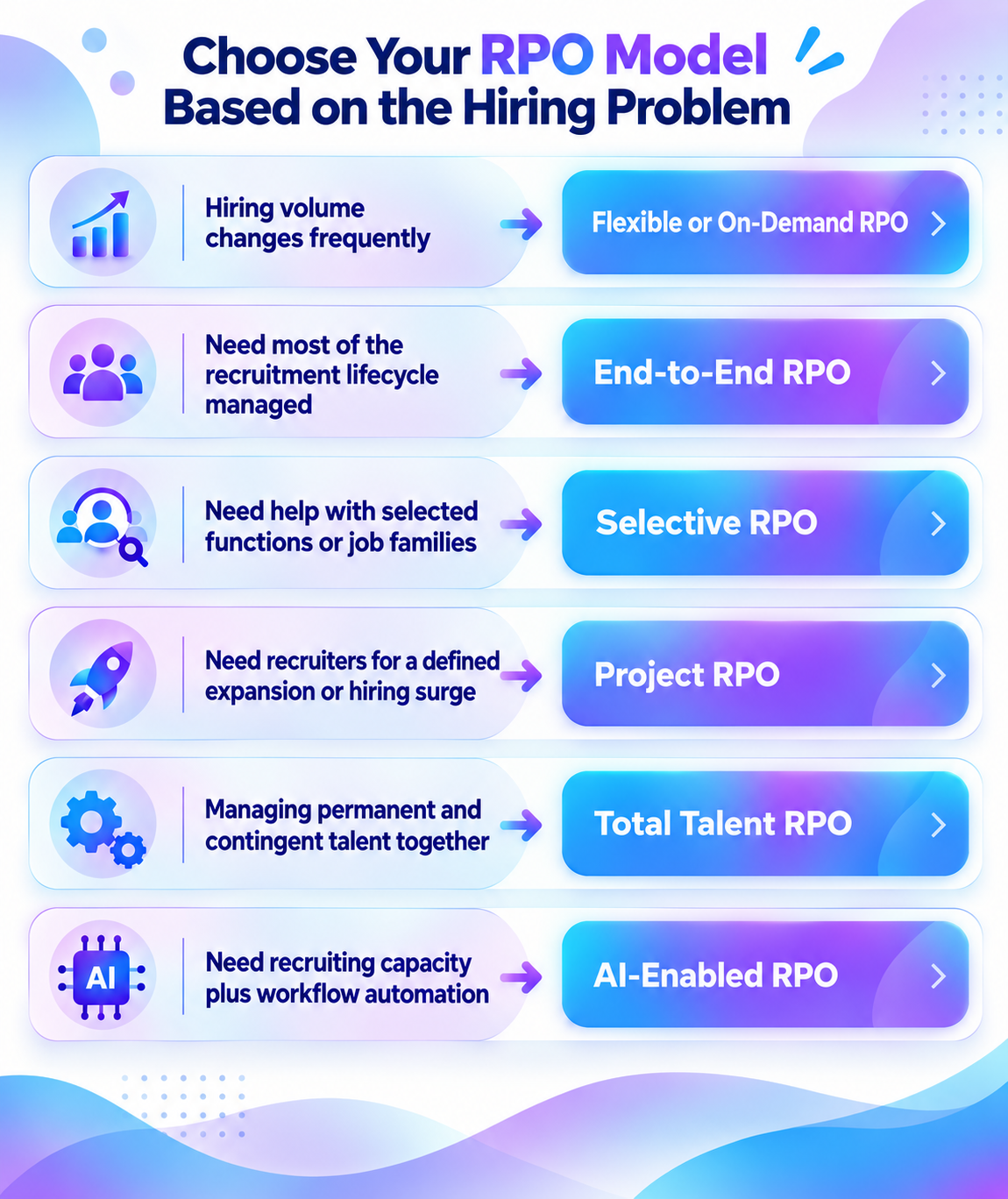
How to Choose an RPO Provider Based on Your Operating Model
The easiest way to make a poor RPO decision is to begin with vendor features.
Start with the hiring problem instead.
Choose End-to-End RPO When Recruitment Needs Structural Change
End-to-end RPO makes sense when an external provider needs to manage most of the recruiting lifecycle.
Responsibilities may include:
– Talent sourcing
– Candidate screening
– Recruitment marketing
– Interview coordination
– Offers
– Reporting
– Onboarding support
This model is useful when internal recruitment capacity consistently falls below business demand.
For a deeper breakdown of how this structure works, see RPO AI’s complete recruitment process outsourcing guide.
Choose Project RPO When Hiring Has a Defined Endpoint
Opening a new location, entering another market, building a product team, or completing a large hiring initiative does not always justify permanently increasing internal recruiter headcount.
Project-based recruitment outsourcing services provide additional capacity around a specific hiring outcome.
Choose Selective RPO When Your Internal Team Already Works Well
Not every organization needs to outsource the whole function.
Sometimes the problem is concentrated in:
– Candidate sourcing
– Technical recruitment
– Screening
– Interview coordination
– Specific regions
– High-volume roles
Selective RPO allows the provider to address those bottlenecks while the internal team continues managing the rest of the process.
Choose AI-Enabled RPO When Recruiter Productivity Is the Constraint
Hiring problems are not always solved by adding recruiters.
Recruiters can lose significant time to sourcing, resume review, scheduling, pipeline updates, data entry, and follow-ups.
AI-enabled RPO combines human recruiting judgment with automation across repetitive workflow stages.
RPO AI describes this approach as moving beyond traditional recruitment outsourcing by combining recruiter execution with automation throughout screening, outreach, scheduling, follow-ups, and pipeline management.
A Practical RPO Selection Framework
Before creating an RFP or provider shortlist, answer these questions.
| Question | What It Helps Determine |
| What recruitment problem needs to change? | Reason for outsourcing |
| Which recruiting activities should remain internal? | Required RPO scope |
| How much does hiring volume fluctuate? | Required scalability |
| Which jobs are hardest to fill? | Needed specialization |
| Which markets need support? | Geographic requirements |
| Which systems must the provider use? | Technology compatibility |
| Which hiring metrics matter most? | Performance expectations |
| How quickly must recruiting capacity change? | Required operating flexibility |
This framework prevents a common procurement mistake: selecting the provider with the broadest capability list instead of the provider whose operating model solves the actual hiring problem.
What Is Changing in the RPO Market in 2026?
The RPO market is shifting from outsourced recruiting execution toward broader talent orchestration.
Broader outsourcing trends are also influencing how companies structure RPO partnerships. More organizations are moving toward flexible and hybrid models that combine internal teams with external specialists, allowing them to scale capacity, access specialized expertise, and adapt faster to changing business needs. For RPO buyers, this makes flexibility, integration, and operating-model fit just as important as recruiting scale.
Three changes are particularly important.
– AI is becoming part of the recruiting infrastructure. Automation increasingly supports sourcing, matching, outreach, screening, scheduling, and workflow management.
– Flexible delivery models are becoming more important. Employers want recruiting capacity that can change with hiring demand.
– RPO relationships are becoming more strategic. Workforce intelligence, technology, skills data, process improvement, and talent advisory are increasingly part of the engagement.
As a result, comparing recruitment outsourcing companies purely on recruiter capacity is becoming less useful.
The stronger question is:
What recruiting operating model can this provider help us build?
Which RPO Company Is Right for Your Business?
There is no universal best RPO company.
The right provider depends on your hiring volumes, regions, technology environment, internal recruitment maturity, workforce strategy, and required level of flexibility.
Large global organizations may prefer established enterprise providers with extensive international delivery infrastructure.
Companies combining permanent and contingent workforce strategies may need providers with total talent capabilities.
Organizations facing unpredictable hiring demand may prioritize project-based or flexible models.
And businesses trying to increase recruiting capacity while simultaneously reducing manual hiring work may find AI-enabled RPO particularly relevant.
For companies evaluating that model, RPO AI combines embedded recruiters with proprietary recruiting technology designed around real hiring workflows.
Frequently Asked Questions
What Are the Best RPO Companies in 2026?
RPO companies worth comparing include RPO AI, Cielo, Korn Ferry, KellyOCG + Sevenstep, PeopleScout, Hudson Talent Solutions, WilsonHCG, Allegis Global Solutions, AgileOne, and ManpowerGroup Talent Solutions. The best provider depends on your hiring volume, operating model, geography, technology, and workforce objectives.
What Services Do RPO Companies Provide?
RPO companies can manage sourcing, screening, interview coordination, recruitment marketing, hiring technology, analytics, offers, onboarding support, and workforce planning. Some providers manage the entire recruitment lifecycle, while others provide project-based, selective, or on-demand support.
How Do I Compare RPO Providers?
Compare RPO providers based on operating model fit, industry expertise, recruiter quality, geographic coverage, scalability, technology, reporting, implementation approach, pricing structure, and measurable hiring outcomes. Start with your recruitment problem rather than evaluating providers only by their list of services.
What Is the Difference Between RPO and a Recruitment Agency?
A recruitment agency typically focuses on filling individual positions. RPO usually involves deeper integration with an employer’s talent acquisition function and may include process ownership, technology, recruiting teams, analytics, employer branding, and ongoing workforce strategy.
Is RPO Suitable for Companies With Fluctuating Hiring Needs?
Yes. Project-based, on-demand, and flexible RPO models allow companies to increase or reduce recruiting capacity as hiring demand changes. This can help organizations manage hiring surges without permanently expanding their internal talent acquisition team.
Ready to Build a More Flexible RPO Strategy?Explore how RPO AI can help you combine embedded recruiting expertise, scalable hiring support, and AI-enabled workflows around your business needs. |

Rameet Singh, Founder & CEO of RPO.AI