
 Log-In
The “perfect candidate” just walked out the door, but your hiring team is paralyzed. One interviewer loved their energy; another felt they lacked a specific technical nuance, but no one can agree on why. If this sounds familiar, you aren’t just losing time—you’re losing talent.
In today’s high-velocity Talent Acquisition landscape, the traditional, conversational interview is a liability. When interviews lack a roadmap, they drift into subjective “vibes,” leading to inconsistent evaluations and agonizingly slow decision-making. This friction doesn’t just frustrate your team; it damages the candidate experience and leads to negative company reviews that scare off future applicants.
The solution isn’t to interview more people; it’s to interview smarter. By implementing a structured interview framework, you transform the interview from a vague conversation into a precision tool for evaluation, ensuring that speed and quality finally work hand-in-hand.
TL;DR
A structured interview framework is a standardized hiring method where every candidate is asked the same predetermined questions and evaluated against a consistent rubric.
By prioritizing recruiter-hiring manager alignment during an initial intake meeting, organizations can eliminate “gut-feel” bias, improve company reviews, and accelerate the hiring process by making data-backed decisions in real-time.
What is a Structured Interview Framework?
A structured interview framework is a repeatable system where every applicant for a role is asked the same set of questions in the same order. These are typically behavioral questions designed to elicit evidence of past performance rather than hypothetical “what if” scenarios.
By using a standardized scoring rubric, the hiring panel can move from “I think they are a good fit” to “This candidate scored a 4.5/5 on our core competency requirements.”
How Does Structured Hiring Speed Up the Process?
Efficiency in the hiring process isn’t about cutting corners; it’s about eliminating the ambiguity that leads to hesitation.
- Removes Interviewer Bias: By focusing on data rather than “vibes,” teams spend less time debating subjective impressions and more time reviewing evidence of skills.
- Streamlines Feedback: With a clear rubric, interviewers can submit feedback in minutes rather than hours.
- Reduces the Number of Interview Rounds: When interviews are high-quality and targeted, you don’t need a “sixth round” to be sure about a candidate.
Improves Recruiter-Hiring Manager Alignment: When everyone agrees on the scorecard upfront, there are no surprises at the final stage.
The Pillar of Success: Recruiter-Hiring Manager Alignment
The most common reason for a slow hiring process is a lack of clarity between the person finding the talent and the person making the decision. Achieving recruiter-hiring manager alignment is the foundation of any structured framework.
The Critical Role of the Intake Meeting
The intake meeting is the most important 30 minutes in the entire recruiting lifecycle. During this session, the recruiter and hiring manager must define:
- Success Indicators: What does “excellent” look like for this specific role?
- Must-Have vs. Nice-to-Have: Which skills are non-negotiable?
- The Interview Panel: Who is testing which competency?
“A well-executed intake meeting can reduce the time-to-fill by up to 30% by ensuring the first batch of candidates is exactly what the manager needs.”
Designing the Interview: Behavioral Questions & Rubrics
A structured framework relies heavily on behavioral questions. These are designed to elicit specific examples of past performance, which is the best predictor of future behavior.
Implementing Behavioral Questions
Instead of asking, “Are you good at multitasking?” ask: “Tell me about a time you had to manage three high-priority projects with the same deadline. How did you prioritize your efforts?”
Using Scoring Rubrics
To maintain objectivity, each question should have a corresponding rubric. For example:
- Score 1 (Poor): Candidate could not provide a specific example or showed a lack of accountability.
- Score 3 (Average): Candidate provided an example but lacked detail on the outcome.
Score 5 (Excellent): Candidate used the STAR method (Situation, Task, Action, Result) and demonstrated high proficiency.
Impact on Candidate Experience and Company Reviews
Speed and structure don’t just benefit the employer; they are vital for candidate experience. Candidates today are highly sensitive to disorganized processes.
A structured interview signals that your company is professional, values its time, and treats all applicants fairly. This professionalism often translates into positive company reviews on platforms like Glassdoor and LinkedIn. Even rejected candidates are more likely to speak highly of your brand if they feel the process was transparent and merit-based.
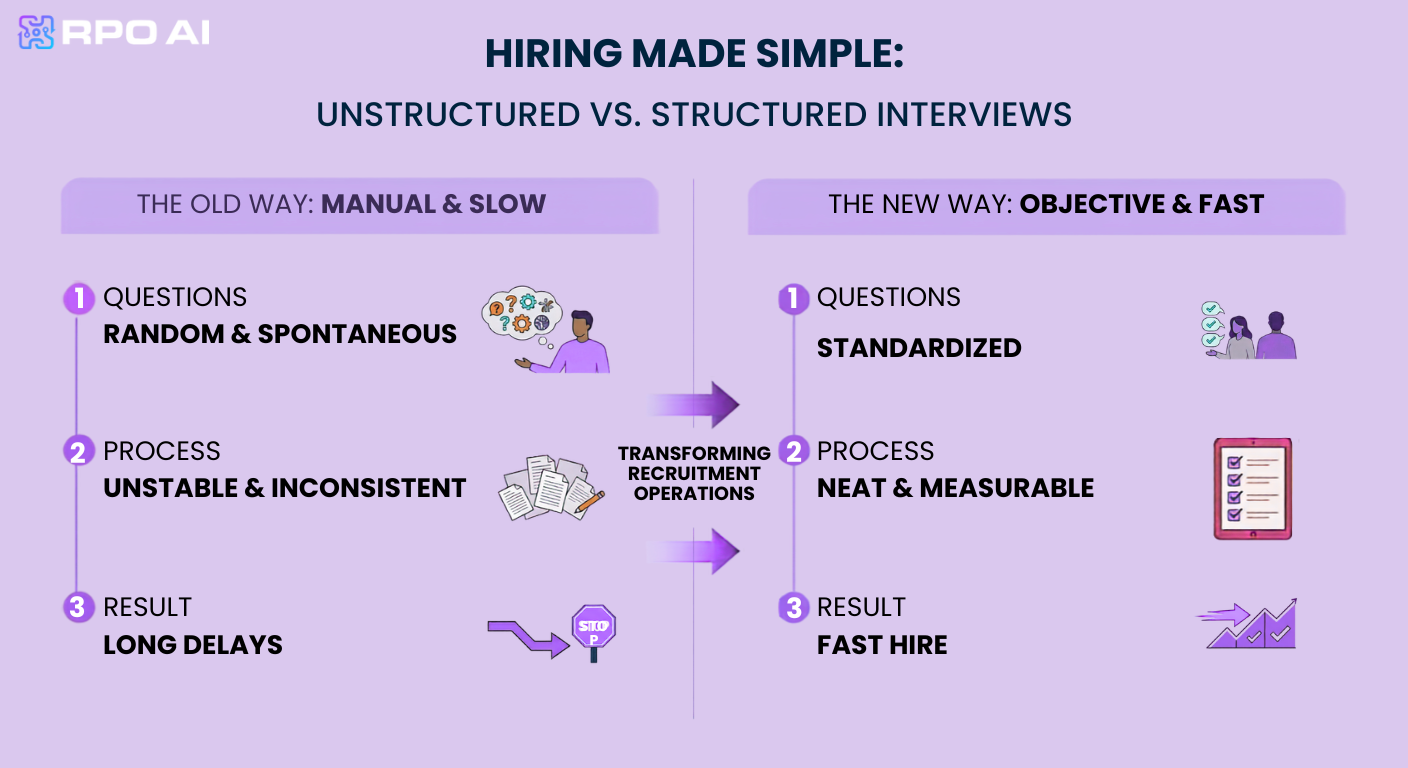
Structured vs. Unstructured Methods
| Feature | Structured Interviews | Unstructured Interviews |
| Questioning | Standardized for all | Conversational / Spontaneous |
| Evaluation | Pre-defined scoring rubric | Subjective “Gut feeling.” |
| Decision Speed | High (Data-backed) | Low (Requires heavy debate) |
| Legal Risk | Minimal (Standardized records) | High (Potential for bias claims) |
| Bias Mitigation | High | Low |
Step-by-Step Checklist for Implementation
- Hold an Intake Meeting: Align on the profile and the scorecard.
- Define Competencies: Map 3–5 core skills required for the job.
- Draft Questions: Create a list of questions for each competency.
- Train the Panel: Ensure all interviewers understand the scoring rubric.
Review Data: Post-interview, compare scores to make a data-driven hiring decision.
Building a Faster, Fairer Future
Adopting a structured interview framework is the most effective way to modernize your Talent Acquisition strategy. While it requires an upfront investment in recruiter-hiring manager alignment and a detailed intake meeting, the dividends are clear: faster decisions and higher-quality hires.
By grounding your hiring process in data and behavioral questions, you protect your brand from bias and improve your company reviews. In a competitive market where top talent vanishes quickly, a structured approach isn’t just an organizational preference—it is your ultimate competitive advantage.
Frequently Asked Questions
1. How do structured interviews improve the hiring process?
They replace subjective debates with objective data. By using a consistent rubric, teams reach consensus immediately, eliminating decision paralysis and identifying qualified talent up to 40% faster than traditional methods.
2. What is the difference between structured and unstructured interviews?
Unstructured interviews are spontaneous and prone to bias. Structured interviews use identical behavioral questions for all candidates, allowing for an “apples-to-apples” comparison that accurately predicts future job performance.
3. Why is an intake meeting necessary for structured hiring?
The intake meeting establishes recruiter-hiring manager alignment. It defines success metrics and scoring benchmarks upfront, preventing wasted time on mismatched candidates and ensuring the entire team pursues the same goal.

Rameet Singh, Founder & CEO of RPO.AI