
 Log-In
 One hard-to-fill role is manageable. Fifty open requisitions arriving at once is a different story.
That is the reality many MSP staffing programs face: hiring demand spikes without warning, qualified talent gets harder to find, suppliers compete for the same candidates, and hiring managers still expect speed, quality, and cost control. When recruiting capacity cannot keep pace, even a well-built MSP program starts feeling the pressure.
Understanding the biggest MSP staffing challenges is the first step toward building a workforce model that can handle demand without sacrificing candidate quality or operational control.
Quick TakeawayMSP staffing problems usually come down to four connected issues: – Visibility: Track aging requisitions, supplier response, and candidate conversion—not just submission volume. – Vendor control: Measure suppliers by interviews, offers, starts, and SLA performance rather than activity alone. – Candidate quality: Follow candidates from submission through successful assignment to identify where quality breaks down. – Recruiting capacity: Before adding more vendors, determine whether the real bottleneck is sourcing, screening, follow-up, or supplier coverage. |
Why MSP Staffing Problems Tend to Travel Together
As an MSP program grows, the number of handoffs grows with it. More requisitions mean more supplier activity. More suppliers mean more candidate submissions to evaluate. More hiring managers bring different priorities, feedback habits, and expectations.
That is why effective contingent workforce management needs more than a VMS and a preferred supplier list. The MSP needs a clear way to see demand, assess vendor performance, measure candidate quality, and decide where the team should step in.
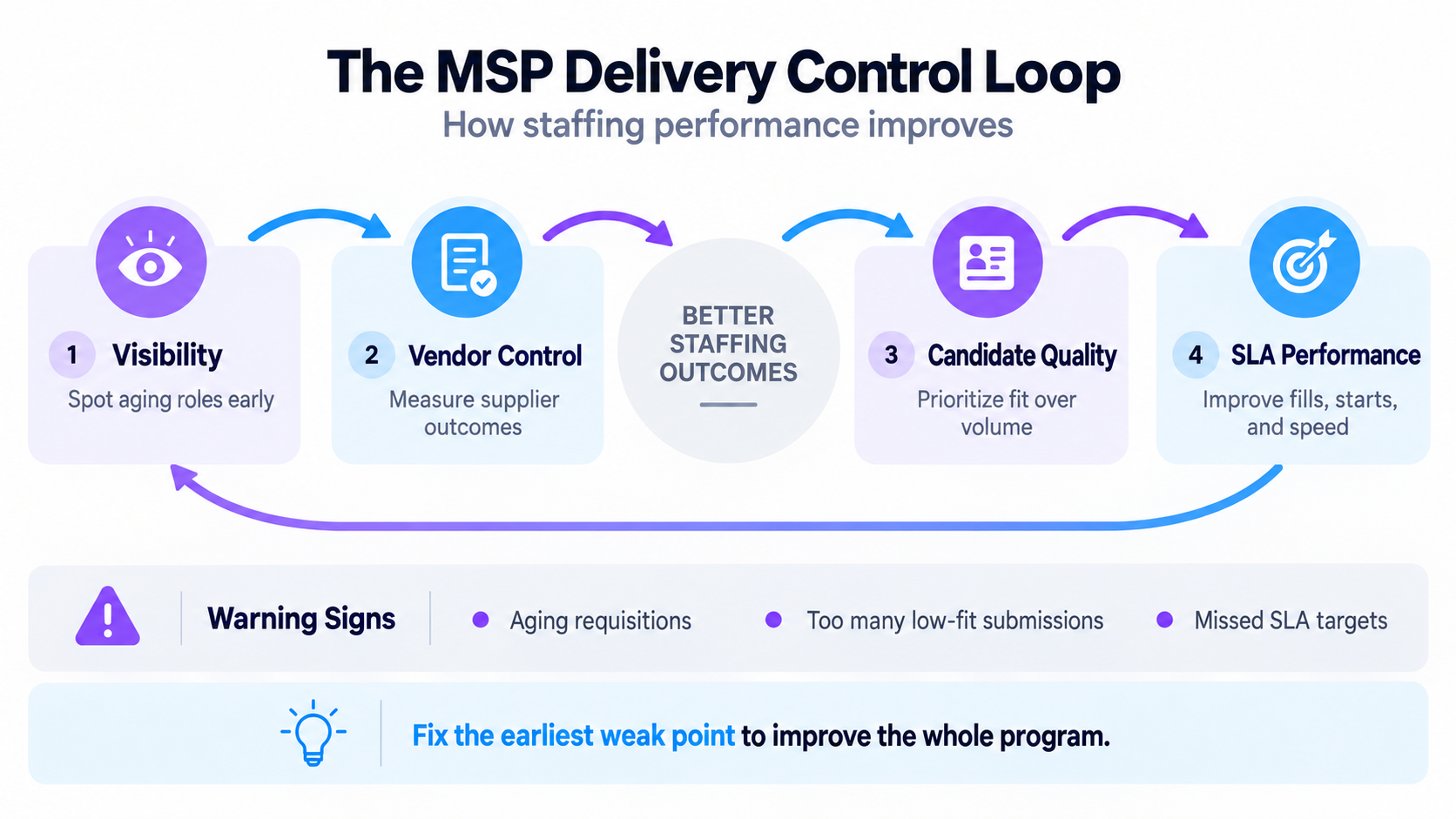
A useful way to think about this is as an MSP delivery control loop:
Visibility → Vendor Control → Candidate Quality → SLA Performance
When this loop works, problems show up early. When it does not, familiar warning signs appear:
– Critical requisitions age without enough qualified candidates.
– Some suppliers generate volume but very few interviews.
– Hiring managers reject candidates for the same reasons repeatedly.
– Recruiters start prioritizing submission speed over fit.
– SLA risks appear only after valuable time has already been lost.
These issues are connected. The first job is finding where the breakdown begins.
Challenge 1: Having Data but Not Enough Visibility
Most MSP programs do not lack data. They lack clear answers.
A VMS can show how many requisitions are open, how many candidates were submitted, when suppliers responded, and how many placements were completed. But activity data alone does not tell program leaders whether the recruiting funnel is healthy.
Imagine an MSP receives 200 submissions in one week. That sounds productive. But what if most of those candidates were sent to straightforward roles while several business-critical requisitions received almost no qualified interest?
The total still looks good. The client experience does not.
This is one of the biggest visibility issues in VMS staffing environments. Teams can end up tracking what is easy to count instead of what helps them make a decision.
Focus on Where Candidates Stop Moving
Fill rate matters, but by the time it falls, the underlying issue may already be weeks old. Strong MSP teams also watch earlier signals.
Useful measures include:
– Requisition aging: How long has the position been open, and what progress has been made?
– Time to first qualified submission: How quickly does useful recruiting activity begin?
– Supplier response rate: Which vendors actively work the requisitions they receive?
– Submission-to-interview ratio: Are hiring managers seeing candidates they actually want to meet?
– Interview-to-offer ratio: Are interviewed candidates properly aligned with the role?
– Offer-to-start ratio: Are accepted candidates reaching their start date?
– Candidate withdrawal rate: At what stage is the program losing talent?
No single metric tells the full story. The value comes from reading them together.
For example, fast submissions combined with a poor interview rate often point to weak qualification. Very few submissions across the supplier network may instead signal an unrealistic rate, narrow requirements, a difficult location, or limited talent availability.
Tracking the right recruitment efficiency metrics helps teams separate a sourcing problem from a screening, process, or conversion problem.
Visibility Should Lead to Action
Good reporting should make the next decision easier.
If an important requisition has been open for two weeks without a qualified submission, the team should be able to see whether suppliers are responding, candidates are being screened out, or market conditions are causing the delay.
If candidates regularly reach interviews but rarely receive offers, sending more résumés will not fix the real issue.
That is the difference between having a dashboard and having operational visibility. One records activity. The other tells the MSP where to act.
Challenge 2: Controlling Vendors Without Creating More Friction
A broad supplier network can be a strength. Different staffing firms bring different talent pools, geographic reach, industry knowledge, and recruiting methods.
But that variety also makes consistency harder.
One supplier may respond within hours, while another spends more time screening. One may excel at technology roles but struggle with finance or specialized hiring.
Strong MSP vendor management is not about forcing every supplier to work identically. It is about making the expected outcome clear.
Stop Confusing Activity With Performance
Consider two suppliers working on similar requisitions:
Supplier | Submissions | Interviews | Offers | Starts |
| Supplier A | 30 | 4 | 1 | 0 |
| Supplier B | 10 | 6 | 3 | 2 |
Supplier A looks busier. Supplier B creates more value.
If an MSP mainly rewards speed and submission count, it can unintentionally encourage vendors to submit candidates before they are properly qualified.
A practical supplier scorecard should balance:
– Speed: Response rate and time to first qualified submission
– Quality: Submission-to-interview and interview-to-offer conversion
– Delivery: Offers accepted, starts, and successful assignments
– Reliability: Candidate withdrawals, no-shows, and SLA adherence
– Process quality: Accurate information, documentation, and compliance
This makes staffing vendor management much less subjective. Instead of saying candidate quality “feels weak,” the MSP can show exactly where a supplier’s candidates stop progressing.
Compare Suppliers Fairly
Supplier scorecards can mislead when every vendor is measured against the same benchmark.
A company sourcing specialized cybersecurity professionals should not necessarily produce the same submission volume as one filling administrative roles. Geography, role complexity, compensation, candidate scarcity, and security requirements all influence performance.
Segmenting suppliers by job family, geography, hiring volume, or requisition difficulty gives MSP leaders a more realistic view. The goal is not a simple vendor leaderboard. It is to understand which suppliers perform best under specific conditions.
Give Vendors Feedback They Can Use
Measurement alone will not improve supplier performance.
If candidates keep being rejected for the same reason, vendors need to know. If a hiring manager changes expectations after sourcing begins, suppliers need that information too.
Useful feedback can cover:
– Why candidates were rejected
– Which skills were missing most often
– Where compensation expectations were misaligned
– Which profiles performed well in interviews
– Whether submission volume is too high or too low
Supplier governance works best as a feedback loop rather than a quarterly report card. Clear feedback gives vendors a chance to adjust before poor performance becomes a recurring pattern.
Challenge 3: Candidate Quality Falls When Speed Becomes the Main Goal
Speed matters in staffing. Strong candidates often have several opportunities, and slow decisions can lose them.
But speed can also work against the program.
When multiple suppliers believe being first matters more than being accurate, screening gets shorter. Candidates may be submitted before the recruiter has fully confirmed skills, motivation, compensation expectations, availability, or interest in the assignment.
The result is familiar: submissions rise while interviews do not.
For hiring managers, this looks like poor candidate quality. For the MSP, it means more profile reviews, more rejected candidates, more supplier follow-up, and ultimately a slower process.
Make Candidate Quality Measurable
Instead of asking whether a supplier “sends good candidates,” track what happens after submission:
Submission → Interview → Offer → Start → Successful Assignment
Different patterns point to different problems:
– Many submissions, few interviews: Likely screening or role-understanding issues
– Many interviews, few offers: Possible skills, rate, assessment, or expectation gaps
– Many offers, few starts: Candidate engagement or competing offers may be the problem
– Good starts, early assignment failures: Role expectations or fit may need closer review
A structured candidate screening process matters because screening should confirm more than résumé keywords. Skills, motivation, availability, expectations, and role alignment all affect whether a submission is genuinely useful.
For managed service provider staffing teams, this makes candidate quality measurable rather than subjective.
Candidate Quality Often Starts With Requisition Quality
Not every poor submission begins with the supplier.
Sometimes the requisition itself is unclear. A job description may list ten skills as mandatory when only four really matter. The pay rate may not match the requested experience. The hiring manager may know exactly what they want but may never have explained it properly.
Recruiters cannot consistently attract qualified candidates when the role, must-have skills, compensation, and evaluation criteria are unclear from the beginning.
Before releasing a difficult role, MSP teams should clarify:
– Which skills are truly non-negotiable?
– Which requirements can be flexible?
– What determines whether a candidate gets an interview?
– Is the rate realistic?
– What makes the assignment attractive?
– How quickly can the hiring manager provide feedback?
A stronger intake process reduces waste later and gives suppliers a better chance of getting the first submission right.
Sometimes the Real Problem Is Recruiting Capacity
Visibility may be strong. Suppliers may be capable. Requisitions may be clear.
The program can still struggle when recruiting resources cannot keep up with demand.
This often happens during a new client launch, seasonal hiring increase, major project, or sudden rise in requisition volume. Existing recruiters may still perform well, but there are more roles than they can cover with the same level of sourcing, screening, and follow-up.
This is where good workforce planning matters. Hiring demand, recruiter capacity, talent-pipeline readiness, and expected spikes should be considered before the workload becomes an emergency.
Common signs of a capacity problem include:
– Good suppliers are responding, but not to every requisition.
– High-priority roles compete with routine positions for recruiter attention.
– Candidate follow-up slows during peak periods.
– Existing talent pools are not being maintained.
– Job-ad responses accumulate faster than recruiters can review them.
– Recruiters spend more time on administration than sourcing.
At that point, the MSP needs to decide whether it has a supplier problem or a capacity problem.
Adding another vendor may increase candidate flow, but it also creates another relationship to onboard, measure, and manage. If execution capacity is the real bottleneck, added complexity may solve very little.
What RPO.ai Has Seen When Recruiting Bandwidth Becomes the Bottleneck
RPO.ai has seen a common pattern in staffing operations: demand grows, the team is capable, but there simply are not enough recruiting hours to keep up.
In one staffing-agency engagement, this happened during peak hiring periods. RPO.ai added support for sourcing and managing job ad responses, which helped the agency handle 30% more requisitions without adding fixed recruiting costs. The key lesson was simple. The problem was not a lack of vendors. It was a lack of recruiting capacity at the right point in the process.
While this example comes from a staffing agency rather than a named MSP program, the same issue can show up in MSP environments. When requisition volume rises faster than sourcing, screening, or candidate follow-up capacity, adding another supplier may create more activity without fixing the real bottleneck.
A Practical MSP Staffing Health Check
When fill rates fall or hiring managers become dissatisfied, the natural response is often to make a visible change quickly.
Add vendors. Replace vendors. Tighten SLAs. Change technology.
Sometimes those actions are necessary. But diagnosis should come first.
Before changing the operating model, MSP leaders should ask:
– Can we identify aging requisitions with no qualified pipeline?
– Do we know which suppliers create interviews rather than just submissions?
– Can we explain the most common reasons candidates are rejected?
– Are suppliers measured on outcomes as well as speed?
– Can recruiting capacity increase when requisition volume suddenly rises?
– Are hiring managers giving timely, useful feedback?
– Can we identify SLA risk before the SLA is missed?
– Do we know which roles require specialized supplier support?
If several answers are “no,” the program may have an operating-model problem before it has a vendor problem.
This is where contingent workforce management becomes less about adding infrastructure and more about making the existing pieces work better together.
When More Recruiting Support Makes More Sense Than Another Vendor
There are good reasons to expand a supplier network. An MSP may be entering a new market, looking for specialized skills, or covering a geography where existing vendors are weak.
But vendor expansion should not become the default response to every difficult requisition.
Additional recruiting capacity may make more sense when the issue is
– Insufficient sourcing bandwidth
– Slow candidate screening
– Weak coverage during hiring spikes
– Underdeveloped talent pipelines
– High volumes of unreviewed applicants
– Recruiters spending too much time on coordination
These situations are common in high-volume recruiting, where hiring speed depends heavily on standardized processes, efficient screening, candidate communication, and enough capacity to keep the funnel moving.
This distinction matters in VMS staffing programs that already have a capable supplier network. If the MSP has enough vendors but not enough recruiting capacity to support demand, another vendor addresses the wrong problem.
What Healthy MSP Staffing Looks Like
A healthy MSP program is not the one with the most vendors or submissions. It is the one where leaders understand what is happening.
They can quickly identify at-risk requisitions. Suppliers know what is expected and receive useful feedback. Hiring managers receive smaller, stronger candidate slates. Recruiting capacity can expand when demand changes without forcing the MSP to permanently increase costs.
Good MSP vendor management supports this by making supplier performance visible and actionable. Good staffing vendor management creates clear expectations without turning the program into unnecessary bureaucracy.
Most importantly, problems appear before SLAs are missed.
Visibility shows the MSP where to look. Vendor control creates consistency. Candidate quality determines whether recruiting activity turns into successful starts. When those pieces work together, MSP staffing becomes far more predictable.
Ready to Strengthen Your MSP Recruiting Capacity?
If your supplier network is already in place but requisition coverage or candidate pipelines are becoming harder to maintain, adding more vendors may not be the only option.
RPO.ai helps MSP teams extend sourcing and recruiting capacity, maintain qualified talent pipelines, and work within existing VMS processes as demand changes.
Build a More Scalable Recruiting Model
Frequently Asked Questions About MSP Staffing
What is an MSP in staffing?
An MSP in staffing is a managed service provider that oversees some or all of an organization’s contingent workforce program. It can coordinate staffing suppliers, distribute requisitions, standardize processes, monitor SLAs, support compliance, and report on workforce performance.
What is the difference between an MSP and a VMS?
An MSP is the people and service layer that manages the workforce program. A VMS is the technology used to support requisitions, candidate submissions, approvals, time tracking, supplier activity, and reporting. Many contingent workforce programs use both together.
What does an MSP do in recruitment?
An MSP can manage day-to-day contingent hiring processes, including supplier coordination, requisition distribution, SLA monitoring, candidate-flow oversight, workforce reporting, onboarding support, and vendor performance management.
How is MSP staffing different from working with a staffing agency?
A staffing agency mainly sources and places its own candidates. An MSP typically manages a broader contingent workforce program involving multiple staffing suppliers, standardized processes, reporting, governance, and often VMS oversight across the supplier ecosystem.

Rameet Singh, Founder & CEO of RPO.AI