
 Log-In
Reducing time to hire is not about rushing decisions. It is about removing delays that do not improve hiring quality. Slow hiring often comes from unclear roles, manual scheduling, late feedback, and misaligned interviewers. A structured process helps teams source better candidates, automate repetitive work, shorten interview timelines, and make confident decisions faster.
Want to hire faster without lowering standards? Connect with us.
What Is Time to Hire?
Time to hire is the number of days between when a candidate enters your hiring pipeline and when they accept an offer.
It is different from time to time. Time to fill usually measures the total time between opening a role and filling it. Time to hire focuses on how quickly a specific candidate moves through the hiring process.
A long time to hire usually signals friction in screening, interviews, feedback, approvals, or offer management.
Why Reducing Time to Hire Matters
A slow hiring process can damage both hiring quality and candidate experience.
Top candidates rarely stay available for long. If your process takes weeks while competitors make decisions in days, you may not be choosing from the best available talent. You may be choosing from the candidates who are still left.
Reducing time to hire helps companies:
– Improve candidate experience
– Reduce candidate drop-off
– Increase offer acceptance rates
– Lower recruiter workload
– Improve hiring manager alignment
– Fill critical roles faster
– Compete more effectively for high-quality talent
The goal is not to move fast blindly. The goal is to remove steps that add time but do not improve hiring accuracy.
1. Start With a Clear Hiring Scorecard
The fastest hiring teams align before they start reviewing candidates.
A hiring scorecard defines what the team is looking for, how candidates will be evaluated, and what evidence is required to make a decision.
Before sourcing begins, align on:
– Role outcomes
– Required skills
– Must-have qualifications
– Nice-to-have qualifications
– Compensation range
– Interview stages
– Evaluation criteria
– Decision owner
This prevents hiring managers from using the first several interviews to figure out what they actually want.
A clear scorecard also reduces subjective decision-making. Instead of relying on gut feel, interviewers evaluate candidates against the same role-specific criteria.
What to Include in a Hiring Scorecard
A strong scorecard may include:
– Technical or functional skills
– Problem-solving ability
– Communication
– Relevant experience
– Collaboration
– Motivation for the role
– Role-specific competencies
Each category should have a simple rating scale and clear notes. This makes candidate comparison faster, fairer, and more consistent.
2. Separate Must-Haves From Nice-to-Haves
Unclear requirements are one of the biggest causes of slow hiring.
When every qualification is treated as mandatory, teams reject strong candidates for minor gaps. When requirements are too vague, teams interview too many weak-fit candidates.
Before launching the role, separate requirements into three groups:
– Must-haves: Skills, qualifications, or conditions required to succeed in the role.
– Nice-to-haves: Experience or traits that are useful but not essential.
– Trainable skills: Tools, processes, or knowledge that a strong candidate can learn after joining.
This distinction helps teams move faster because they know which gaps matter and which do not.
It also prevents analysis paralysis. Once a candidate meets the agreed hiring bar, the team can make a decision instead of delaying the process to search for someone “perfect.”
3. Improve Sourcing Quality Before Screening
A slow hiring process often starts with poor sourcing.
If recruiters are spending too much time reviewing unqualified resumes, the issue is not just screening speed. The issue is pipeline quality.
Instead of relying only on broad job postings, focus on targeted sourcing channels that are more likely to produce qualified candidates.
Effective sourcing channels include:
– Employee referrals
– Niche talent communities
– Industry-specific job boards
– Past strong applicants
– Silver-medalist candidates
– Alumni networks
– Specialized recruiting partners
– Candidates already engaged with your employer brand
The goal is not to attract the highest number of applicants. The goal is to attract candidates who are more likely to match the role.
Build a Warm Talent Pool
Companies that start sourcing only after a role opens are already behind.
A warm talent pool gives recruiters a list of qualified candidates to contact when a new role becomes available.
Your talent pool should include:
– Strong past applicants
– Previous finalists
– Referred candidates
– Passive candidates
– Former interns or contractors
– Candidates who declined previous offers but stayed engaged
Tag candidates by skills, seniority, location, compensation expectations, and role interest. This makes future searches faster and more relevant.
4. Use Recruitment Technology to Remove Administrative Delays
Technology can reduce the time to hire when it removes repetitive work. It should not replace human judgment in important hiring decisions.
The best use of recruitment technology is to automate low-value administrative tasks so recruiters and hiring managers can focus on evaluation, communication, and closing candidates.
Automate Scheduling
Manual scheduling can add days to every interview stage.
Self-scheduling tools allow candidates to choose available interview times based on synced calendars. This eliminates back-and-forth emails and keeps the process moving.
Scheduling automation is especially useful for:
– Recruiter screens
– Hiring manager interviews
– Panel interviews
– Candidate reminders
– Rescheduling requests
Use AI Screening Carefully
AI screening can help prioritize applicants, summarize resumes, and identify candidates who match predefined criteria.
However, it should be used carefully. Poorly configured tools can reject qualified candidates because of missing keywords, unconventional backgrounds, or resume formatting issues.
To use AI screening without lowering quality:
– Define screening criteria before using automation
– Keep humans involved in final screening decisions
– Review a sample of rejected candidates
– Avoid relying only on keyword matching
– Monitor for bias and false negatives
– Tie screening criteria to the hiring scorecard
AI should support recruiters, not replace them.
Use Asynchronous Screening When Appropriate
Asynchronous interviews or written screening questions can help evaluate candidates faster at an early stage.
They work best for:
– Basic qualification checks
– Role motivation
– Communication ability
– Scenario-based questions
– Initial technical understanding
Use asynchronous screening to reduce coordination delays, but do not remove meaningful human conversation from the process.
5. Streamline Interview Stages
Too many interview rounds do not always improve hiring quality.
In many cases, extra rounds create repetition, delays, and candidate drop-off. A strong hiring process should have only as many stages as needed to collect reliable evidence.
A focused process may include:
– Recruiter screen
– Hiring manager interview
– Skills or technical assessment
– Final panel or decision interview
For many roles, one or two structured rounds after screening may be enough.
Remove Redundant Interviews
Every interview should answer a specific question.
Remove stages that are:
– Repetitive
– Unstructured
– Based on vague “culture fit”
– Added only to get another opinion
– Not tied to the scorecard
– Unclear in decision value
If an interview does not produce new evidence, it is slowing the process without improving quality.
Assign Each Interviewer a Clear Focus
Do not have every interviewer ask the same general questions.
Assign each person a specific competency to evaluate.
For example:
– Recruiter: motivation, compensation, availability
– Hiring manager: role fit and business outcomes
– Technical interviewer: job-specific skills
– Peer interviewer: collaboration and communication
– Final interviewer: decision validation
This improves signal quality and reduces repeated conversations.
6. Compress the Interview Timeline
Sometimes the problem is not the number of interviews. It is the amount of time between them.
A process that requires three hours of interviews should not take four weeks to complete.
Compress the timeline by scheduling interviews in coordinated blocks. For example, after an initial screen, a candidate can complete the hiring manager interview, technical interview, and panel interview within one or two days.
This reduces:
– Calendar delays
– Candidate drop-off
– Recruiter follow-up work
– Interview fatigue
– Time spent waiting between stages
For senior or specialized roles, a half-day interview block can be more effective than spreading four separate meetings across several weeks.
7. Set Fast Feedback and Decision Deadlines
A hiring process loses momentum when interviewers delay feedback.
Require interview feedback within 24 hours. For urgent roles, feedback should be submitted within a few hours.
Good feedback should include:
– Scorecard ratings
– Evidence for each rating
– Clear recommendation
– Concerns or risks
– Suggested next step
Avoid vague feedback like “good candidate” or “not a fit.” Feedback should be specific enough to support a decision.
Schedule Debriefs in Advance
Do not wait until interviews are complete to schedule the debrief.
If multiple stakeholders need to discuss a candidate, schedule the debrief before the interview block happens. This prevents the team from losing several days after the final interview.
A strong debrief should answer:
– Did the candidate meet the hiring bar?
– What evidence supports the decision?
– Are there any unresolved concerns?
– Is another step truly needed?
– Who owns the next action?
If the team cannot decide, identify the exact missing evidence. Do not add another interview unless it answers a specific question.
8. Optimize the Offer Phase
Many companies move quickly through interviews but lose candidates during the offer stage.
A slow offer process can signal hesitation and give competitors time to move first.
Discuss Compensation Early
Recruiters should discuss compensation expectations during the first screening call.
This helps avoid late-stage surprises and prevents both sides from investing time in a process that is unlikely to close.
Clarify:
– Candidate compensation expectations
– Approved salary range
– Bonus or equity expectations
– Notice period
– Start date
– Location or relocation constraints
– Competing offer status
Prepare Offer Approvals Before the Final Interview
Before the final decision, confirm:
– Salary range
– Benefits details
– Bonus or equity structure
– Approval workflow
– Negotiation limits
– Offer letter process
– Background check requirements
Once the team decides to hire, the offer should move quickly.
9. Track Speed and Quality Together
Time to hire should never be measured alone.
If time to hire improves but new-hire performance drops, the process may be moving too fast or skipping important evaluation steps.
If time to hire improves while retention, performance, and offer acceptance stay strong, the process is becoming more efficient.
Track both speed and quality metrics.
Speed Metrics
– Time to hire
– Time to fill
– Time in each stage
– Scheduling delay
– Feedback turnaround time
– Offer approval time
Quality Metrics
– Offer acceptance rate
– Interview-to-offer ratio
– New-hire performance
– Retention after 6 or 12 months
– Hiring manager satisfaction
– Candidate experience score
– Source quality
The goal is not just faster hiring. The goal is faster, better hiring.
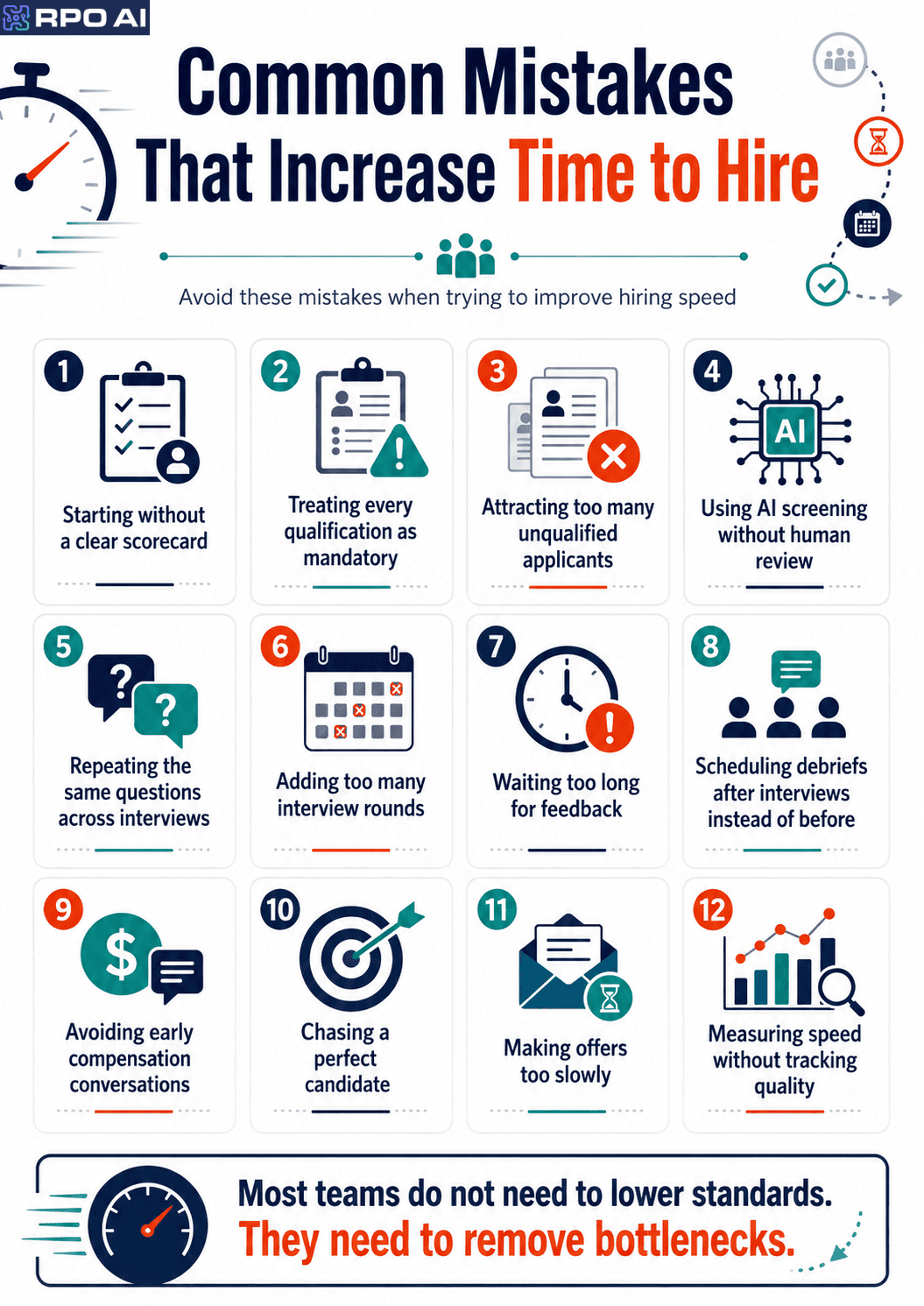
Example of a Faster Hiring Process
Here is a simple 10-day hiring workflow that maintains quality.
Day 0: Intake and Scorecard
Recruiter and hiring manager define the role, outcomes, must-have skills, compensation range, interview stages, scorecard, and decision owner.
Days 1–3: Targeted Sourcing and Screening
Recruiters source from targeted channels and screen candidates using predefined criteria.
Days 4–5: Hiring Manager Interview
Qualified candidates meet with the hiring manager to assess role fit, experience, motivation, and business outcomes.
Days 6–7: Skills Assessment or Panel Interview
Candidates complete a structured evaluation. Interviewers assess assigned competencies using the scorecard.
Day 8: Debrief
Interviewers submit feedback within 24 hours. The hiring team reviews evidence and makes a decision.
Days 9–10: Offer
The recruiter confirms details, sends the offer, and begins closing the candidate.
This process is fast, but it is not careless. Each step has a clear purpose and decision criteria.
Build a Faster Hiring Process Without Sacrificing Quality
Reducing time to hire without lowering hiring quality requires a structured process, not a rushed one. Strong hiring teams move faster because they define role requirements early, use scorecards, automate administrative tasks, remove redundant interviews, and collect feedback quickly.
A slow process does not guarantee better hires; it often causes companies to lose top candidates. When every hiring step has a clear purpose, teams can hire faster while improving candidate experience, recruiter efficiency, and overall hiring quality.
To explore how we support growing teams
| Talk to Us |
FAQs
1. How can companies reduce time to hire without sacrificing quality?
Companies can reduce time to hire by using structured scorecards, improving sourcing quality, automating scheduling, reducing redundant interviews, setting feedback deadlines, and preparing offers in advance.
2. Does faster hiring reduce candidate quality?
Faster hiring does not reduce candidate quality if the process remains structured and evidence-based. It can improve quality by reducing candidate drop-off and helping companies secure strong candidates before competitors do.
3. What is the biggest cause of slow hiring?
The biggest causes of slow hiring are unclear role requirements, too many interview rounds, delayed feedback, manual scheduling, weak sourcing quality, and a lack of decision ownership.
4. Can AI help reduce time to hire?
Yes. AI can help with resume screening, candidate matching, structured questionnaires, scheduling, and pipeline organization. However, AI should support human decision-making, not replace it.
5. How many interview rounds should a company have?
Most hiring processes should include only the stages needed to collect role-relevant evidence. Many roles can be evaluated with a recruiter screen, hiring manager interview, skills assessment, and final decision interview.

Rameet Singh, Founder & CEO of RPO.AI