
 Log-In
Candidates assess your organization while you assess them. Your job description, application form, interview process, response times, and rejection messages all reveal how your company operates.
As hiring becomes more automated, a strong candidate experience requires more than speed. Employers must remove unnecessary friction while preserving transparency, fairness, human judgment, and respect. Companies that get this balance right are better positioned to keep qualified candidates engaged and protect their employer reputation.
Quick Answer: Why Does Candidate Experience Matter?
Candidate experience matters because it influences whether qualified applicants complete the hiring process, accept an offer, recommend the employer, apply again, and maintain a positive view of the company.
A positive candidate experience provides:
– Accurate information about the role.
– A simple application process.
– Clear timelines and next steps.
– Relevant and fair assessments.
– Prepared, respectful interviewers.
– Timely updates and appropriate closure.
– Human accountability when important decisions are made.
A poor experience creates uncertainty and distrust. Candidates may withdraw, reject an offer, discourage others from applying, or publicly criticize the company.
Employer branding is a promise. Candidate experience is the operational proof behind that promise.
What Is Candidate Experience?
Candidate experience is the perception a job seeker forms through every interaction with an employer during the recruitment process.
It reflects what candidates see, what they are asked to do, how they are treated, how long they wait, and whether the process feels understandable and fair.
Candidate experience is related to, but different from, the following concepts:
– The candidate journey is the sequence of recruitment stages and touchpoints.
– Employer brand is the organization’s wider reputation as a workplace.
– Recruitment marketing communicates why someone should consider the employer.
– Employee experience begins when the candidate joins the organization.
A company can have polished recruitment marketing and still deliver a frustrating hiring process. The strength of the employer brand depends partly on whether the experience matches the claims made on the careers page.
Where Does the Candidate Journey Begin and End?
The candidate journey begins before someone applies and continues through rejection or the transition into onboarding.
|
Stage |
What candidates need to understand |
| Employer discovery | What does this organization do, value, and offer to employees? |
| Job research | Is the role credible, suitable, and worth pursuing? |
| Application | Is the process accessible and worth the effort? |
| Screening | What is being evaluated, and what happens next? |
| Interview | Are the people prepared, honest, and respectful? |
| Assessment | Is the exercise relevant, proportionate, and fair? |
| Decision | When will an outcome be communicated? |
| Rejection | Was the candidate’s effort acknowledged appropriately? |
| Offer | Do the final terms match what was discussed? |
| Preboarding | Is the company organized and ready for the new hire? |
A candidate’s experience should not end when an offer is accepted. Silence, contradictory information, or administrative confusion before the start date can quickly weaken the confidence built during recruitment.
Why Candidate Experience Matters More Than Ever
Understanding why candidate experience matters requires looking beyond candidate satisfaction. It affects talent conversion, employer reputation, recruiting operations, fairness, and the long-term talent pipeline.
It Keeps Qualified Candidates in the Hiring Process
Candidates are more likely to remain engaged when the hiring process is clear, relevant, and predictable.
A recruitment process does not have to be completed immediately. It does need to give candidates enough information to make informed decisions.
Candidates should know:
– What the next stage involves.
– Why is each assessment necessary?
– How many interviews to expect?
– When should they receive an update?
– Who can they contact with questions?
– How to request an accommodation.
Survale found that 60% of the top North American CandE winners made an initial candidate disposition within three to five days. These employers also left considerably fewer candidates waiting two months or longer for an update.
The lesson is not that every vacancy must be filled within days. The lesson is that internal delays should not become unexplained candidate delays.
It Affects Offer Acceptance
Candidates use the recruitment process as evidence of what employment at the company might feel like.
Prepared interviewers indicate competent management. Consistent information suggests internal alignment. Honest answers build trust. Repeated delays, disorganization, or changing requirements create doubt.
Candidates may reject an otherwise attractive offer when the hiring process raises concerns about:
– Leadership quality.
– Workplace communication.
– Decision-making.
– Role stability.
– Workload expectations.
– Organizational culture.
– Respect for employees.
Compensation remains important, but the people and process surrounding the offer affect whether candidates trust what they have been promised.
It Protects the Employer Brand
Every applicant leaves the hiring process with an opinion about the company, including candidates who are not hired.
Candidates may share their experiences through:
– Employer-review platforms.
– LinkedIn.
– Reddit and online communities.
– Professional networks.
– Private conversations with colleagues.
– Referrals and recommendations.
Poor communication at scale can become a reputation problem at scale. Future applicants frequently research interview experiences before deciding whether to apply.
Candidate experience therefore has a wider audience than the people currently moving through the recruitment funnel.
It May Affect the Customer Brand
In consumer-facing companies, candidates may also be customers, subscribers, partners, or prospective buyers.
An iCIMS survey of 1,000 US job seekers found that 51% would be less likely to remain consumers after a negative application or interview experience. This does not mean every dissatisfied applicant will stop purchasing from a company. It does show that people may not separate their experience of the employer from their perception of the wider brand.
Candidate experience should therefore be considered a brand-risk issue, not just a recruiting issue.
It Preserves Future Talent Value
A rejected candidate may still become a future hire, referrer, customer, partner, or advocate.
Someone who is not suitable today may become qualified after gaining additional experience. A finalist who loses to another strong candidate may be appropriate for a future position.
A respectful rejection preserves these possibilities. A dismissive rejection, or no rejection at all, can end the relationship unnecessarily.
The objective is not to make every candidate happy with the decision. It is to make the process sufficiently clear and respectful that the candidate can understand and accept how the decision was handled.
It Improves Recruiting Efficiency
A well-designed process reduces avoidable work for recruiters, candidates, and hiring managers.
A confusing process generates:
– Status-update requests.
– Scheduling problems.
– Interview no-shows.
– Repeated explanations.
– Candidate withdrawals.
– Offer-stage uncertainty.
– Restarted searches.
– Duplicate work across HR teams.
Improving the experience can support higher application completion, faster interviewer feedback, better candidate responsiveness, and fewer late-stage withdrawals.
However, candidate experience should not be reduced to speed. A fast process can still be inconsistent, inaccessible, or unfair. Efficiency means removing work that does not improve the hiring decision.
It Supports Fairer and More Accessible Hiring
Candidates are more likely to trust a process when they are evaluated using consistent, job-related criteria.
Structured interviews use consistent questions and scoring criteria, helping candidates receive a fairer assessment.
Employers should also provide reasonable accommodations during applications, interviews, and assessments. Anti-discrimination laws may apply when AI or automated hiring tools influence employment decisions, so requirements should be reviewed by jurisdiction.
What Does a Poor Candidate Experience Look Like?
A poor candidate experience is usually caused by accumulated process failures rather than one dramatic incident.
|
Hiring stage |
Common failure | What candidates may infer |
Better approach |
| Job advertisement | Vague responsibilities or inflated requirements | The employer is unclear or withholding information. | Explain the work, requirements, location, compensation, and process |
| Application | Duplicate data entry and unnecessary questions | My time is not valued. | Request only the information needed at that stage. |
| Screening | No confirmation or timeline | My application has disappeared. | Confirm receipt and explain the next step. |
| Scheduling | Repeated changes or unclear instructions | The team is disorganized. | Coordinate availability and confirm details. |
| Interview | Late, distracted, or unprepared interviewers | This may reflect daily management. | Train interviewers and provide structured guides |
| Assessment | Excessive or unrelated work | The employer is extracting unpaid effort. | Use proportionate, job-related exercises. |
| Decision | Weeks of silence | The employer avoids accountability. | Send a decision or revised timeline. |
| Rejection | Generic message after several interviews | My time and effort were ignored. | Increase personalization as candidate investment increases. |
| Offer | Terms differ from earlier discussions. | The company is unreliable. | Confirm major conditions throughout the process. |
| Preboarding | Little contact before the start date | The organization is not ready for me. | Maintain communication and coordinate the handoff. |
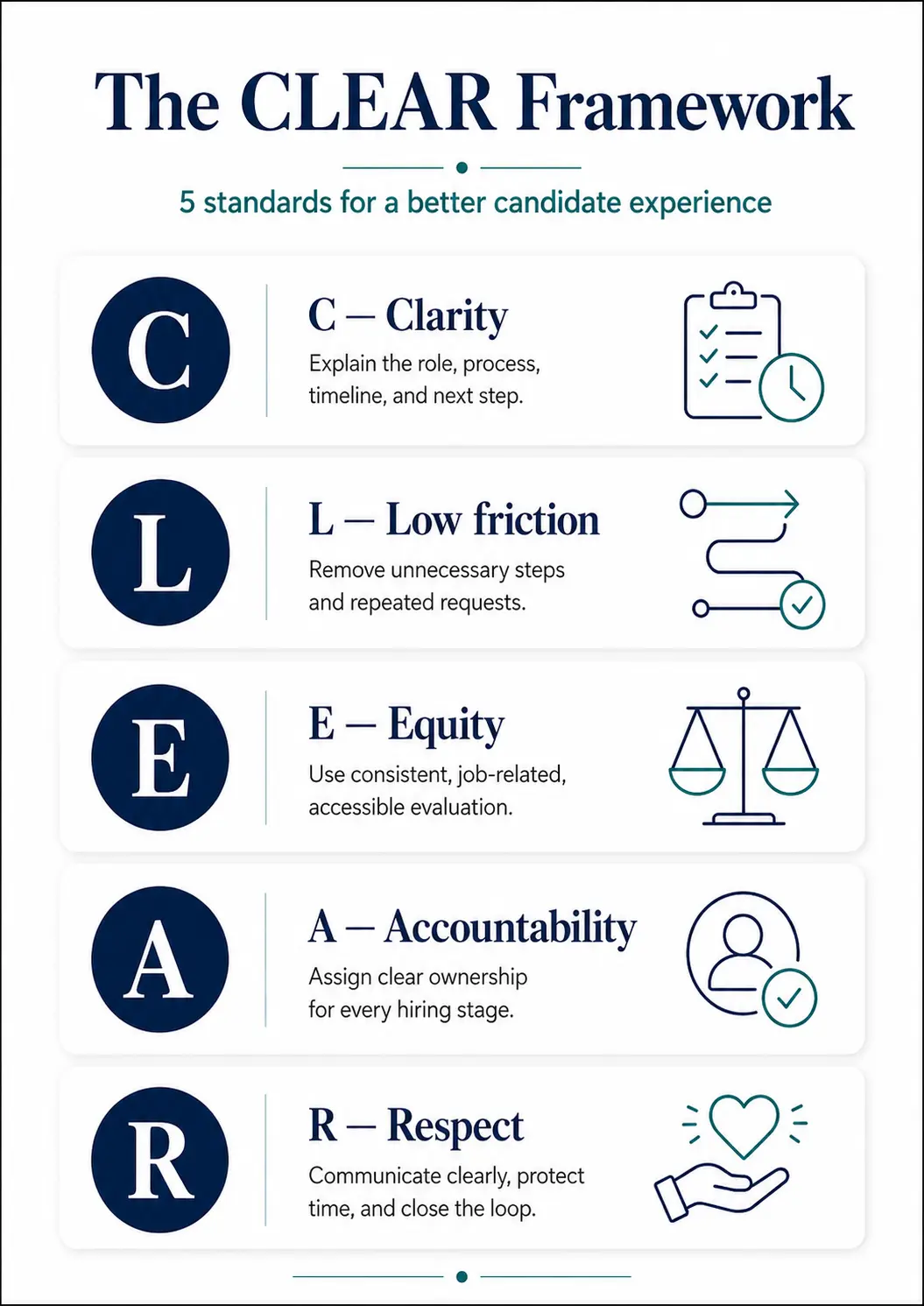
The CLEAR Candidate Experience Framework
The following framework turns candidate experience best practices into five operational standards.
C: Clarity
Candidates should understand the role, selection criteria, stages, timeline, compensation approach, and next action.
Clarity removes avoidable uncertainty. It does not require employers to reveal confidential deliberations or guarantee a decision date they cannot meet.
L: Low friction
Every required action should improve the hiring decision or satisfy a genuine operational requirement.
Remove:
– Duplicate form fields.
– Unnecessary interview rounds.
– Irrelevant assessments.
– Repeated requests for the same information.
– Preventable scheduling exchanges.
– Technology that adds steps without adding value.
E: Equity
Candidates should be evaluated against consistent, job-related criteria and have a fair opportunity to participate.
This includes:
E: Equity
Candidates should be evaluated against consistent, job-related criteria and have a fair opportunity to participate.
This includes:
– Structured questions.
– Defined scoring standards.
– Accessible technology.
– Reasonable accommodations.
– Consistent instructions.
– Monitoring stage outcomes for unexplained disparities.
A: Accountability
Every stage should have an internal owner.
Candidates should not have to determine which recruiter, coordinator, interviewer, or HR team is responsible for providing an update. Technology may deliver messages, but a person or team must remain accountable for the process.
R: Respect
Respect appears in practical behaviors:
– Starting interviews on time.
– Reading the candidate’s résumé.
– Explaining changes.
– Allowing candidate questions.
– Protecting personal information.
– Recognizing invested time.
– Closing the process properly.
Respect is not the same as excessive personalization. A clear automated rejection can be more respectful than weeks of silence.
How to Improve Candidate Experience
The most reliable way to improve candidate experience is to examine each stage from the candidate’s perspective, remove unnecessary friction, and assign clear ownership.
1. Map the Real Candidate Journey
Document what candidates actually experience, not only what appears in the applicant tracking system.
Apply for one of your own vacancies. Use a mobile device. Open every email. Complete the assessment. Measure how long each stage takes.
For every touchpoint, document:
– The candidate’s objective.
– The action required.
– The information provided.
– The internal owner.
– The expected response time.
– Possible accessibility barriers.
– The data collected.
– Whether the step improves decision quality.
Interview recent hires, rejected finalists, and candidates who withdrew. Successful hires cannot tell you where the process loses people.
2. Make Job Descriptions Accurate Enough for Self-Selection
A useful job description helps the right people apply, and the wrong people opt out early.
Include:
– A recognizable job title.
– Core responsibilities.
– Required versus preferred qualifications.
– Reporting relationship.
– Location and working arrangement.
– Compensation where required or appropriate.
– Main hiring stages.
– Assessment expectations.
– Instructions for requesting accommodations.
– What success looks like during the first six to twelve months.
CareerPlug’s 2025 research found that clearer and more accurate information about the job was candidates’ highest-priority improvement, followed by greater compensation transparency and better communication with interviewers.
Accuracy may reduce total application volume. That is not necessarily a problem if it improves applicant relevance and prevents expectation gaps later.
3. Simplify the Application Process
Only ask for information that is necessary at the current stage.
Review every application field and ask:
– Is this information already available in the résumé?
– Will anyone use it before the next stage?
– Is it legally or operationally required now?
– Can it be collected after the candidate advances?
– Does the question work on mobile devices?
– Can candidates save their progress?
– Is the process accessible?
Longer applications may be justified for regulated, security-sensitive, or senior positions. The problem is not length alone. It is effort that does not improve the selection decision.
4. Create Candidate Communication Standards
Candidates should receive an update before the date they were told to expect one.
Set service standards for key communications:
|
Communication |
Recommended operating standard |
| Application confirmation | Send immediately. |
| Initial screening outcome | Communicate as soon as a decision is available. |
| Interview invitation | Include format, duration, participants, and preparation. |
| Process delay | Send before the previous deadline passes |
| Post-interview update | Provide a decision or revised timeline. |
| Rejection | Match the level of personalization to the candidate’s stage. |
| Offer | Provide clear terms and a named contact. |
| Preboarding | Maintain contact through the start date. |
A delay message does not need to be long:
Subject: Update on your application
We are still completing interviews for the [role]. We expected to update you by [date], but the decision will take longer than planned. We will contact you again by [new date], even if the process is still ongoing. Thank you for your patience.
“No final decision yet” is useful information when it is communicated honestly.
5. Prepare Candidates and Interviewers
Both sides should enter the interview knowing its purpose and format.
Before the interview, provide candidates with:
Interviewer names and roles.
– Format and expected duration.
– Technology or location details.
– The general competencies being assessed.
– Assessment requirements.
– Accommodation options.
– A contact for logistical questions.
Interviewers should receive:
– The job requirements.
– Structured questions.
– Scoring criteria.
– The candidate’s relevant information.
– Interview conduct guidance.
– A deadline for submitting feedback.
Structured interviews can remain conversational. The structure should standardize what is evaluated, not prevent interviewers from asking relevant follow-up questions.
6. Treat Interviews as Two-Way Decisions
Candidates need enough information to assess whether the role is right for them.
Leave time for questions about:
– Manager expectations.
– Performance measures.
– Team structure.
– Current challenges.
– Workload.
– Decision authority.
– Development opportunities.
– Flexibility.
– Why the role is open.
– What tends to make someone successful or unsuccessful.
Honest answers may cause some candidates to withdraw. That is preferable to convincing someone to accept a role that does not match their expectations.
7. Keep Assessments Relevant and Proportionate
An assessment should test a genuine job requirement without demanding unreasonable effort.
Tell candidates:
– What the assessment measures.
– Why is it required?
– How long should it take?
– How will it be evaluated?
– Whether alternative formats are available.
– Whether the submitted work will be used commercially.
Avoid exercises that resemble unpaid consulting. For substantial finalist assignments, narrow the scope, use fictional information, or compensate candidates when appropriate.
8. Use an Investment-Based Feedback Model
The depth of feedback should increase with the time and effort the candidate has invested.
The Candidate Feedback Ladder
|
Candidate stage |
Appropriate response |
| Application only | Prompt confirmation and clear closure |
| Recruiter screen | Clear outcome and, where practical, a broad job-related reason |
| Interview | Personalized rejection acknowledging the candidate’s time |
| Assessment completed | Relevant feedback on the criteria assessed where policy allows |
| Finalist | Personal conversation, useful observations, and an honest statement about future consideration |
A finalist rejection might say:
Thank you for the time and preparation you invested in the process. We selected a candidate whose experience more directly matched our immediate need for [specific requirement]. Your examples involving [strength] were strong, and the panel appreciated [specific positive observation]. We would only like to retain your details if you are comfortable being considered for roles that better match your experience.
Avoid vague statements about “culture fit” or personality. Feedback should relate to documented, job-relevant criteria.
Survale’s 2025 benchmark found that specific feedback was associated with stronger willingness to refer others and maintain a relationship with the employer.
9. Connect Recruitment With Onboarding
The information given during recruitment should match what the new hire experiences after accepting.
After the offer:
– Confirm the terms in writing.
– Explain checks and documentation.
– Introduce the manager.
– Provide a realistic onboarding timeline.
– Maintain contact during the notice period.
– Confirm equipment and working arrangements.
– Ask about accommodations.
– Share the first-day plan.
– Avoid changing agreed conditions without explanation.
This handoff is where candidate experience becomes employee experience.
How Should Employers Use AI in the Hiring Process?
Use AI to remove administrative friction, not to remove human accountability.
AI can improve the experience when it supports:
– Application acknowledgements.
– Interview scheduling.
– Routine status updates.
– Candidate FAQs.
– Internal workflow reminders.
– Job matching.
– Interview preparation.
– Recruiter note organization.
AI can damage trust when candidates:
– Are not told that it is being used.
– Cannot ask questions.
– Do not understand how they are evaluated.
– Encounter inaccessible technology.
– Receive a consequential decision with no meaningful human review.
– Cannot correct inaccurate information.
– Are forced through an impersonal process for a relationship-based role.
In a 2026 iCIMS and Aptitude Research survey, 69% of talent-acquisition teams reported using AI in some capacity. Screening and candidate communication were among the most common uses. Although 82% considered transparency and explainability important, 45% said they did not have a formal AI governance framework. Recruiter judgment overrode AI recommendations in 58% of organizations when conflicts arose.
A practical AI governance checklist should answer:
– Where is AI used in the process?
– What candidate data does it analyze?
– What decision does it influence?
– Is its use disclosed appropriately?
– Can a candidate request human help or an accommodation?
– Who reviews the tool’s output?
– How is accuracy evaluated?
– How are stage outcomes monitored?
– What happens when the system is wrong?
– Who is accountable for the final decision?
The operating principle should remain: Automate administration. Preserve human responsibility.
Candidate Experience Scorecard
Use this practical scorecard to evaluate each hiring process. Score every area from zero to five.
|
CLEAR dimension |
0 points | 3 points |
5 points |
| Clarity | Candidates receive little process information. | Basic stages are explained. | Role, stages, criteria, dates, and owners are consistently clear. |
| Low friction | Multiple unnecessary or repetitive steps | Some friction has been removed. | Every required step has a documented purpose. |
| Equity | Evaluation varies by interviewer or candidate. | Some structured criteria exist. | Consistent, accessible, job-related evaluation is used throughout. |
| Accountability | Ownership is unclear | Recruiters manage most follow-up manually. | Every stage has an owner, standard, escalation route, and audit trail. |
| Respect | Silence, delays, or unprepared interviews are common. | Communication is generally professional. | Candidate effort is consistently recognized with timely, appropriate treatment. |
Score interpretation
– 21–25: Strong and consistently managed.
– 16–20: Functional but vulnerable to team-level inconsistencies.
– 10–15: Material candidate and employer-brand risk.
– Below 10: The process requires redesign rather than isolated fixes.
This is an operational diagnostic, not a scientifically validated assessment. Use it to locate priorities and then confirm them using candidate feedback and performance data.
Common Candidate Experience Mistakes
Avoid these recurring failures:
– Treating speed as the only measure of success.
– Adding technology without testing the candidate’s experience.
– Automating every interaction.
– Leaving candidates without closure.
– Requiring excessive unpaid work.
– Changing role expectations during the process.
– Asking candidates to repeat information.
– Conducting unnecessary interviews.
– Training recruiters but not hiring managers.
– Collecting feedback only from successful candidates.
– Tracking satisfaction without tracking withdrawal.
– Promising personalized feedback that the team cannot consistently provide.
Candidate Experience Is an Operating System, Not a Courtesy
Candidate experience influences whether people remain in your hiring process, trust your organization, accept an offer, recommend the employer, and consider returning later.
The strongest hiring process is not necessarily the fastest or most automated. It is the one that helps both sides make an informed decision without unnecessary friction.
Start with the stage that creates the most uncertainty, effort, or delay. Clarify what candidates should expect, remove steps that do not improve the decision, assign an accountable owner, and measure whether the change produces a better outcome.
That is how candidate experience becomes a practical advantage rather than an abstract HR objective.
Build a Hiring Process Candidates Trust
Frequently Asked Questions
1. What makes a good candidate experience?
A good candidate experience is clear, relevant, respectful, accessible, and consistent. Candidates understand the role and process, complete only the necessary steps, meet prepared interviewers, receive timely updates, and get appropriate closure.
2. Who owns candidate experience?
Talent acquisition usually coordinates candidate experience, but ownership is shared across recruiters, coordinators, hiring managers, interviewers, HR operations, technology teams, and leadership.
Each touchpoint should have one named operational owner, even when strategic accountability is shared.
3. When does candidate experience begin?
Candidate experience begins with the first meaningful exposure to the employer. This may be a job advertisement, recruiter message, careers page, employee recommendation, social post, or employer review.
It continues through rejection or the transition into onboarding.
4. Should every rejected candidate receive feedback?
Every candidate should receive closure, but the depth of feedback should reflect how far the person progressed.
Candidates rejected before screening need timely communication. People who complete interviews or assessments should receive more personalized and useful responses where company policy and local requirements allow.
5. Can AI improve candidate experience?
Yes. AI can reduce scheduling delays, answer routine questions, organize workflows, and send timely updates.
It can make the experience worse when it creates additional steps, obscures how decisions are made, introduces accessibility barriers, or removes meaningful human accountability.

Rameet Singh, Founder & CEO of RPO.AI