
 Log-In
 AI candidate screening was meant to make hiring faster and fairer. But in many companies, it has become a faster way to reject good people. Strong candidates are filtered out because they used the wrong keywords, had a nontraditional career path, or submitted a resume that the system could not read properly.
The real issue is not AI itself. It is how companies use it. When AI is built on weak hiring rules, it scales weak decisions. To use AI in recruitment well, companies need clear criteria, human oversight, and a process that measures real skills, not just machine-friendly resumes.
That requires a different standard.
The right question is not “Can AI screen candidates faster?”
The better question is:
“Can this system identify the right candidates for the right reasons, in a way that is fair, explainable, practical, and defensible?”
TL;DR: What Companies Get Wrong and How to Fix It
| Mistakes companies make | Why is it a problem | Practical solution |
| Treating AI as a silver bullet | AI speeds up a broken process instead of fixing it | Define clear hiring criteria before using automation |
| Over-relying on keyword matching | Strong candidates get rejected for using different wording | Move to skills-based screening and recognize equivalent experience |
| Training tools on biased historical data | Past hiring bias gets repeated and scaled | Audit training data, reduce pedigree bias, and test outcomes regularly |
| Ignoring resume parsing failures | Candidate information is missing or misread | Test parsing accuracy and let candidates correct the extracted data |
| Using opaque AI video analysis | Candidates may be judged on style, expression, or speech patterns instead of skill | Use structured, job-related assessments and offer alternative formats |
| Penalizing nontraditional candidates | Career changers, caregivers, veterans, freelancers, and self-taught candidates are overlooked | Evaluate transferable skills and create alternate pathways |
| Using “culture fit” as a screening signal | Culture fit often becomes a proxy for sameness | Replace culture fit with specific, observable values-based behaviors |
| Creating an AI arms race with candidates | Companies waste time trying to detect AI-written resumes instead of assessing ability | Test real skills through interviews, work samples, and job simulations |
| Treating human oversight as a checkbox | Recruiters may rubber-stamp AI rankings | Train humans to challenge, override, and document AI recommendations |
| Failing to explain rejections | Candidates lose trust, and companies cannot defend their decisions | Maintain clear, job-related rejection criteria |
The Shift Companies Need to Make
AI recruitment should not be about replacing judgment. It should be about improving judgment.
The best use of AI in recruitment is not to silently reject candidates at scale. It is to help hiring teams organize information, reduce repetitive work, and spend more time evaluating people who may genuinely be able to do the job.
That distinction matters.
A poor AI screening process asks: Who looks most like the ideal candidate based on past patterns?
A better AI screening process asks: Who has evidence of the skills, judgment, learning ability, and experience needed to succeed in this role?
The difference between those two questions determines whether AI in hiring expands opportunity or narrows it.
Common Mistakes About AI Candidate Screening
1. Treating AI as a Silver Bullet
Many companies introduce AI candidate screening as if it will solve the hardest parts of hiring: finding quality talent, reducing bias, improving recruiter productivity, and creating a better candidate experience.
That expectation is unrealistic.
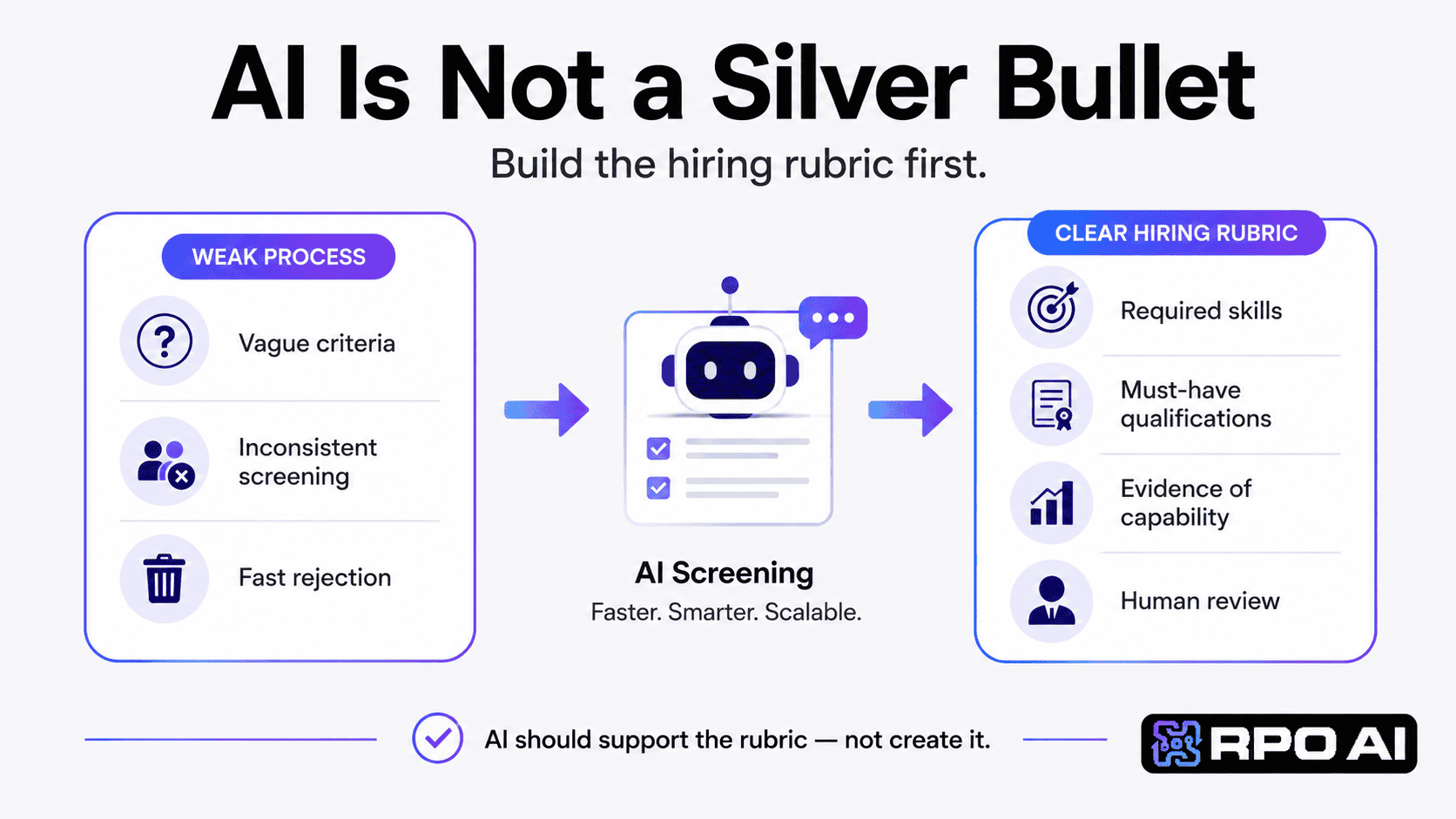
AI can help manage volume. It can summarize applications, identify possible matches, organize candidate data, and flag profiles for review. But it cannot fix unclear job descriptions, inconsistent hiring manager expectations, vague success criteria, or biased decision-making.
When candidate screening software is layered on top of a weak hiring process, the result is not better hiring. It is a faster rejection.
The Practical Fix
Before using AI for candidate screening, companies need a clear hiring foundation.
That means defining:
- What skills are actually required for the role
- Which qualifications are mandatory
- Which qualifications are preferred but not essential
- What evidence proves capability
- Which factors should never be used to reject candidates
- When human review is required
Every role should have a structured screening rubric before automation is applied.
For example, instead of allowing the system to rank candidates based on vague similarity to past hires, the rubric should specify job-related criteria such as customer-facing experience, technical proficiency, regulatory knowledge, sales cycle complexity, project ownership, or people management scope.
AI should support the rubric. It should not create the rubric.
2. Over-Relying on Keyword Matching
One of the biggest problems in AI recruitment is that many tools labeled as intelligent are still heavily driven by keyword matching.
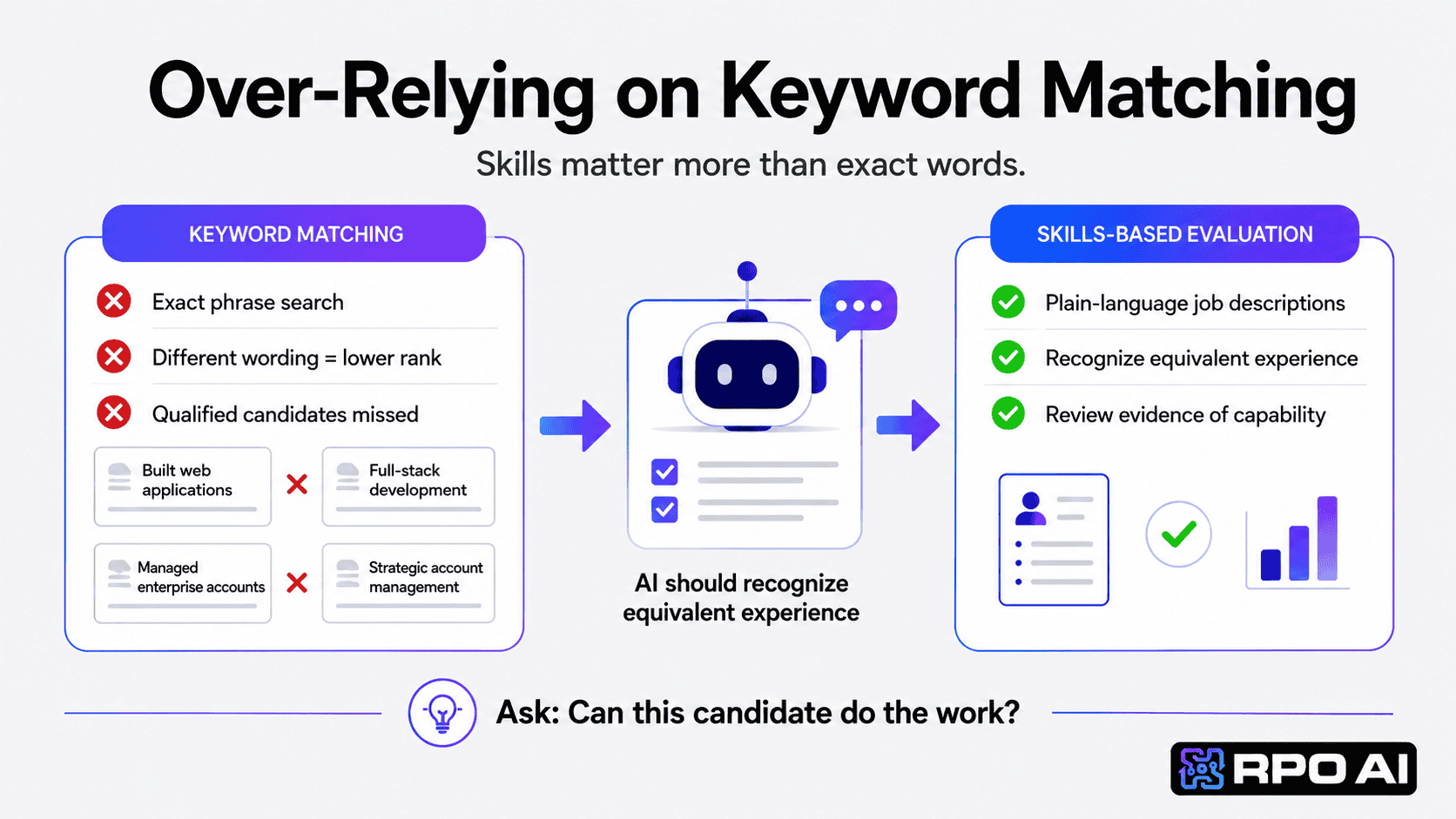
They scan resumes for exact terms from the job description. If a candidate uses different wording, the system may rank them lower or reject them altogether.
This is how qualified candidates disappear.
A software engineer may write “built web applications across front-end and back-end systems” instead of “full-stack development.” A project manager may describe “leading global delivery across business units” instead of “cross-functional stakeholder management.” A sales professional may explain “managed enterprise accounts” without using the exact phrase “strategic account management.”
The skill is there. The keyword is not.
That is not intelligent screening. It is brittle filtering.
The Practical Fix
Companies need to move from keyword matching to skills-based evaluation.
That requires three practical changes.
First, job descriptions should be written in plain language. They should describe the work, not just list tools, buzzwords, and inflated requirements.
Second, AI screening tools should be configured to recognize equivalent experience. Similar phrases, related tools, adjacent responsibilities, and transferable skills should be considered.
Third, keyword gaps should not trigger automatic rejection when there is other evidence of capability.
A strong screening process asks:
Is there credible evidence that this candidate can do the work?
Not:
Did this candidate use the exact phrase the system expected?
Keyword matching can help organize information. It should not miss an opportunity.
3. Training AI on Biased Historical Hiring Data
Many AI systems learn from previous hiring decisions. That sounds logical until the company examines the quality of those decisions.
Historical hiring data may reflect years of bias, inconsistency, preference, and unequal access.
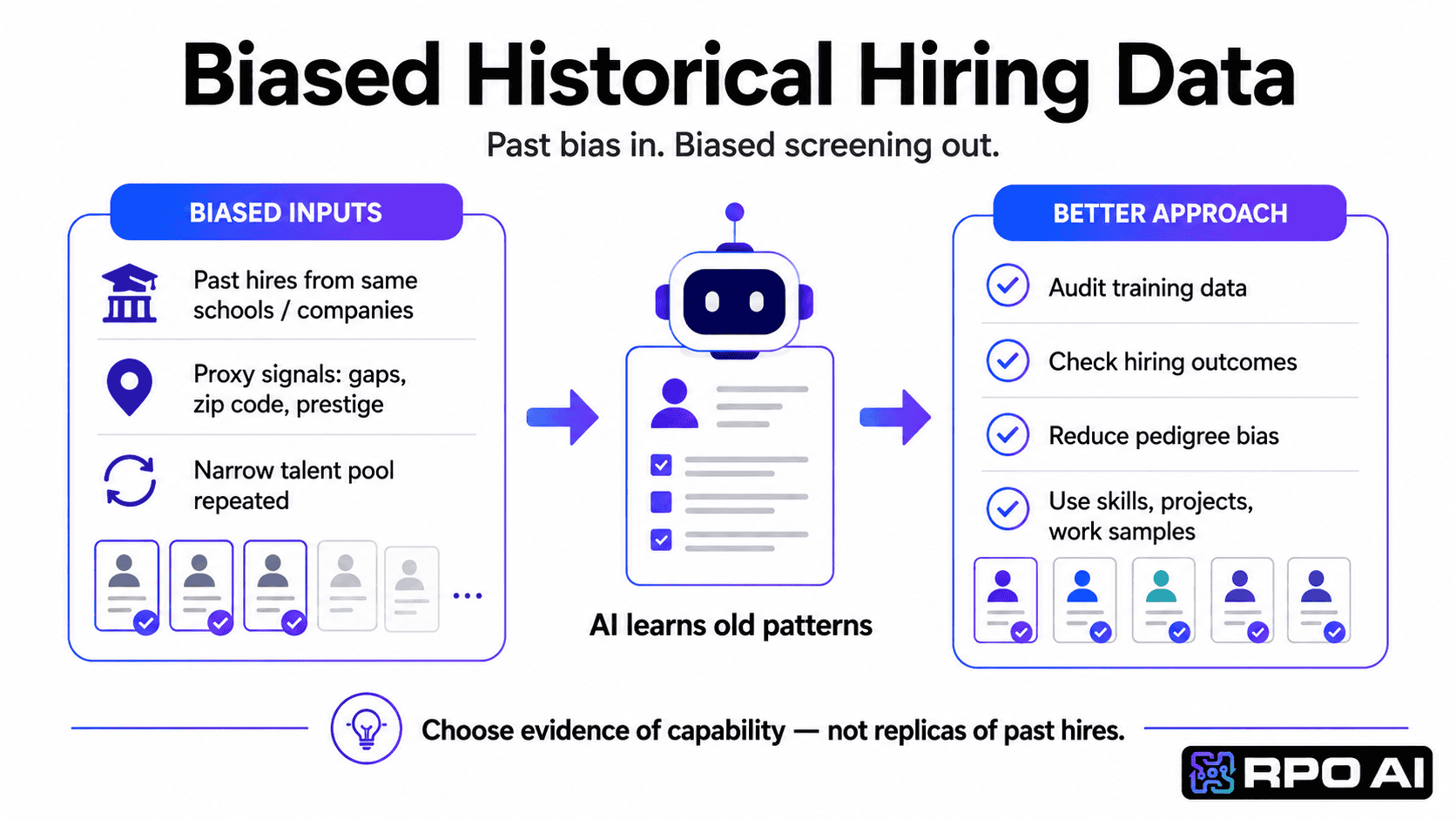
If an organization previously hired mostly from certain universities, companies, geographies, or networks, the AI may learn those patterns as signals of success. It may then recommend candidates who resemble previous hires and downgrade those with different backgrounds.
This is how bias becomes automated.
The system may not directly use race, gender, age, disability, or socioeconomic status. But it may use proxies such as school names, employment gaps, hobbies, zip codes, career paths, language patterns, or company prestige.
The result is a narrower talent pool disguised as objective screening.
The Practical Fix
Companies must audit both the data and the outcomes.
They should ask:
- What historical data was used to build or tune the system?
- Were past hiring decisions consistent and job-related?
- Are certain schools or employers being overrepresented?
- Are nontraditional candidates being filtered out more often?
- Are selection rates different across groups where they are legally and appropriately measured?
- Does the tool favor candidates who resemble current employees?
Removing protected characteristics from the dataset is not enough. Proxy bias can remain even when obvious identifiers are removed.
The practical solution is to reduce reliance on pedigree-based signals and increase reliance on demonstrated skills, relevant projects, work samples, structured interviews, certifications, and role-specific evidence.
AI in recruitment should not find replicas of past hires. It should help identify people who can succeed now.
4. Ignoring Resume Parsing Failures
Resume parsing is one of the most overlooked problems in candidate screening software.
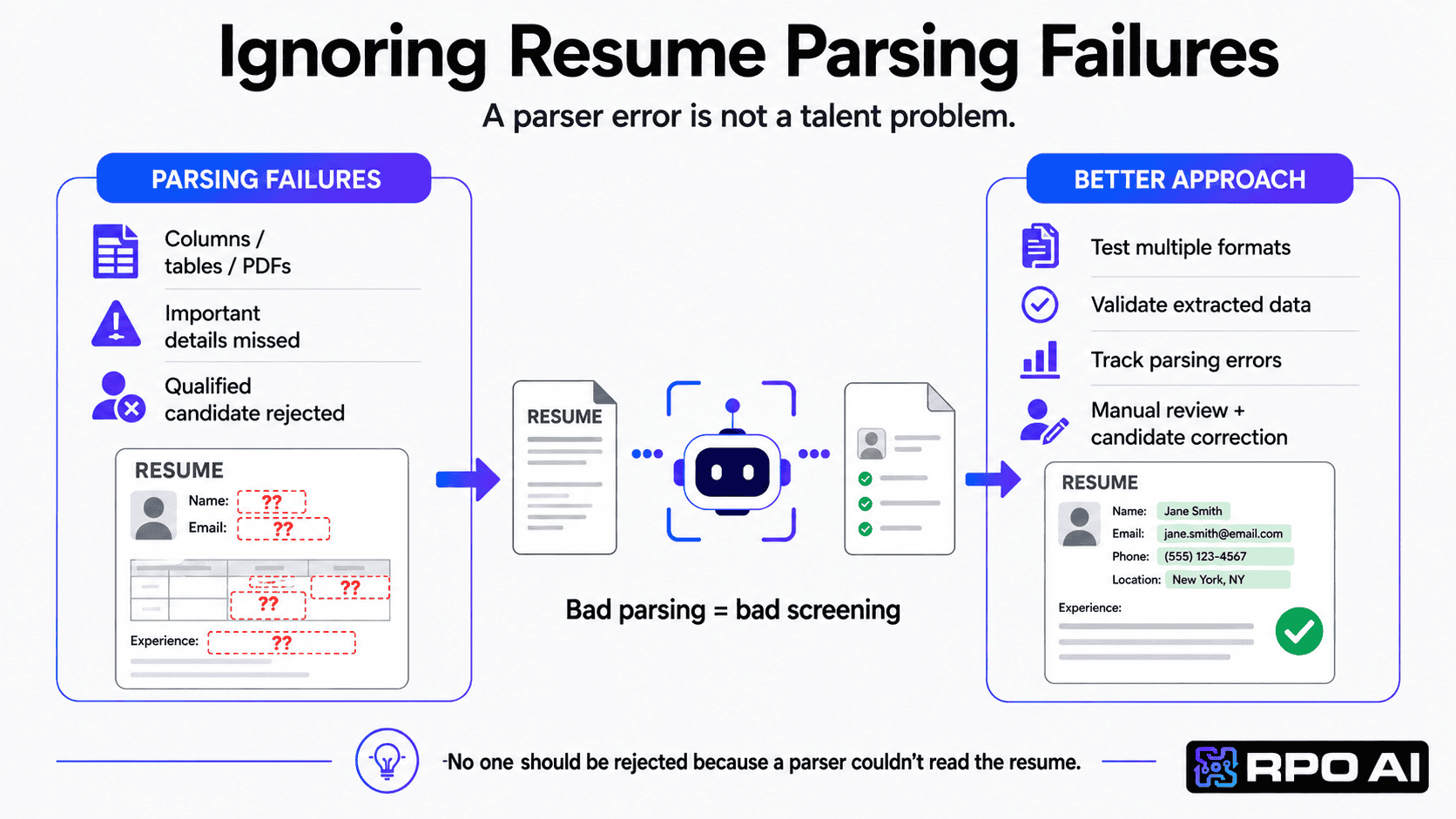
Many systems struggle to read resumes with columns, tables, icons, graphics, unusual headings, creative layouts, or certain PDF formats. Important information may be skipped, misplaced, or misinterpreted.
A candidate may have the right experience, but if the system cannot read the resume properly, the candidate may be treated as unqualified.
This is a technology failure, not a talent failure.
The worst part is that candidates usually never know it happened. They submit an application, receive no response, and assume they were rejected by a person. In reality, their resume may never have been understood by the system.
The Practical Fix
Companies should test resume parsing before relying on automated screening.
A practical quality-control process should include:
- Testing multiple resume formats
- Checking whether job titles, employers, dates, skills, education, and certifications are extracted correctly
- Reviewing how the system handles columns, PDFs, tables, and nonstandard headings
- Measuring parsing error rates
- Creating a manual review path when data extraction is incomplete
Candidates should also be able to review and correct parsed information before submitting an application.
If the system extracts a candidate’s work history incorrectly, the candidate should not pay the price for that error.
No one should be rejected because a parser could not read a resume layout.
5. Using Opaque AI Video Interview Analysis
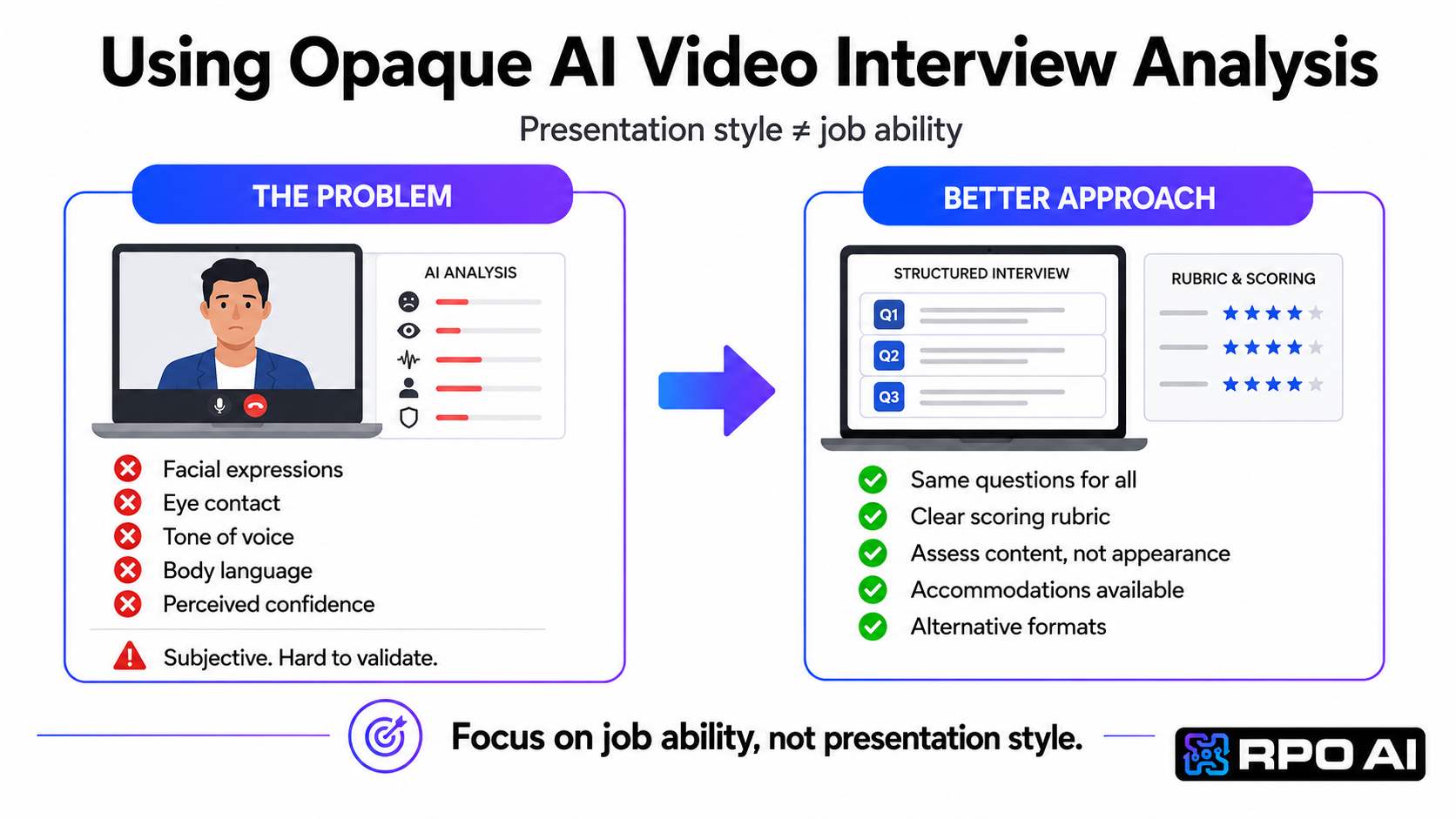
Some companies use AI tools to analyze video interviews based on speech patterns, facial expressions, tone, eye contact, body language, or perceived confidence.
This is one of the riskiest uses of AI in hiring.
These systems may claim to assess communication ability, professionalism, engagement, or culture fit. But the criteria are often opaque, subjective, and difficult to validate.
They can also disadvantage neurodivergent candidates, disabled candidates, non-native speakers, anxious candidates, and people from cultures with different communication norms.
The core issue is simple: presentation style is not the same as job ability.
For many roles, success does not require perfect webcam presence, polished eye contact, or a specific speech rhythm. Yet candidates may be screened out based on those signals before their actual skills are assessed.
The Practical Fix
Companies should avoid using AI video analysis to judge personality, emotion, facial expression, or culture fit.
If video interviews are used, they should be structured, consistent, and job-related.
That means:
- Every candidate receives the same questions
- Answers are scored against a clear rubric
- Evaluation focuses on content, not facial expression
- Candidates can request accommodations
- Alternative formats are available when appropriate
Instead of asking whether a candidate appears confident, the company should assess whether the candidate can explain a relevant project, solve a realistic scenario, handle a customer issue, or describe how they would approach role-specific work.
AI should not measure what is easy to observe. It should support the evaluation of what actually matters.
6. Penalizing Nontraditional Candidates
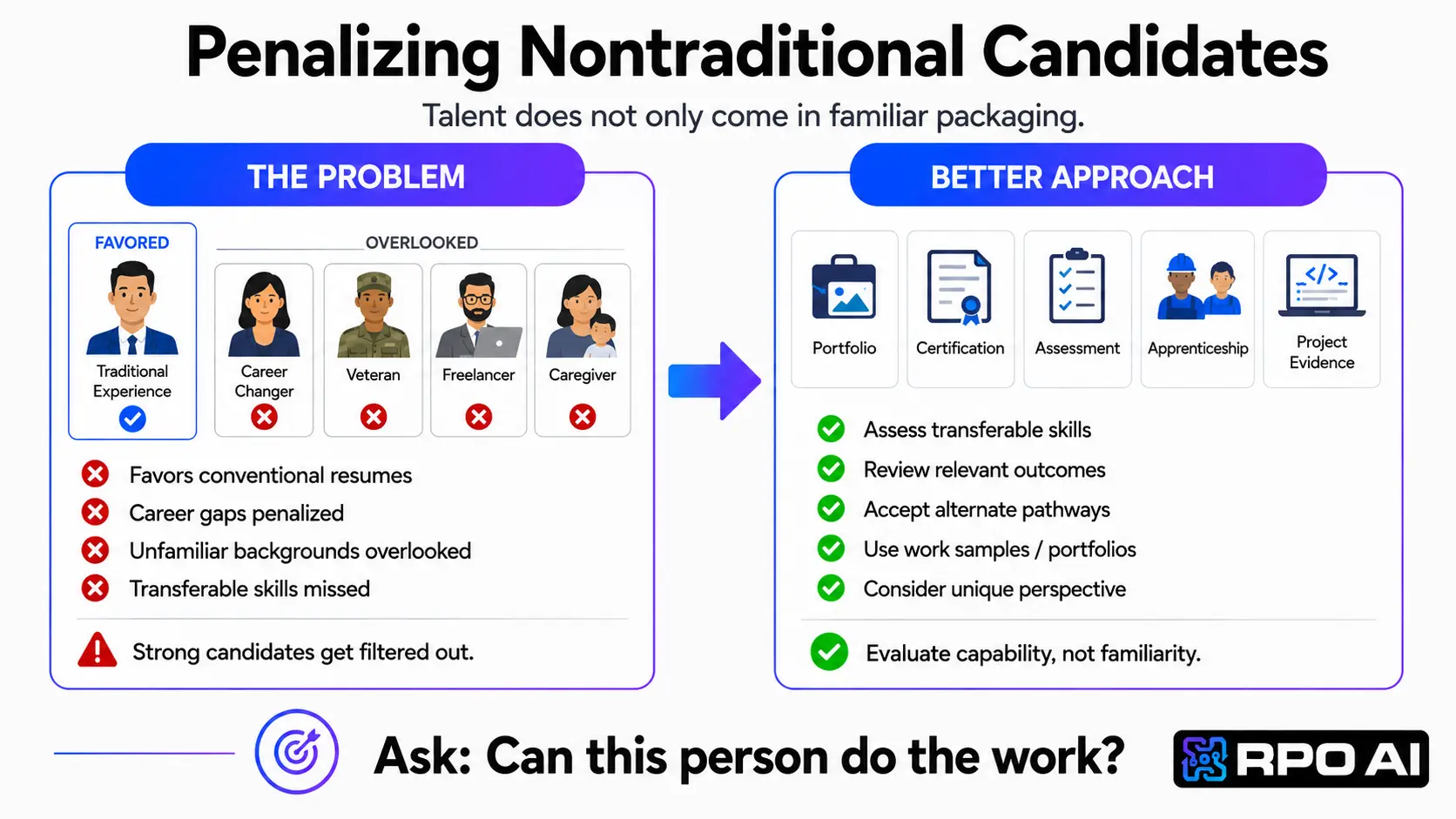
AI screening often performs best on conventional resumes.
That means linear career paths, familiar job titles, recognizable employers, standard education, and predictable formatting.
But strong candidates do not always look conventional.
Career changers, caregivers returning to work, veterans, immigrants, freelancers, bootcamp graduates, self-taught technologists, people with employment gaps, and candidates from smaller companies may all be undervalued by automated systems.
This creates a major contradiction.
Companies say they want diverse talent, broader pipelines, and transferable skills. Then their AI screening process quietly filters out the very candidates who bring those qualities.
The Practical Fix
Companies should design screening criteria that recognize transferable skills.
Instead of relying heavily on job titles, school names, or employer brands, hiring teams should ask:
- Has the candidate solved similar problems?
- Have they worked at a comparable level of complexity?
- Have they delivered relevant outcomes?
- Can they show evidence of the required skill?
- Could their background bring a useful perspective to the role?
Alternate pathways are also important.
For some roles, candidates should be able to demonstrate their ability through portfolios, short work samples, structured recruiter screens, apprenticeships, certifications, or practical assessments.
The hiring process should not assume talent only comes in familiar packaging.
7. Using “Culture Fit” as a Screening Signal
“Culture fit” is one of the most dangerous phrases in hiring when it is not clearly defined.
In AI candidate screening, it becomes even riskier.
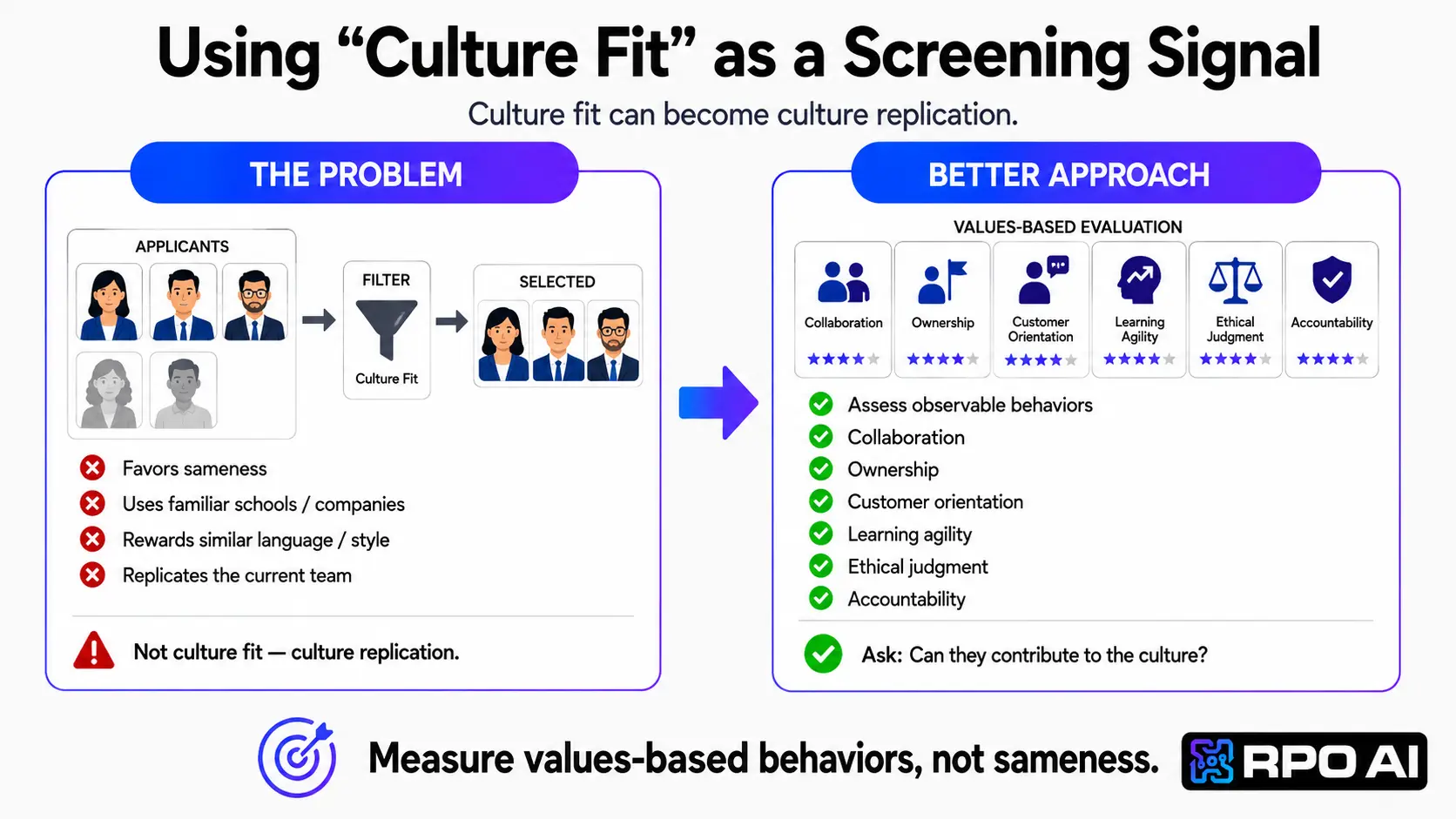
If a system is asked to identify candidates who match company culture, it may learn from current employees, past hires, or subjective recruiter preferences. That can quickly become a proxy for sameness.
Candidates may be favored because they use familiar language, attended familiar schools, worked at familiar companies, or present themselves in ways that resemble the dominant group inside the organization.
That is not a culture fit. That is culture replication.
The Practical Fix
Companies should replace “culture fit” with specific values-based behaviors.
Instead of asking whether someone feels like a fit, define observable behaviors such as:
- Collaboration
- Ownership
- Customer orientation
- Learning agility
- Ethical judgment
- Ability to handle ambiguity
- Respectful communication
- Accountability
These should be assessed through structured interview questions, examples, and consistent scoring.
AI should not infer culture fit from hobbies, language style, personality signals, social background, or resume tone.
The better question is not whether a candidate mirrors the culture; it’s whether the candidate can contribute to it.
8. Creating an AI Arms Race With Candidates
Generative AI has changed the application process. Candidates now use AI tools to improve resumes, draft cover letters, prepare for interviews, and tailor applications.
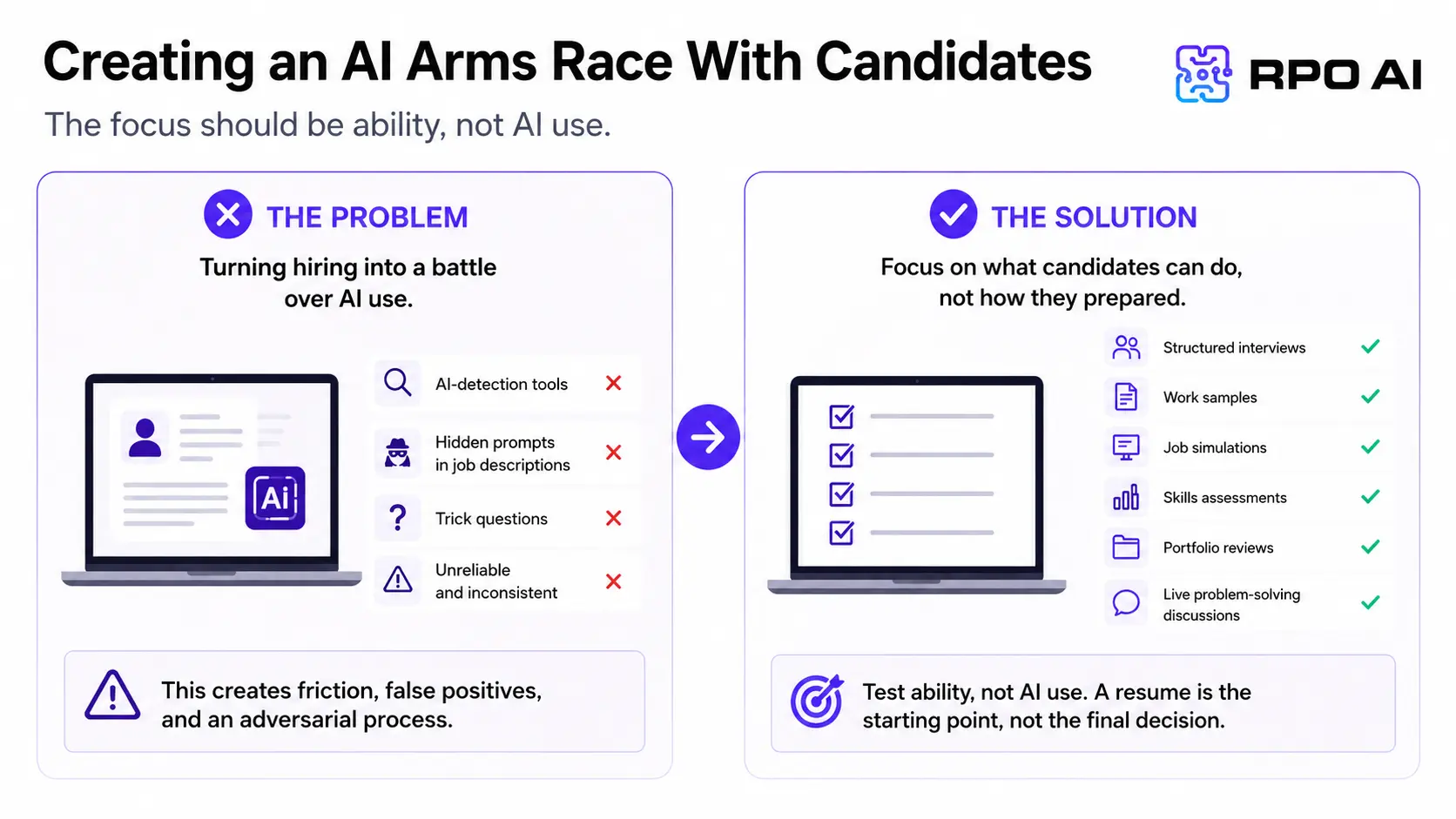
Some companies have responded with AI-detection tools, hidden prompts in job descriptions, trick questions, or aggressive attempts to identify AI-generated resumes.
This creates an adversarial hiring process.
It also misses the point.
Many employers use AI to write job descriptions, summarize resumes, draft outreach, and support recruiting workflows. Penalizing candidates for using common tools can appear inconsistent, especially when the real issue is not AI use but whether the candidate has the required ability.
AI detection is also unreliable. It can misclassify human-written content, penalize non-native speakers, and create unnecessary friction.
The Practical Fix
Companies should stop trying to catch candidates using AI and start testing whether candidates can do the work.
The better approach is to use:
- Structured interviews
- Work samples
- Job simulations
- Case exercises
- Skills assessments
- Portfolio reviews
- Live problem-solving discussions
A polished resume should not be treated as final proof of ability. It should be the starting point for deeper evaluation.
Companies can set reasonable expectations. For example, candidates may be asked to explain their work, discuss how they prepared, or complete part of an assessment live.
The question should not be:
Did this candidate use AI?
The question should be:
Can this candidate think, communicate, and perform effectively in this role?
9. Treating Human Oversight as a Checkbox
Many organizations say humans remain involved in AI-assisted hiring.
That statement means very little unless the oversight is real.
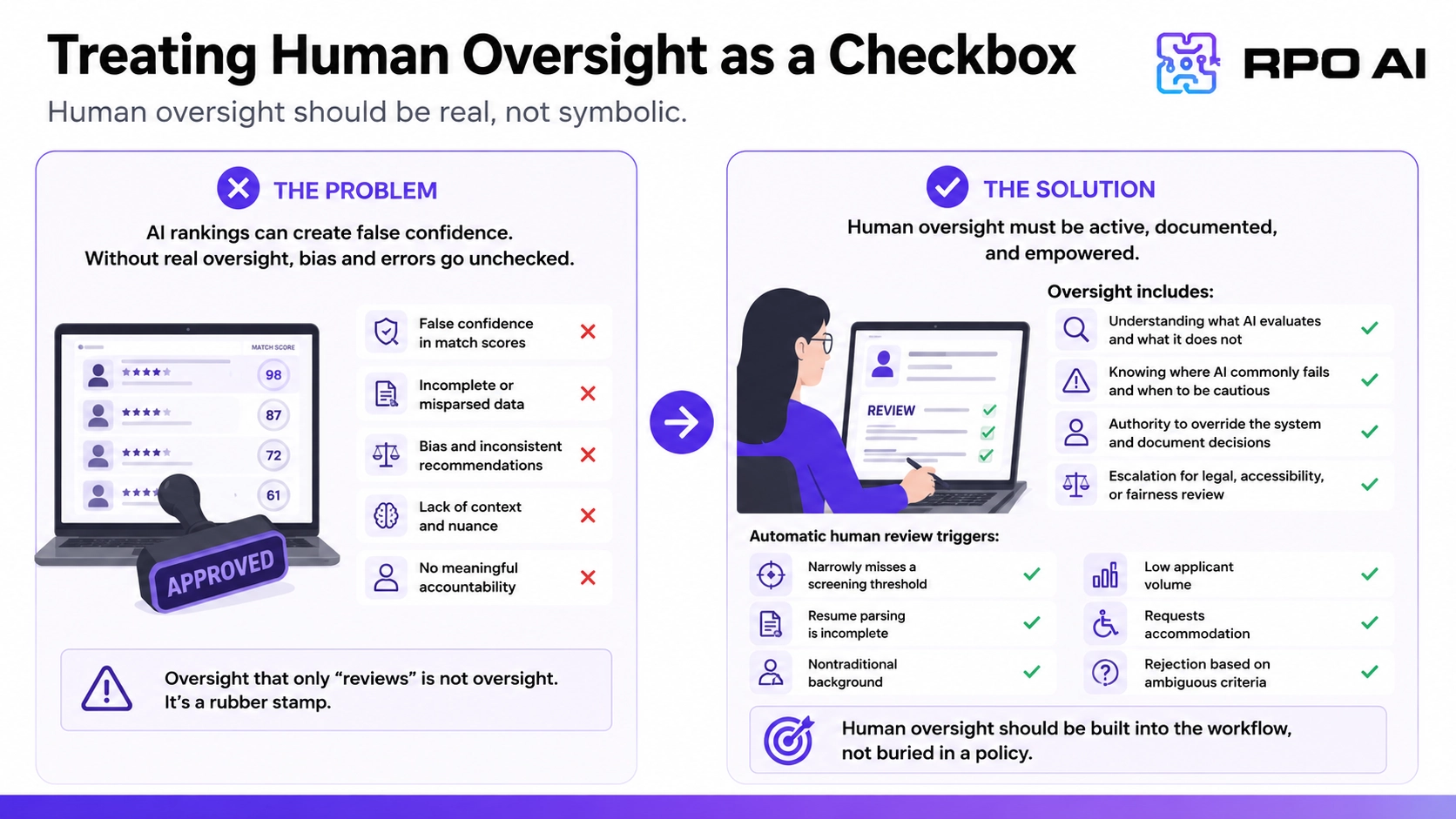
If recruiters simply accept AI rankings, human oversight becomes a rubber stamp. Match scores, rankings, and automated recommendations can create false confidence. Recruiters may assume the system has already made a reliable decision, even when the score is based on incomplete, biased, or poorly parsed information.
Human-in-the-loop hiring is only meaningful when the human has authority, context, and training.
The Practical Fix
Human oversight must be active, documented, and empowered.
Recruiters and hiring managers should understand:
- What the AI system evaluates
- What it does not evaluate
- Where it commonly fails
- Which recommendations require caution
- When to override the system
- How to document an override
- When to escalate for legal, accessibility, or fairness review
Companies should also create automatic human review triggers.
For example, human review should be required when:
- A candidate narrowly misses a screening threshold
- Resume parsing is incomplete
- The candidate has a nontraditional background
- The role has low applicant volume
- The candidate requests accommodation
- The rejection is based on ambiguous criteria
Human oversight should be built into the workflow. It should not be a sentence in a policy.
10. Failing to Explain Rejections
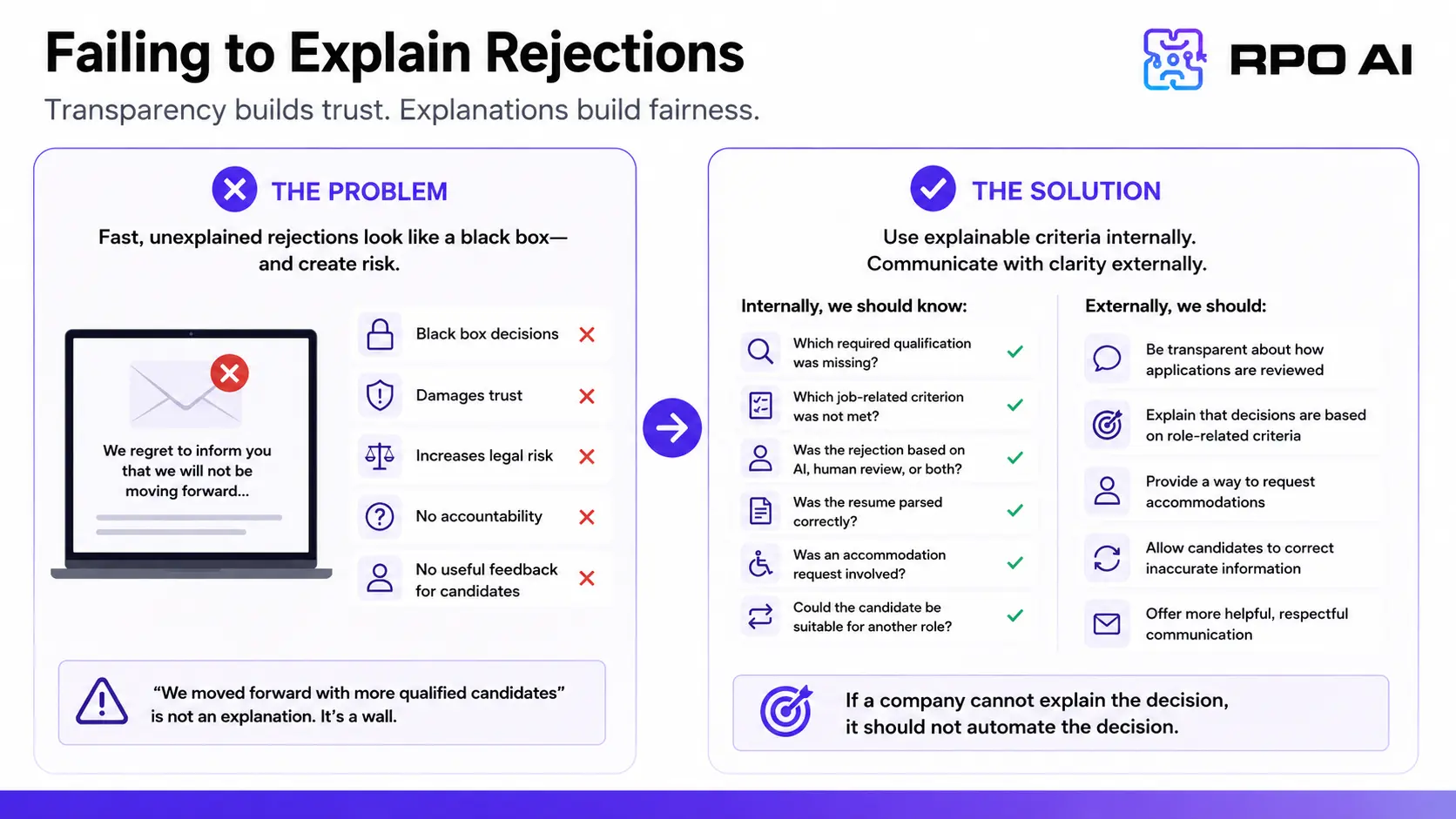
Candidates increasingly understand that AI in hiring may influence whether they move forward. When they receive a fast rejection with no explanation, they may assume a black box screened them out.
That damages trust.
It also creates risk for the company. If the employer cannot explain why a candidate was rejected, it may struggle to defend the fairness and job relevance of its process.
Generic rejection language does not solve the problem. Saying “we moved forward with more qualified candidates” gives candidates little information and gives the company little accountability.
The Practical Fix
Companies need explainable screening criteria.
Internally, the company should be able to answer:
- Which required qualification was missing?
- Which job-related criterion was not met?
- Was the rejection based on AI, human review, or both?
- Was the resume parsed correctly?
- Was an accommodation request involved?
- Could the candidate be suitable for another role?
Externally, candidate communication should be more transparent where possible.
This does not mean every candidate receives a detailed report. But candidates should understand that applications are reviewed against role-related criteria, and they should have a way to request accommodation or correct inaccurate information.
The principle is clear:
If a company cannot explain the decision, it should not automate the decision.
What Better AI Candidate Screening Looks Like
A mature AI screening process is not anti-automation. It is disciplined automation.
It uses AI for work that AI can support well: organizing information, identifying possible matches, summarizing experience, highlighting gaps, and reducing repetitive administrative effort.
It keeps humans responsible for work that requires judgment: fairness, context, accommodation, candidate communication, and final decisions.
Better AI in hiring has six characteristics.
1. It is skills-based
The system evaluates evidence of capability, not just keywords, titles, schools, or employer brands. It looks for signs that the candidate has done similar work, solved relevant problems, or developed transferable skills that match the role.
2. It is explainable
Recruiters should be able to understand why a candidate was advanced, ranked lower, or rejected. Clear explanations help hiring teams spot errors, defend decisions, and avoid relying blindly on a score or recommendation.
3. It is accessible
Candidates should be able to request accommodations, use alternative formats, and correct inaccurate information when needed. A fair screening process does not disadvantage someone because of a resume format, disability, communication style, or technical barrier.
4. It is audited
The company regularly checks for bias, parsing errors, adverse impact, and unintended outcomes. These reviews should happen over time, not just before launch, because hiring data, job needs, and candidate behavior can change.
5. It includes real human review
Humans are trained, empowered, and expected to challenge AI outputs. Recruiters should be able to override recommendations, review edge cases, and apply context that the system may miss.
6. It is continuously improved
The company monitors outcomes over time and adjusts the system when results drift. If qualified candidates are being missed, certain groups are being filtered out, or recruiters are seeing repeated errors, the process should be updated.
Final Thought
AI candidate screening should not decide who deserves a chance based on formatting, keywords, proxies, historical bias, or machine-readable polish.
Used well, AI can make recruitment more focused, consistent, and efficient. Used poorly, it becomes a silent rejection engine.
The companies that get AI in recruitment right will not be the ones with the flashiest tools. They will be the ones with the clearest hiring criteria, strongest oversight, best candidate experience, and most disciplined governance.
The future of hiring will be hybrid.
AI can support the process. Humans must remain accountable for their judgment.
FAQs About AI Candidate Screening
1. Are companies rejecting AI resumes?
Yes. Some companies reject resumes that seem generic or AI-written. But the better approach is not AI detection. Employers should verify real skills through structured interviews, work samples, and role-specific assessments.
2. What is the 30% rule for AI?
The 30% rule is a practical guideline: let AI support the process, but do not let it control high-stakes decisions. In hiring, humans should own rejection decisions, accommodations, edge cases, and final selection.
3. Which companies fired employees because of AI?
Companies such as IBM, Klarna, Duolingo, UPS, Salesforce, and Cisco have been reported in AI-related workforce discussions. However, not every case means direct replacement. Many involve broader restructuring, automation, or efficiency programs.

Rameet Singh, Founder & CEO of RPO.AI