
 Log-In
Slow hiring is no longer a problem HR quietly deals with on its own. It’s a leadership issue. When roles stay open too long, projects stall, teams burn out, and strong candidates walk towards the next offer. From AI in recruitment to full-scale recruitment automation, the direction is clear: better matches, cleaner workflows, fairer decisions, and communication that doesn’t leave candidates feeling ignored.
And the pressure to get ahead of this is real. Recent research from SHRM’s 2026 Talent Trends Report found that a large share of HR professionals are already struggling to retain and attract full-time talent, even before accounting for the hiring backlog that slow processes create. The organizations closing that gap fastest are the ones treating technology as a strategic lever, not an afterthought.
Where the Market Is Heading: 10 Trends Defining the Next Wave of Hiring
Adopting modern recruitment technology isn’t about chasing every shiny new platform on the market. It’s about building a hiring system that saves recruiters time while still treating candidates like people. Organizations rethinking how they scale hiring for what’s ahead can see how RPO services combine embedded recruiting expertise with the technology stack needed to compete, without turning the process into a cold, robotic assembly line.
1. AI-Driven Talent Acquisition: Beyond Resume Screening
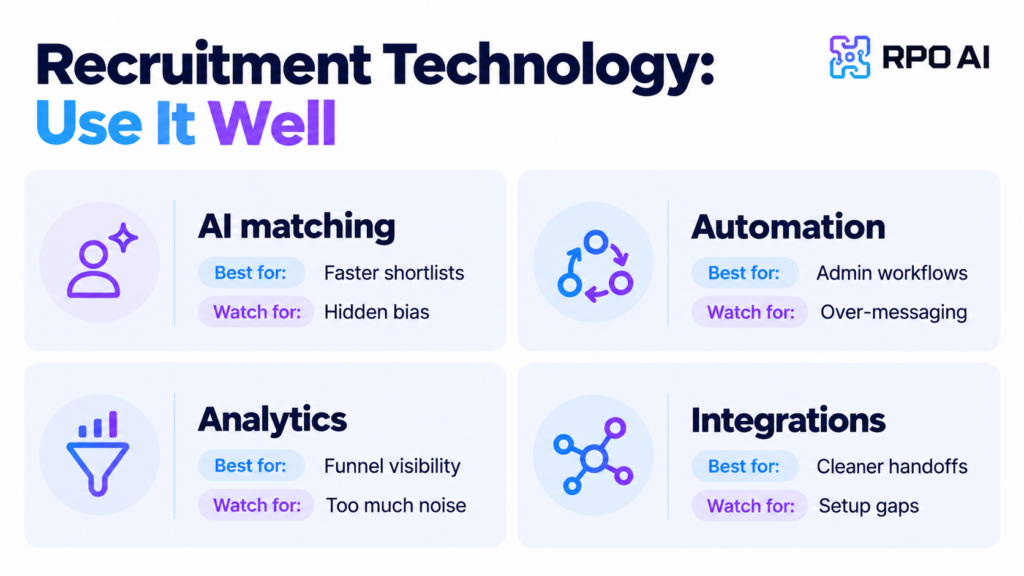
AI in recruitment has moved well past basic keyword scanning. Hiring teams now use it to review skills, career trajectories, role alignment, and even growth potential, not just whether a resume contains the right buzzwords.
That matters because great candidates don’t always have perfect resumes. Maybe they took a nontraditional path. Maybe their job title doesn’t map cleanly onto the role. AI can help surface people who might otherwise be filtered out before a human ever sees their profile.
The market is moving toward AI as a first-pass partner, not a gatekeeper. Recruiters who stay closely involved will outperform those who don’t; bad training data can quietly reproduce old bias, and nobody wants a faster version of a flawed process.
2. Hyper-Personalized Candidate Experiences
Nobody enjoys feeling like application number 482. As the talent market tightens, candidates increasingly expect timely, relevant updates that make sense for wherever they are in the process, and companies that can’t deliver this will lose people to competitors who can.
Smart messaging tools can send reminders, interview prep, status updates, and follow-ups based on role, stage, and behavior. Done well, it feels helpful. Done poorly, it feels like spam wearing a blazer. This is where automation needs a human touch; a short, thoughtful note will always beat a perfectly timed but empty one.
3. Advanced Recruitment Automation for Smarter Workflows
Hiring teams are leaning on recruitment automation to remove the repetitive tasks that eat up the day: scheduling, assessment invites, background check steps, routine status updates, and reminders.
That frees recruiters to focus on the work humans are actually better at: listening, advising, persuading, and building trust with candidates and hiring managers alike. The next phase of this shift isn’t about automating more; it’s about automating smarter, so the candidate experience never feels transactional even as workflows scale.
4. Data-Driven Recruiting Decisions with Stronger Analytics
Recruiters can’t fix what they can’t see. Better dashboards now surface sourcing quality, funnel delays, recruiter activity, offer acceptance rates, and hiring manager response times, and forward-looking teams are already treating this data as a competitive asset rather than a reporting exercise.
This doesn’t mean judgment disappears, far from it. Good analytics simply point to where the process is leaking talent, wasting budget, or creating uneven outcomes for certain candidate groups. Sometimes the numbers confirm what your gut already suspected. Other times they surprise you. Both are useful.
5. Video Interviewing Powered by AI Emotion and Skill Analysis
Video interviewing tools are becoming far more structured, with scoring rubrics, skill-based prompts, and communication review features built in.
The goal shouldn’t be to “read” candidates like a mystery novel; that gets uncomfortable fast, and the market is already pushing back on tools that overreach. The better use case, and the one gaining traction, is making interviews more consistent, especially when several hiring managers are weighing in on the same role.
6. Next-Gen Recruitment Software Trends: Integrations and Ecosystems
The most useful recruitment software trends aren’t always flashy. Often, they’re about tools finally talking to each other. Your ATS, CRM, assessment tools, onboarding system, payroll platform, and compliance software need to share data cleanly, or recruiters end up copying the same information into three different places. That’s not innovation, that’s digital paperwork.
Open APIs, shared candidate records, and flexible integration marketplaces are quickly becoming the baseline expectation for any modern hiring stack, not a differentiator.
7. Mobile-First Recruiting and Chat-Based Applications
A lot of candidates apply while riding the bus, sitting in a parking lot before a shift, or grabbing a quick break at work. If an application takes 35 minutes to complete on a phone, you’re going to lose people before they finish, and that drop-off only grows as candidate patience shrinks.
Mobile-first applications reduce this by keeping the process simple. Chat-based hiring helps too, especially for hourly, retail, hospitality, and high-volume roles. When candidates can answer basic screening questions in minutes, more of them make it through the funnel.
8. Virtual Reality and Augmented Reality for Immersive Candidate Evaluation
Some roles are genuinely difficult to explain in a job description; a paragraph can only do so much. VR and AR can show candidates what a day on the job actually looks like, simulate workplace tasks, or test hands-on skills in a realistic setting.
This is still an early-adopter trend, but the trajectory is clear: candidates get a clearer picture before accepting an offer, and employers get to observe behavior closer to real work conditions. Fewer surprises later, on both sides.
9. Blockchain for Recruitment Transparency and Trust
Credential checks are often slow and repetitive, with degrees, licenses, certifications, and employment history needing to be re-verified again and again across different employers.
Blockchain-based records could make parts of that process faster and more reliable. For regulated industries in particular, verified candidate data may save time while improving trust and privacy control. It’s still early for most employers, but the direction makes sense wherever accuracy and compliance matter most, and it’s worth watching over the next few hiring cycles.
10. Sustainability and Ethical Hiring Technologies
Digital hiring reduces travel, paper, and wasted coordination. That might sound small, but it adds up as more companies tie hiring practices to broader sustainability goals, and increasingly, candidates are factoring this into where they choose to work.
Ethical hiring technology also needs real guardrails: bias checks, informed consent, explainable results, and data protection can’t be afterthoughts. If a tool influences someone’s career, candidates deserve to understand how those decisions are actually being made. This is quickly shifting from a differentiator to table stakes.
What This Means for Your Hiring Stack
A future-ready hiring stack doesn’t need to be massive. It needs to be flexible, secure, and simple enough that busy recruiters will actually use it.
Build around integration, not tool count: More tools don’t automatically mean better hiring; too many disconnected systems can slow everyone down. Start with the systems that hold your core candidate, role, and outcome data, then connect other tools around those records.
Put privacy and compliance first: Hiring data is personal data. Consent, access controls, retention rules, and audit logs should be part of the buying checklist from day one, especially for global hiring where privacy requirements vary widely by market.
Train recruiters before scaling tools: Even good software fails when teams don’t trust it. Recruiters need practical training on when to lean on automation, when to step in personally, and how to catch strange or questionable outputs, not a two-hour demo they forget by lunch.
Why Moving Early Matters
Companies that adopt recruitment technology early aren’t just trying to buy software before everyone else. The real advantage comes from learning faster, improving workflows sooner, and building stronger hiring habits before competitors catch up, and in a market this dynamic, that head start compounds.
Faster hiring without rushed decisions: Smart tools reduce delays between application, screening, interview, and offer, which matters because strong candidates are usually talking to more than one employer at once. But speed can’t mean sloppy decisions; structured assessments and consistent feedback keep teams moving quickly without lowering the bar.
Better quality of hire: Skills-based matching, realistic job previews, and more consistent interview oversight help candidates understand a role before they accept it, which improves fit on both sides. Hiring managers also get better evidence to work from; gut instinct still has a place, but it shouldn’t be the whole decision.
Lower costs and stronger recruiter focus: Automation reduces repetitive work, and analytics show which sourcing channels are worth the budget and which ones quietly drain it. Over time, teams spend less on weak channels and more on what actually brings in qualified candidates, and recruiters get more room to focus on the conversations that matter.
The Road Ahead
The strongest hiring teams in 2026 won’t be the ones with the biggest software budget; they’ll be the ones that read where the market is heading and combine better tools with good judgment early. Recruitment technology like AI, automation, analytics, mobile hiring, immersive assessments, blockchain checks, and ethical design can absolutely improve recruiting. But software alone won’t fix a broken process, and the gap between early adopters and late movers is only going to widen from here.
Start with real pain points. Run careful pilots. Train your people well. Keep improving as you go. Teams weighing whether to build this capability in-house or bring in outside support can also explore how flexible, on-demand recruiting fills the gap during hiring sprints without a long-term commitment.
Common Questions About Hiring Technology in 2026
What are the top 10 recruiting tools?
Common choices include LinkedIn Recruiter, Greenhouse, Workday, Lever, SmartRecruiters, iCIMS, Ashby, Gem, HireVue, and Calendly. The best fit depends on company size, hiring volume, budget, and whether the team needs sourcing, tracking, assessments, or scheduling.
What are the key tech trends expected in 2026?
Key trends include AI matching, automated scheduling, talent analytics, mobile applications, chat-based screening, video assessments, VR job previews, blockchain verification, connected HR systems, and ethical AI controls. The strongest tools save time while keeping hiring fair and human.
How do I measure the ROI of new recruitment software?
Track time-to-fill, cost-per-hire, quality of hire, offer acceptance, recruiter workload, candidate satisfaction, and hiring manager response time. Compare results before and after rollout, and allow enough time for training and workflow changes to settle before concluding.

Rameet Singh, Founder & CEO of RPO.AI