
 Log-In
A bad hiring decision rarely shows up as a single bad line item. It shows up as manager burnout, team friction, missed deadlines, and workforce planning that never quite fits the work in front of it. The choice between permanent staffing solutions and temporary hiring is a structural decision that determines how your business absorbs risk, manages cash flow, and builds capability over time, not a line-item budget call.
This guide breaks down what each model actually delivers inside a real organization, backed by data, real company outcomes, and a decision framework you can apply this week, is not another generic comparison you’ve already read on five other sites.
Need the right staffing mix for your business? Build a hiring strategy around your roles, growth plans, and workforce needs. |
Quick Answer: Permanent Staffing Solutions Vs. Temporary Hiring
Choose permanent staffing solutions when a role is mission-critical, client-facing, or requires institutional knowledge that compounds over time. Choose temporary hiring when you need speed, seasonal flexibility, or a specialized skill set for a defined project window. Most mature organizations use both models at once, deploying permanent staff in core functions while flexing temporary talent around demand.
When you examine temporary vs permanent employees side by side, the differences run deeper than contract length. Permanent employees bring loyalty, institutional memory, and cultural investment. Temporary workers bring speed and the ability to plug gaps without triggering long-term financial obligations. The table below summarizes how the two models compare at a glance.
Factor | Permanent Staffing | Temporary Hiring |
| Cost structure | Fixed payroll, benefits, and compliance costs | Variable, project-based cost with no long-term obligation |
| Time to productivity | Longer onboarding, higher long-term output | Fast deployment, immediate task coverage |
| Best fit | Leadership, core operations, specialized roles | Seasonal spikes, project work, skill gaps |
| Cultural investment | High, builds institutional memory | Low, limited by contract length |
| Flexibility | Lower, harder to scale down quickly | High, scales up or down on demand |
| Risk profile | Mis-hire cost is higher and slower to correct | Retention instability and knowledge-transfer gaps |
The scale of this decision matters industry-wide: staffing provided job and career opportunities to roughly 11 million employees in 2024, confirming that both permanent and temporary hiring are operating at a serious scale across the U.S. economy.
What Permanent Staffing Solutions Actually Contribute
Permanent hiring is not simply about filling an open seat; it is about building a team with memory, direction, and a genuine stake in outcomes. Permanent staffing solutions make the most sense for leadership roles, core operational functions, and specialized technical positions where mid-project turnover creates real, measurable damage.
Advantages for Long-Term Business Strategy
Companies that prioritize permanent hires consistently report stronger team cohesion and more predictable customer experiences. That consistency is difficult to price on a spreadsheet, but it shows up unmistakably in retention and performance data over time.
Culture Doesn’t Build Itself
Culture forms through repeated interactions, shared setbacks, and people who care about the outcome. Permanent employees are far more likely to internalize company values, advocate for the brand internally, and mentor newer team members, a kind of institutional momentum that is nearly impossible to replicate with a rotating cast of temporary workers.
The Case for Temporary Hiring in Fast-Moving Organizations
When fixed financial commitments give a business pause, temporary hiring becomes the flexibility lever it needs, particularly when speed and scalability are non-negotiable. Temporary hiring performs best for project-based work, seasonal demand spikes, or situations requiring a highly specific skill set for a defined window: lower barrier to entry, controlled timelines, and faster deployment.
Where Temporary Hiring Actually Shines
The advantages surface most clearly during peak demand cycles, retailers scaling for the holidays, construction firms juggling overlapping project timelines, or tech companies racing a product launch. In these scenarios, the ability to scale headcount quickly is operationally critical, not just convenient.
The data backs this up: 58% of industrial leaders selected faster hiring as a primary advantage of temporary staffing. Speed matters enormously in competitive markets, and temporary hiring delivers it reliably. Temporary specialists also frequently arrive carrying expertise an in-house team simply doesn’t have, accelerating timelines on complex, time-boxed projects.
The Vulnerabilities You Need to Acknowledge
Retention instability is real; temporary workers are fulfilling a contract, not building a career with the company, which can translate to inconsistent effort or abrupt departures at inconvenient moments.
Knowledge transfer becomes a recurring operational headache: when temporary workers cycle out, documentation gaps and broken workflows follow, and managing that churn requires HR infrastructure that quietly erodes the cost savings the business thought it was capturing.
Contract Staffing vs. Permanent Hiring: What the Evidence Actually Shows
Comparing contract staffing vs permanent hiring across industries and regulatory environments reveals there is no universal winner; the right answer depends entirely on context. Healthcare and financial services tend to lean toward permanent hires because compliance requirements and credentialing demands make continuity non-negotiable.
Tech and creative sectors frequently thrive on contract models, where specialized expertise cycles in and out by design.
What Real Companies Have Learned
A regional e-commerce brand scaled from 40 to 120 staff during a major product launch using temporary hires, then converted its strongest performers to permanent roles after a three-month evaluation window.
The result was lower hiring risk and stronger cultural alignment than a traditional permanent search would have produced upfront, proof that contract staffing vs permanent hiring doesn’t have to be a one-time decision; it can be a phased strategy.
A mid-sized professional services firm took the opposite approach, committing fully to permanent hiring for all client-facing positions. Client retention rates climbed steadily as a direct result; clients consistently worked with the same team members, familiarity built trust, and trust drove revenue.
Permanent vs. Contract Employment: Building Your Decision Framework
These real-world outcomes underscore one truth: no single model wins universally. Permanent vs contract employment decisions hinge on three core variables: budget predictability, role criticality, and growth pace. Use the framework below to identify which approach fits your business right now.
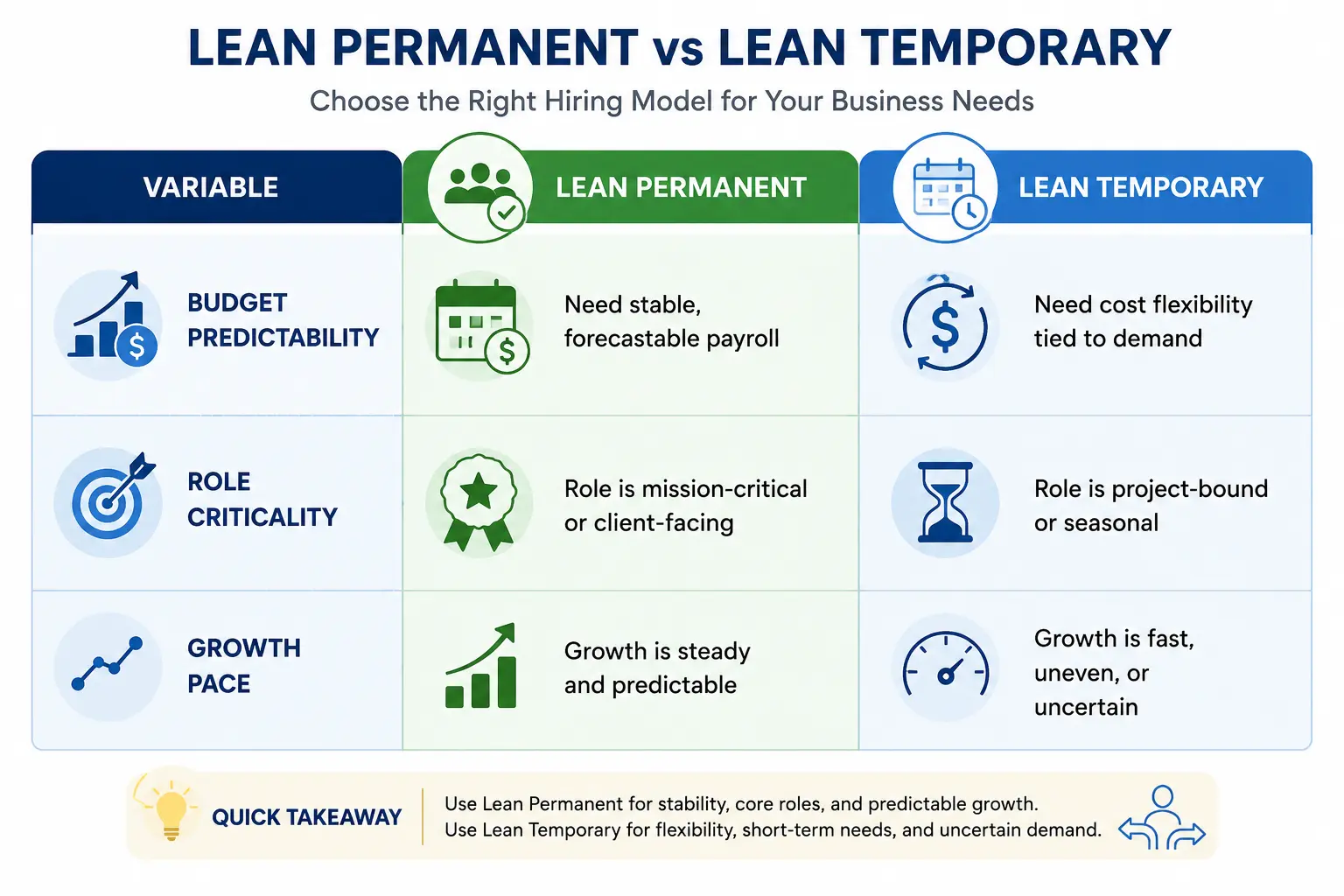
Hybrid models are gaining serious traction, and for good reason. Keeping permanent employees in core positions while leveraging temporary staff for surge roles delivers stability and adaptability at the same time. AI-enabled recruitment platforms are accelerating this trend by helping businesses match candidates to output potential rather than credentials alone.
How to Build a Staffing Strategy That Actually Holds Up
A durable staffing strategy starts with an honest audit, not a template, and it should already reflect where your business landed on contract staffing vs permanent hiring in the framework above. Follow this sequence:
– Map role criticality. Identify which roles create genuine disruption when vacant and which can flex without damaging operations.
– Match model to role. Use the decision framework above to assign each role to permanent, temporary, or hybrid coverage.
– Build dual onboarding paths. Create onboarding processes that work for both permanent and temporary hires from day one.
– Partner deliberately. Work with staffing partners who understand your industry deeply, not just your job description, and who design around your timeline, budget, and team dynamics.
– Review quarterly. Revisit the audit as growth pace and budget predictability shift; the right mix changes as the business does.
Final Thoughts: Stop Treating This as Either/Or
There is no single formula that fits every business, but there are smarter decisions available. Permanent hires protect culture and institutional knowledge. Temporary hiring delivers speed and flexibility exactly when it’s needed.
The organizations that win consistently are the ones that stop treating permanent staffing solutions and temporary hiring as opposites and start deploying both strategically, auditing their workforce honestly, identifying real gaps, and building a hiring strategy that grows with the business instead of against it.
Frequently Asked Questions
Is it better to get a job through a temp agency?
It depends on the goal. Temp agencies are effective for breaking into new industries, building experience quickly, or testing a role before committing. Nearly 46% of temporary workers view assignments as a pathway to permanent positions, making agencies a genuinely smart entry point for many professionals.
What is the 3-month rule for jobs?
The 3-month rule refers to evaluating a new hire’s performance and cultural fit within the first 90 days. Many organizations use this window deliberately, converting high-performing temporary staff to permanent roles only after confirming genuine alignment, a practical bridge between temporary Vs permanent employee decisions.
How do you maintain culture with a mixed permanent and temporary workforce?
Include temporary workers in team meetings and culture-building activities wherever practical. Clear communication of values from day one, paired with structured onboarding, helps contract staff align with company standards quickly and authentically.

Rameet Singh, Founder & CEO of RPO.AI