
 Log-In
Hiring talented people becomes harder when candidates cannot clearly see why they should choose one employer over another. Salary matters, but candidates also compare career growth, flexibility, leadership, benefits, workplace culture, and the overall employee experience.
An employee value proposition (EVP) brings those factors together into a clear answer to one important question: What will employees receive in return for bringing their skills, time, and effort to this organization?
A strong EVP helps employers communicate that answer consistently throughout recruiting. More importantly, it sets expectations that the organization must continue to deliver after someone accepts the offer.
Turn Your EVP Into Better HiringBuild a hiring experience that reflects your EVP and attracts the right talent. |
Key Takeaways
– An employee value proposition explains the complete value people receive from working for an organization.
– Strong EVPs combine compensation, benefits, growth, flexibility, culture, purpose, and employee recognition.
– Effective EVP development starts with employee research instead of assumptions made by leadership.
– A compelling EVP must be relevant to target talent, different from competitors, and supported by real evidence.
– Employers should measure EVP effectiveness across recruiting, employee experience, engagement, and retention.
Quick Answer:
An employee value proposition is the complete value an employer gives employees in return for their skills and contributions. It includes compensation, employee benefits, career growth, flexibility, workplace culture, purpose, and employee recognition. A strong EVP helps candidates understand why they should join and gives employees reasons to stay. Effective EVPs are specific, supported by real workplace experiences, and consistently reflected throughout recruitment and employment.
What Is an Employee Value Proposition?
An employee value proposition is the combination of financial, professional, social, and personal value employees receive from their employer.
The employee value proposition definition goes beyond salary. Compensation may get a candidate’s attention, but the complete employment decision often includes benefits, career opportunities, work flexibility, management quality, recognition, job stability, meaningful work, and workplace relationships.
SHRM describes an EVP as everything of value an employer provides employees, including pay, benefits, training, and career development. It also emphasizes that successful EVPs should reflect what matters to a specific company’s employees rather than relying on a generic formula.
An EVP is also different from employer branding.
“The EVP is the employment promise. Employer branding is how that promise is communicated and perceived.”
A company can promote an excellent employer brand, but the message becomes difficult to sustain if the actual employee experience does not match it.
Why Is an Employee Value Proposition Important?
A clear EVP helps candidates understand what makes an organization worth joining before they accept an offer.
Without that clarity, recruiters often depend on broad statements such as “great culture,” “competitive compensation,” or “exciting growth opportunities.” Those claims are easy for competitors to repeat and difficult for candidates to evaluate.
According to the U.S. Bureau of Labor Statistics, private-industry employers spent an average of $46.89 per employee hour on total compensation in June 2026, including $32.82 for wages and $14.07 for benefits. Benefits, therefore, accounted for 30% of total employer compensation costs.
A well-defined EVP gives recruiters more specific reasons to communicate.
It can explain what career development actually looks like, how employees receive recognition, how flexibility works, or what employees gain from working with a particular team.
The broader lesson is simple: employers should communicate the whole employment package instead of reducing their value proposition to salary.
EVP planning also becomes stronger when it connects with workforce planning. Understanding which roles, skills, and talent groups the organization will need helps HR teams build employment messages around the people they actually need to attract.
What Are the Main Employee Value Proposition Components?
Most effective employee value proposition components can be grouped into five connected areas.
| EVP Component | What Employees Want to Know |
| Compensation | Am I being rewarded fairly for my contribution? |
| Employee benefits and flexibility | How does this employer support my health, finances, time, and personal needs? |
| Career growth | Can I learn, progress, and build valuable skills here? |
| Culture and purpose | What will working here actually feel like, and does the work matter? |
| Recognition and employee experience | Will my contribution be noticed, respected, and supported? |
Compensation
Compensation gives employees financial value in exchange for their work.
Salary, bonuses, commissions, incentives, equity, and pay transparency can all form part of this component. The goal is not necessarily to pay more than every competitor. The goal is to offer compensation that is fair, understandable, and appropriate for the market and responsibilities.
Employee Benefits and Flexibility
Employee benefits explain how the organization supports employees beyond base pay.
Health coverage, retirement contributions, paid time off, parental leave, wellness benefits, flexible schedules, and remote or hybrid work can contribute to this part of the EVP.
Specificity makes these benefits more believable.
“Flexible workplace” is vague. “Employees can work remotely three days per week and choose their start time within defined collaboration hours” tells candidates what they can actually expect.
Career Growth and Development
Career growth tells candidates whether joining the company can help them move forward professionally.
Employees may value mentorship, training budgets, leadership programs, internal mobility, certifications, stretch assignments, or clear promotion criteria.
Companies should also show how development works in practice. A promise of “unlimited learning opportunities” means little if employees rarely receive the time or support needed to use them.
Culture and Purpose
Culture describes the everyday behaviors that shape an employee’s experience.
It includes leadership style, trust, communication, collaboration, autonomy, inclusion, decision-making, and how managers respond when problems occur.
Purpose connects individual responsibilities with a larger outcome. Employees should be able to understand why their work matters and how their role contributes to customers, teams, or company objectives.
Employee Recognition
Employee recognition helps employees understand whether their hard work will be noticed and appreciated.
Recognition can include manager feedback, peer recognition, awards, expanded responsibility, promotions, public acknowledgment, or personalized appreciation.
Recognition should be timely and connected to genuine contribution. An annual awards program cannot replace managers consistently noticing and acknowledging good work.
How Do You Build an Effective Employee Value Proposition?
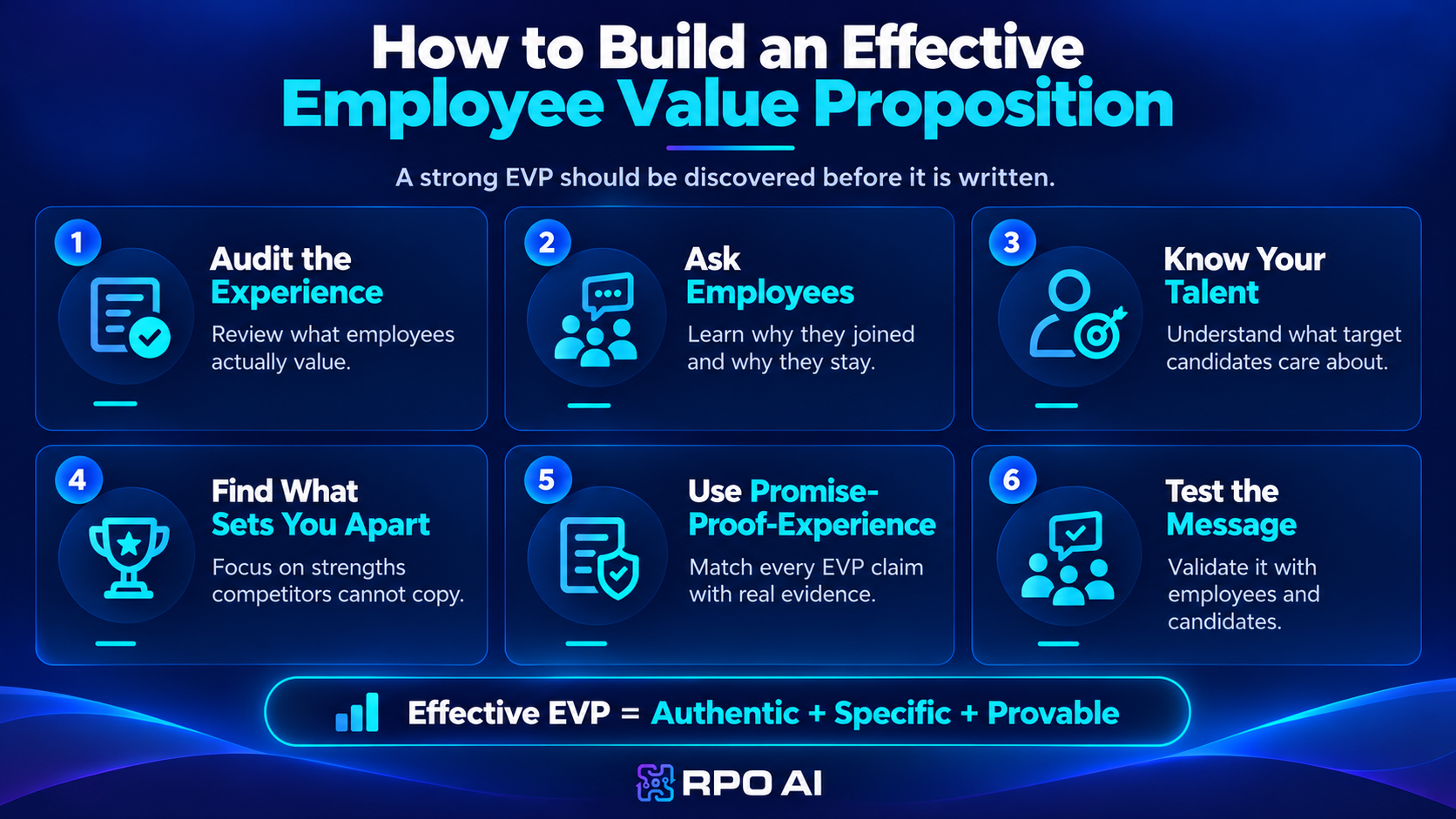
A strong EVP should be discovered before it is written.
Companies often start by asking leadership what the organization wants to be known for. A better starting point is asking employees what already makes the organization valuable and where the employee experience falls short.
1. Audit Your Current Employee Experience
Start by listing what employees currently receive across compensation, benefits, career development, culture, flexibility, leadership, purpose, and recognition.
Look beyond formal policies.
Employees may value access to senior leaders, meaningful ownership, faster career progression, interesting client exposure, or greater independence even when those advantages are not formally documented.
2. Ask Employees Why They Joined and Why They Stay
Employees provide the strongest evidence for building an authentic EVP.
Use employee surveys, interviews, focus groups, new-hire feedback, stay interviews, and exit interviews.
Ask questions such as:
– Why did you originally accept our offer?
– What makes working here different from previous employers?
– What would you miss if you left?
– Which company benefit or experience matters most to you?
– What did recruitment promise that turned out to be accurate?
– What part of the employee experience needs improvement?
The answers often reveal EVP strengths that leadership overlooks.
3. Understand What Your Target Talent Values
Different employee groups may prioritize different parts of an EVP.
Early-career professionals may value training and mentorship. Experienced specialists may prioritize autonomy and meaningful projects. Parents may place greater value on flexibility, while senior executives may focus on influence, leadership scope, and organizational impact.
Talent teams can use candidate conversations and talent sourcing strategies to identify which employment factors repeatedly influence engagement among priority talent pools.
4. Find the Factors That Truly Differentiate You
A useful EVP explains something competitors cannot easily copy.
Statements such as “we value our people” or “we provide career growth” offer little differentiation because almost any company could use them.
Look for specific experiences instead.
For example:
Generic: We give employees opportunities to grow.
Specific: Every employee has quarterly development conversations and access to cross-functional assignments before external hiring begins for eligible roles.
Specific details turn abstract promises into something candidates can evaluate.
5. Use the Promise-Proof-Experience Framework
A useful way to test each EVP component is through three questions:
Promise: What are we telling employees they will receive?
Proof: What policy, program, behavior, or evidence supports that promise?
Experience: What will employees actually see or feel during everyday work?
For example:
Promise: We invest in employee development.
Proof: Every employee receives an annual learning budget.
Experience: Employees can use dedicated work hours for approved courses, certifications, or training.
This Promise-Proof-Experience framework helps HR teams identify EVP statements that sound attractive but lack evidence.
6. Test the EVP With Employees and Candidates
An EVP should be tested before becoming part of recruitment campaigns.
Share the draft with employees, recent hires, recruiters, hiring managers, and leaders.
Ask them:
– Does this sound accurate?
– Is anything exaggerated?
– Which point feels most meaningful?
– Which point sounds generic?
– Can we prove every promise?
– Would our target candidates care about these points?
Rewrite anything employees do not recognize as part of their actual experience.
What Makes an Employee Value Proposition Stand Out?
A strong EVP is not the one with the longest list of benefits. It is the one that candidates can understand, remember, and believe.
Use this EVP Reality Check before finalizing your proposition:
Specific
Can candidates clearly understand what you are offering?
Relevant
Does the proposition address factors your priority talent actually values?
Differentiated
Could five competing employers copy the statement without changing anything?
Provable
Can current employees provide evidence that the promise is real?
Sustainable
Can the organization continue delivering the promise as hiring and headcount increase?
This last point is often overlooked.
A benefit may be attractive today but should not become a central EVP promise if the business cannot consistently provide it as the organization grows.
Employee Value Proposition Examples
Useful employee value proposition examples describe real employment experiences rather than relying on inspirational language.
For a Growing Technology Company
“Build products with visible impact while growing alongside the business. Employees receive meaningful ownership, direct access to decision-makers, and clear opportunities to expand their responsibilities as the company scales.
This proposition communicates ownership, access, impact, and career opportunity.
For a Flexible Employer
“Do your best work without designing your entire life around an office. Teams collaborate during shared working hours while employees retain flexibility over where they complete focused work.“
This proposition explains what flexibility means instead of using the word alone.
For a Career-Focused Employer
“Know what your next career step requires. Employees receive documented development expectations, regular career conversations, mentorship, and consideration for appropriate internal opportunities.”
This proposition gives employees evidence behind the promise of career progression.
For a Purpose-Led Organization
“See how your work creates an impact. Teams receive clear customer feedback, visibility into business outcomes, and opportunities to contribute ideas that influence how products and services improve.
This example connects purpose with observable experiences rather than a broad mission statement.
How Do You Measure EVP Effectiveness?
EVP measurement should cover both recruitment and employment.
Hiring teams can track:
– Offer acceptance rate
– Candidate withdrawal reasons
– Application quality
– Employee referral volume
– Recruitment conversion rates
– Candidate feedback
HR teams can track:
– Voluntary turnover
– New-hire retention
– Employee engagement
– Internal mobility
– Employee recognition participation
– Stay interview feedback
– Employee advocacy
Qualitative feedback is equally important.
Ask new hires why they accepted the offer and then ask six or twelve months later whether those reasons remain true.
The difference between what candidates expect and what employees experience is the EVP promise gap.
A growing promise gap can signal that employer branding has moved ahead of the actual employee experience.
Common Employee Value Proposition Mistakes to Avoid
The most common EVP mistake is treating it as a marketing exercise.
Good writing can communicate an attractive workplace, but it cannot create one.
Other common mistakes include:
– Copying EVP language from well-known employers
– Building the proposition entirely around employee benefits
– Trying to appeal equally to every type of candidate
– Using vague terms such as “great culture” without proof
– Ignoring employee feedback
– Promising flexibility that individual managers do not support
– Keeping the same EVP after major organizational changes
Another mistake is treating EVP development as a one-time project.
Workforce expectations, leadership, benefits, working models, skills requirements, and hiring priorities change. Organizations should review the EVP periodically and after major changes to make sure the proposition still represents reality.
Conclusion
A strong employee value proposition gives talented people a clear reason to choose an organization and gives existing employees reasons to continue building their careers there.
The strongest EVPs combine competitive compensation with employee benefits, growth opportunities, flexibility, culture, purpose, and employee recognition. But those components only become meaningful when employees can see evidence behind them.
Start with employee research. Identify what people genuinely value, understand what priority candidates expect, find the experiences that differentiate your organization, and test every claim using the Promise-Proof-Experience framework.
Your EVP should ultimately describe the employment experience you can confidently deliver, not simply the one you would like to advertise.
Turn Your EVP Into a Stronger Hiring ExperienceA clear EVP gives candidates a reason to pay attention. A structured recruiting process helps make sure that the promise remains consistent through sourcing, screening, interviews, offers, and hiring. |
FAQ About Employee Value Proposition
What is an employee value proposition in simple terms?
An employee value proposition is everything employees receive from working for a company, including pay, benefits, growth, flexibility, culture, purpose, and recognition. It explains why someone should join the organization and why existing employees may choose to stay.
What are the main components of an employee value proposition?
Common EVP components include compensation, employee benefits, flexibility, career growth, workplace culture, purpose, and employee recognition. Effective organizations combine these elements into a clear proposition based on what their employees and target candidates genuinely value.
What is the difference between EVP and employer branding?
An EVP defines what employees receive from an organization, while employer branding communicates that experience to candidates and the wider market. The EVP provides the substance behind employer branding and should reflect what employees actually experience after joining.

Rameet Singh, Founder & CEO of RPO.AI