
 Log-In
When staffing agencies handle every recurring contingent role, each requisition can restart the search, supplier coordination, and fee cycle. That works for urgent or specialized hiring, but it can become expensive when the same skills are needed again and again.
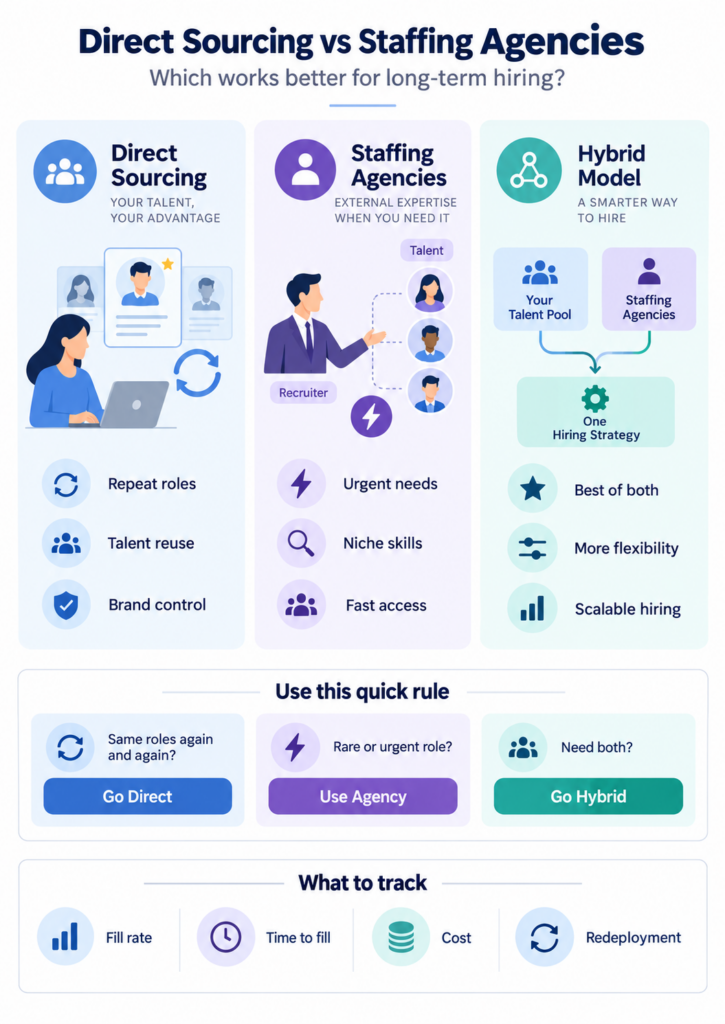
For organizations with predictable demand, a direct sourcing strategy often works better for long-term hiring because it creates a reusable pool of contingent talent under the company’s employer brand. Staffing agencies remain valuable for niche, urgent, low-volume, or hard-to-reach hiring.
Need a smarter way to scale your hiring? Build a flexible recruiting strategy with expert sourcing support, talent pipelines, and scalable hiring solutions designed around your business needs. |
Key Takeaways
– Direct sourcing is strongest for repeatable, high-volume contingent roles.
– Staffing agencies are strongest for urgent, niche, or one-time hiring needs.
– Direct sourcing creates a reusable talent pool instead of restarting every search.
– A vendor management system can govern direct and agency channels in one workflow.
– Most mature programs benefit from a hybrid model rather than replacing agencies completely.
What Is a Direct Sourcing Model?
Companies can build and engage their own talent pool instead of relying heavily on third-party recruiters. This pool may include former contractors, referrals, alumni, silver-medalist candidates, and new prospects. A direct sourcing model keeps the company’s employer brand central while internal teams or sourcing partners identify, screen, and engage candidates.
For teams that want more control over candidate relationships, the company’s brand becomes the main attraction point while recruiters or a sourcing partner curate, screen, and re-engage talent. This makes employer brand recruitment important because contractors need a reason to join the community and stay interested between assignments.
When workforce leaders need context on flexible work, the U.S. Bureau of Labor Statistics reported that 6.9 million people held contingent jobs as their main job in July 2023, while 11.9 million were independent contractors and 945,000 were temporary help agency workers.
Direct Sourcing vs. Staffing Agencies: Which Works Better?
When buyers compare only placement fees, they miss the bigger issue: which model performs better over repeated hiring cycles?
| Decision Factor | Direct Sourcing | Staffing Agencies |
| Best fit | Repeat, predictable demand | Urgent, niche, one-time demand |
| Talent relationship | Employer-led | Agency-led |
| Upfront effort | Higher | Lower |
| Long-term value | Improves as talent is reused | Cost repeats with each fill |
| Speed | Strong with a mature pool | Strong when niche talent already exists |
| Brand control | High | Moderate |
Best role | Core recurring channel | Specialist or overflow channel |
For companies hiring the same profiles month after month, direct sourcing can create compounding value because every successful engagement strengthens the next search. For organizations hiring a rare skill once or twice a year, an agency may be more efficient because there is little reason to maintain a dedicated pool.
When Does a Direct Sourcing Strategy Work Best?
When recruiters repeatedly rebuild the same shortlist, direct sourcing can turn recurring demand into a managed talent asset. The best starting categories usually have steady volume, similar skill requirements, repeat locations, and a realistic chance of contractor redeployment.
For teams evaluating fit, direct sourcing is attractive when the same job families reopen, previous contractors can return, screening criteria are consistent, and hiring managers want more visibility into source performance. It also works better when sourcing can connect to existing contingent workforce management processes rather than becoming a separate hiring lane.
When the employer brand is not yet strong with contractors, the talent community needs a clear value proposition. IBM’s talent acquisition strategy guidance recommends defining a strong employer value proposition and using the employer brand to stand out to skilled candidates.
When Are Staffing Agencies Still the Better Choice?
When a hiring manager needs a rare skill immediately, building a new talent pool first can slow the process. Specialist staffing agencies can bring existing networks, recruiter expertise, local market knowledge, and access to talent the employer does not already know.
When the role is urgent, niche, geographically difficult, or outside normal hiring patterns, agencies can remain the strongest channel. A sound contingent workforce strategy uses agencies where their access is hard to reproduce rather than sending every requisition to them automatically.
How Does a Vendor Management System Fit Into Direct Sourcing?
When direct sourcing is added without governance, hiring can scatter across talent pools, email, spreadsheets, agencies, and procurement systems. A vendor management system can centralize requisitions, suppliers, candidates, assignments, approvals, time, invoices, and reporting.
For mature programs, direct sourcing should sit inside the same governance structure as agency hiring. Teams need rules for candidate ownership, requisition priority, supplier release timing, onboarding, and performance reporting.
When MSPs or staffing partners need more sourcing capacity inside an existing workflow, staffing agency and MSP support can add sourcing, candidate engagement, coordination, and pipeline support without replacing the current VMS process.
Should You Replace Agencies or Build a Hybrid Model?
When leaders treat direct sourcing as a full agency replacement, they add unnecessary risk. A hybrid model is usually more practical: direct sourcing handles recurring demand, while agencies support specialist skills, sudden volume, new locations, and hard-to-fill roles.
For procurement and talent teams, a simple order is to re-engage proven workers, search the branded pool, run direct outreach, and then release unresolved roles to selected agencies.
This approach changes the role of an agency rather than removing it. Agencies become specialist channels for demand that the organization cannot efficiently satisfy through its own contingent talent network.
The Repeat-Demand Test: What Should Move Direct First?
When teams try to direct-source every role at once, implementation becomes harder. A simpler approach is to score each job family using five questions:
– Repeat: Does the role open several times per year?
– Volume: Is demand high enough to support a talent pool?
– Reuse: Can successful contractors return?
– Brand pull: Will candidates respond to your employer brand?
– Consistency: Can screening, rates, and onboarding be standardized?
For roles scoring four or five “yes” answers, direct sourcing is a strong candidate. For zero to two, agencies may remain more efficient. For a score of three, run a pilot and compare results before expanding.
When teams need proactive research and outreach around priority roles, talent sourcing services can support pipeline development without requiring every search to begin with an agency.
What Metrics Should You Track?
When direct sourcing is measured only by agency spend, leaders can miss weak adoption or poor talent reuse. Track direct fill rate, time to first qualified candidate, time to fill, cost per fill, redeployment rate, talent-pool response rate, interview conversion, acceptance rate, and agency usage by role category.
For talent teams, direct fill rate shows whether the owned talent channel is actually carrying more demand over time. Redeployment rate shows whether the organization is keeping proven contingent talent instead of paying to rediscover similar workers later.
For procurement teams, agency usage by job category can reveal where suppliers continue to create measurable value. Rising agency use in a category that already has a mature direct pool can signal poor adoption, slow internal response, or poor talent-pool quality.
What Can AI’s Experience Add to the Decision?
When sourcing bandwidth becomes the bottleneck, changing the sourcing channel alone does not fix execution. In one staffing agency case study, a leading staffing agency with limited peak-season capacity used dedicated sourcing and job-ad-response support to take on 30% more requisitions without adding fixed recruiting costs.
For direct sourcing buyers, that case is not proof of direct sourcing ROI because it involved a staffing agency. The relevant lesson is that any sourcing model needs enough execution capacity when demand rises.
That distinction matters. A company can build the right direct sourcing architecture and still fail if nobody consistently researches talent, responds to candidates, refreshes pipelines, coordinates hiring managers, and re-engages proven contractors.
How Do You Start Without Disrupting Hiring?
When leaders want better long-term economics without slowing current hiring, a controlled pilot is safer than a company-wide rollout. Start with one or two high-repeat job families and keep agencies available while the direct pool develops.
For a practical launch, follow six steps:
– Audit the last 12 months of contingent requisitions. Identify repeated roles, agency usage, locations, fill times, and demand patterns.
– Select high-repeat roles for the pilot. Avoid starting with the hardest role in the organization.
– Build the initial talent pool. Include past contractors, referrals, alumni, prior finalists, and qualified prospects.
– Define employer-brand messaging and ownership. Decide who attracts, communicates with, screens, and re-engages talent.
– Connect the process to the VMS or approved workflow. Keep governance and reporting consistent.
– Compare performance for 60 to 90 days. Measure direct fill, speed, cost, quality, and redeployment before expanding.
When internal recruiters already lack bandwidth, on-demand recruiting can add flexible sourcing and recruiting support without requiring permanent headcount.
Why Staffing Agencies Remain the Better Choice for Modern Hiring
Direct sourcing works for predictable hiring needs, but when companies need speed, specialized talent, and workforce flexibility, staffing agencies provide the stronger advantage.
With established talent networks and recruiting expertise, staffing agencies help businesses quickly access qualified candidates without the time and effort required to build talent pools internally. For urgent roles, niche skills, and changing workforce demands, they offer the scalability needed to keep hiring moving.
Need Help Finding the Right Talent Faster?Whether you need support for urgent hiring, specialized roles, or ongoing workforce demands, RPO.ai provides scalable recruiting solutions to help you access qualified talent without slowing down your hiring process. |
Frequently Asked Questions
What Is Direct Sourcing in Recruitment?
When a company wants less dependence on third-party suppliers, direct sourcing means building and engaging its own talent pool under its employer brand. The pool can include former contractors, referrals, alumni, prior applicants, and newly sourced candidates who can be re-engaged for future contingent roles.
Is Direct Sourcing Cheaper Than Staffing Agencies?
When demand is repeatable, direct sourcing can become more cost-efficient because the organization can reuse its talent community instead of paying for external discovery on every requisition. Agencies may still be more economical for low-volume, highly specialized, or unpredictable hiring.
Does Direct Sourcing Replace Staffing Agencies?
When organizations need both efficiency and flexibility, direct sourcing usually complements rather than eliminates agencies. Direct sourcing can become the first channel for recurring roles, while agencies handle urgent, specialized, new-market, or overflow demand.
What Roles Are Best for Direct Sourcing?
When the same skills are hired repeatedly, those roles are the strongest candidates. High-volume operations, recurring project roles, seasonal positions, common technical skills, and jobs with strong contractor-redeployment potential are usually better starting points than rare or one-time assignments.
Do You Need a VMS for Direct Sourcing?
When a contingent program is large or supplier-heavy, a VMS can make direct sourcing easier to govern. Smaller programs can operate without one, but they still need clear systems for candidate ownership, compliance, onboarding, measurement, and agency release rules.

Rameet Singh, Founder & CEO of RPO.AI